Our Top Picks


The role of AI in sales development is not to hand a headset to a robot and send your reps home.
It is to strip the manual drudgery out of the SDR job so that human reps spend their hours on the one thing machines still cannot do well: build trust in a live conversation.
Done right, AI in sales development turns a rep who used to research 15 accounts a day into one who has smart, personalized context on 150 and still owns every relationship. That is the framing that matters as you evaluate tooling in 2026: AI as a force multiplier for people, not a substitute for them.
Sales development has always been a numbers game constrained by human time. An SDR only has so many hours to research prospects, write emails, dial numbers, and update the CRM.
AI collapses the cost of the repetitive 80% so reps can pour their judgment, empathy, and persuasion into the high value 20%.
Below, we break down exactly where AI in sales development creates leverage intelligent lead scoring, automated prospect research, personalized outreach, predictive analytics, and AI sales agent automation, and how to adopt it without hollowing out the human craft that closes deals.
What "AI in Sales Development" Means
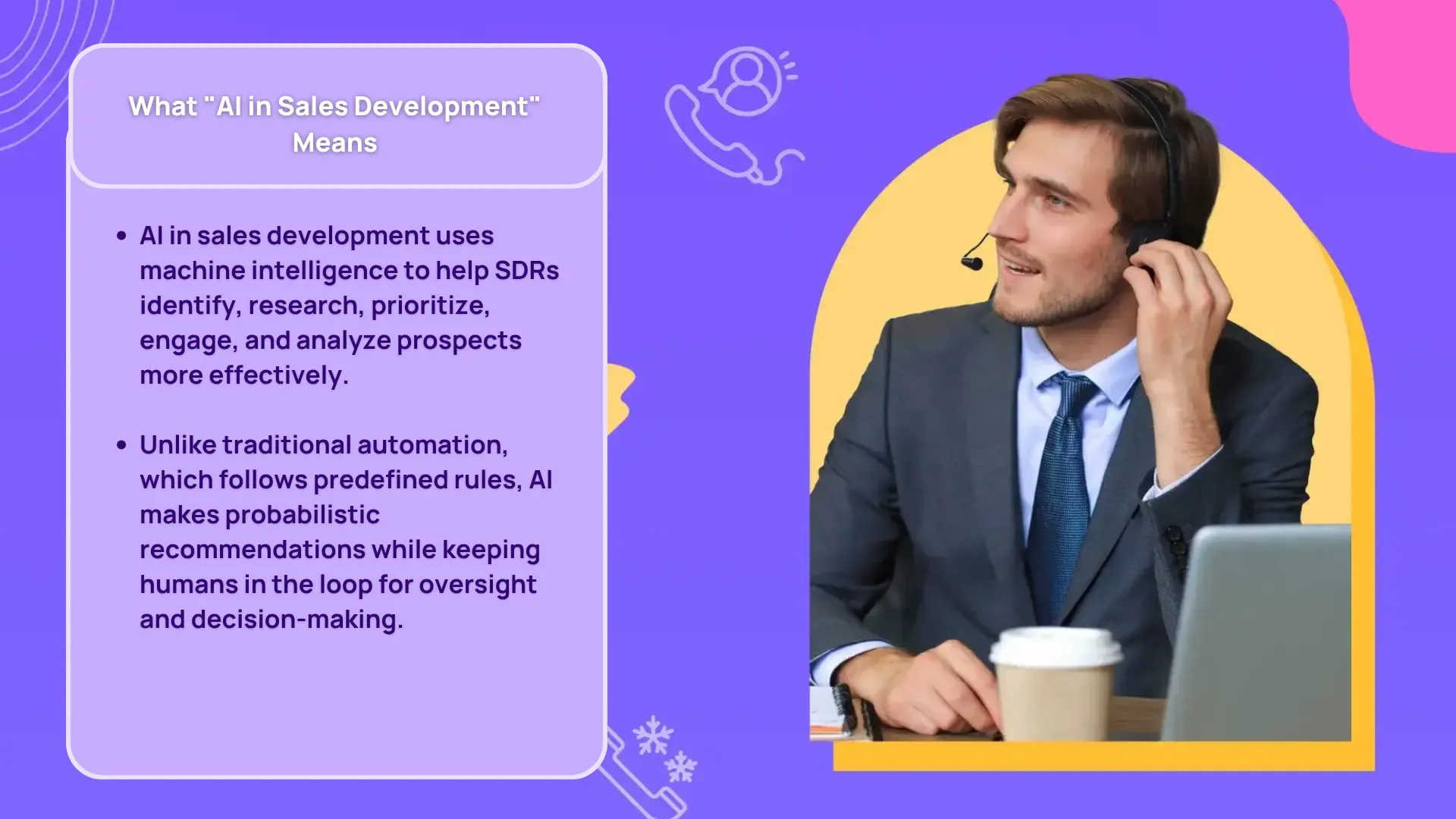
Sales development is the top of funnel discipline: identifying prospects, qualifying interest, and booking meetings for account executives. The role of AI in sales development is to embed machine intelligence into each of those steps scoring, researching, writing, dialing, and analyzing so the SDR operates at a higher altitude.
It helps to separate two things people often blur together. General sales automation handles rules based, repetitive work: logging activities, triggering follow ups, syncing data.
AI adds a layer of judgment on top, predicting which lead is worth calling first, drafting a message tuned to a specific buyer, or surfacing the objection a rep is about to hear. Both matter, and modern platforms blend them. The distinction to keep in mind is that automation follows instructions, while AI makes probabilistic recommendations a human still approves.
That human in the loop pattern is the safest and most productive way to deploy AI in sales development today.
According to Gartner's future of sales research, a growing share of the B2B seller's day is shifting toward AI augmented workflows, with routine prospecting and data tasks increasingly automated so reps can concentrate on complex, high judgment buyer interactions. The direction of travel is clear: the SDRs who thrive are the ones who let AI carry the load they never enjoyed anyway.
Intelligent Lead Scoring and Prospect Prioritization
The first and highest ROI application is deciding who to work and in what order. Traditional lead scoring relied on static point systems plus 10 for a demo request, plus 5 for a job title. It was better than nothing, but blunt.
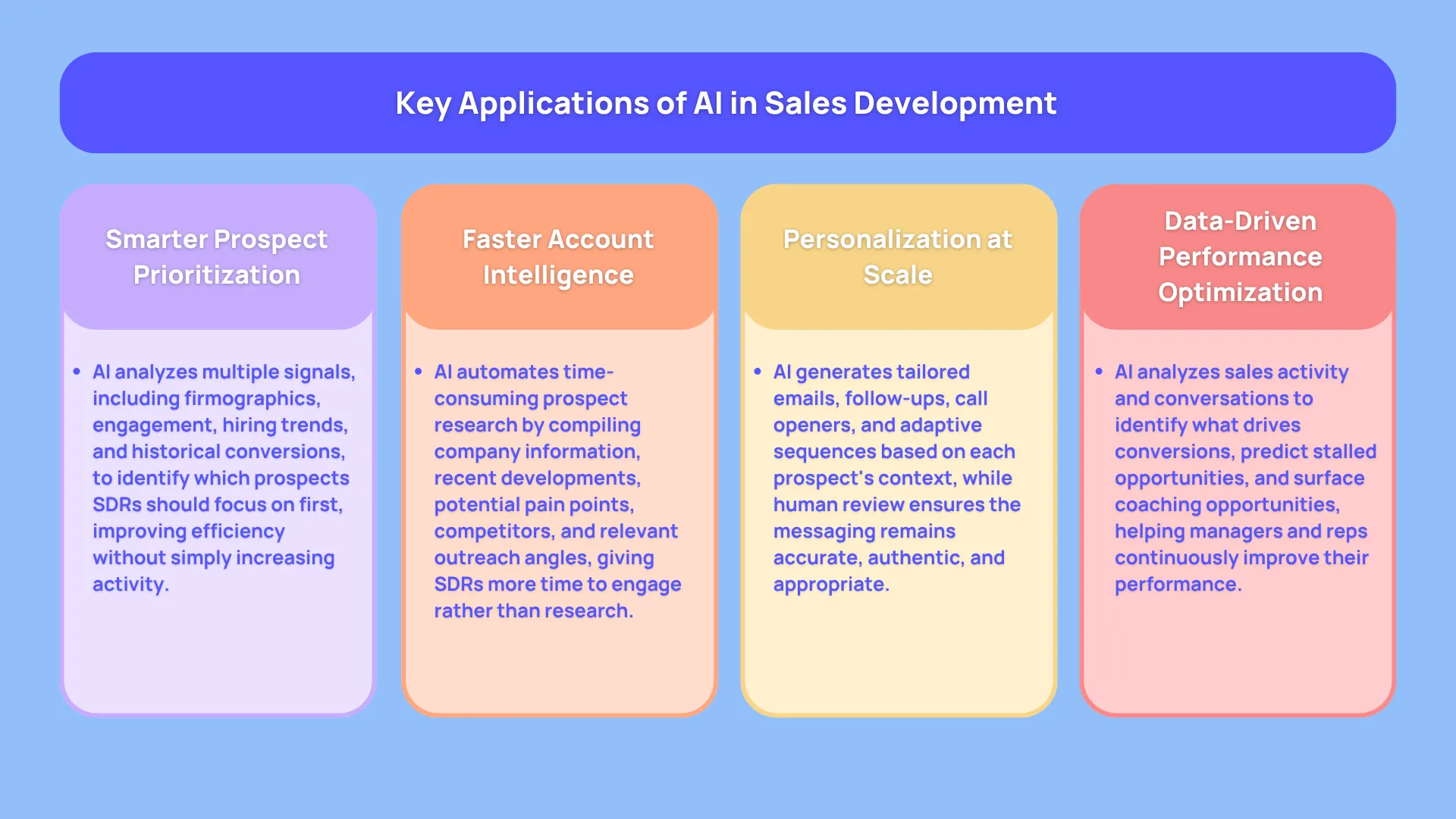
AI driven intelligent lead scoring and prospect prioritization looks at hundreds of signals at once: firmographic fit, website behavior, email engagement, technographic data, hiring trends, and how similar accounts converted historically. It then ranks the list so a rep starts the day on the accounts most likely to turn into pipeline. That single change can meaningfully raise an SDR's meeting rate without adding a single dial, because time is being spent where it pays off.
The empowerment angle matters here. Scoring does not remove the rep's discretion; it hands them a smarter starting order.
A good SDR still overrides the model when they know something it doesn't: a warm referral, a trigger event, a champion who just changed companies. The best AI sales prospecting tools make that override easy, treating the model as a co pilot rather than an autopilot. Better prioritization is also one of the cleanest levers for SDR efficiency, because it improves output quality without demanding more raw activity.
Automated Prospect Research and Account Intelligence
Ask any SDR where their day disappears, and you'll hear the same answer: research.
Pulling up LinkedIn, skimming the 10 K, checking recent funding, reading press releases, figuring out the org chart. It is essential work, and it is brutally slow when done by hand.
Automated prospect research and account intelligence are where AI in sales development gives back the most hours. Instead of 20 minutes per account, an AI research agent assembles a briefing in seconds: what the company does, recent news, likely pain points, relevant competitors they may already use, and a suggested angle for outreach.
The rep reads the summary, adds their own read of the situation, and moves straight to writing or dialing.
This is a genuine empowerment story rather than a replacement one, because the output is a draft of understanding, not a decision. The rep still decides whether the angle is right, whether the timing makes sense, and how to frame the value. For sellers in complex technical categories, purpose built tech sales AI tools can go further, mapping the specific stack and use cases a prospect cares about so the conversation lands as informed rather than generic. Research that used to gate how many accounts a rep could touch stops being the bottleneck.
Personalized Outreach Message Generation
Personalization at scale has always been the great contradiction of outbound. Reps know that tailored messages get replies, but truly tailoring every email and call opener to hundreds of prospects is impossible by hand. So most teams fell back on templates that prospects learned to ignore.
AI resolves the contradiction. Personalized outreach message generation uses the research and account intelligence above to draft a first touch email, a follow up, or a call opener that references the specific prospect's context their role, their company's initiatives, a recent trigger in the rep's own voice and tone.
The SDR edits, approves, and sends. The result is template level speed with hand written level relevance.
The same principle powers AI sequencing, where the system adapts the cadence and content across email, phone, and social based on how each prospect responds, pausing a channel that isn't landing, escalating one that is. Crucially, the rep still owns the message.
AI writes the draft; the human supplies the judgment about whether it's honest, on brand, and appropriate for that buyer. Teams that skip the human edit step
are the ones who end up spamming; teams that keep it get scale and quality. That is the line between using AI well and abusing it.
Predictive Analytics and Conversion Rate Optimization
Sales development generates an enormous amount of data: dials, connects, replies, meetings booked, meetings held, opportunities created. Historically, most of it went unexamined because no one had time to analyze it. AI closes that loop.
Predictive analytics and conversion rate optimization turn that exhaust into direction. AI models spot which subject lines, call times, talk tracks, and sequences convert, then recommend changes.
They forecast which in flight opportunities are likely to progress and which are stalling, so managers coach where it counts. They can even flag, mid conversation, that a rep is drifting into a losing pattern.
That real time layer is where conversation intelligence tools shine.
Through proactive transcription and call scoring, they surface the concrete behaviors that separate top performers from the rest: talk-to-listen ratio, question rate, how the best reps handle a pricing objection, and turn those into coachable, repeatable playbooks.
Again, the human stays central: the analytics tell a manager where to coach, but a person still does the coaching. AI makes the feedback loop fast and evidence based instead of slow and anecdotal.
McKinsey's research on generative AI in sales and marketing points to substantial productivity upside when organizations apply AI across the funnel from lead identification through personalized engagement, provided they redesign workflows around the technology rather than simply bolting it onto old processes. In other words, the tooling is necessary but not sufficient; the operating model has to change with it.
AI Powered Sales Agent Automation
The most advanced application is AI powered sales agent automation software that can execute multi step tasks with limited supervision. This is where fears of replacement run highest, and where clear eyed framing matters most.
In practice, AI sales agents work best on the parts of the job that are structured and repetitive: qualifying inbound leads against set criteria, answering common product questions, booking meetings on a shared calendar, routing calls, and handling first line follow up. Removing that load frees human reps for the nuanced, relationship heavy conversations where a person outperforms any model: reading hesitation, building rapport, negotiating, navigating a complex buying committee.
Voice is a fast moving frontier here. A modern AI dialer can multiply the number of live conversations a rep gets by dialing several lines at once and dropping voicemails automatically, so the rep only ever spends breath on a human who picks up.
The agent handles the mechanical dialing; the human handles
every real conversation. That division of labor is the template for AI in sales development overall: machines take the volume and the busywork, people take the moments that require a human.
How Trellus Puts AI in Sales Development to Work
Plenty of vendors sell the vision above.
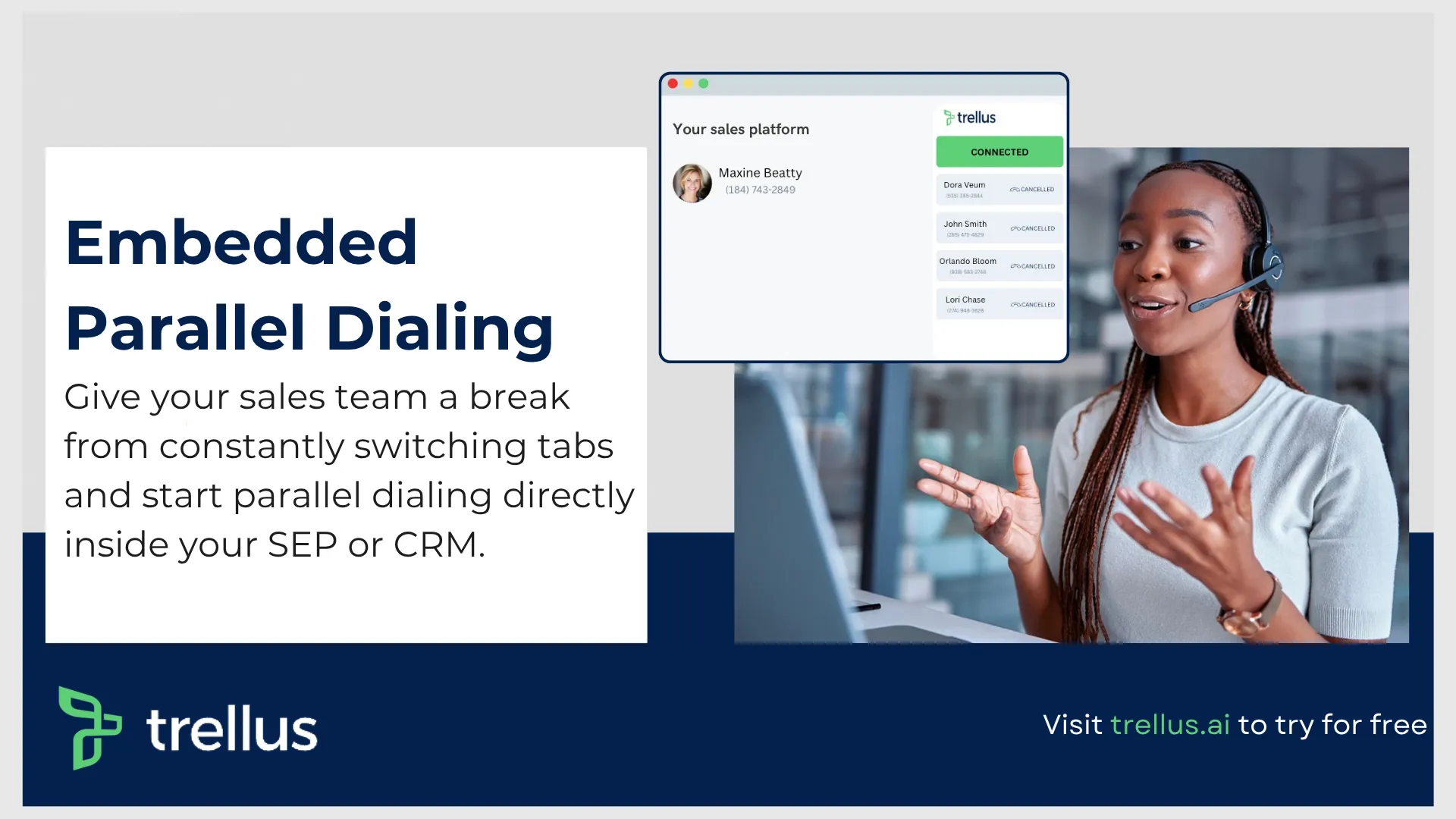
Trellus is worth a shot because it embeds AI in sales development directly inside the tools reps already use, rather than forcing them into yet another standalone app. Its signature product is a parallel dialer that runs inside your existing sales engagement platform: SalesLoft, Outreach, Apollo, HubSpot, or Salesforce via a Chrome extension, so there's no context switching.
What Trellus contributes to each layer we've covered:
• AI voice agents that route and qualify inbound calls, set appointments, answer FAQs, and act as 24/7 practice partners reps can rehearse against.
• Real time AI coaching that appears on screen during live calls with objection handling, competitor battle cards, and customizable talk tracks the empowerment principle made literal.
• Call analytics that score 100% of calls (not a sample), exposing the behavior gaps between top and bottom performers so coaching is grounded in evidence.
• A Virtual Sales Floor where remote teams listen to live calls, run call blitzes, coach in real time, and celebrate wins together.
Pricing. Trellus keeps it simple and self serve, with no forced demo:
• Power $99.99/mo: power dialing, voicemail drop, five phone numbers, and the LinkedIn tool. Best for individuals.
• Parallel $149.99/mo: everything in Power plus multi line parallel dialing, unlimited AI practice calls, and eight phone numbers. Best for individual high volume callers.
• Business custom pricing: everything in Parallel plus customizable AI research, team analytics, custom reporting, and AI modeling. Best for teams.
Best for. SDR/BDR and AE teams running high volume outbound calling who want AI assistance without leaving their current SEP; remote and hybrid teams that need live coaching and visibility; and agencies or appointment setting teams that live on the phone.
Pros and cons. On the plus side: it's embedded (zero context switching), parallel dialing multiplies live connects, real time AI coaching guides reps mid call, every call is scored, integrations are broad (Salesloft, Outreach, HubSpot, Salesforce, Apollo, Zoho, Clay, and more), and the price point is aggressive.

How to Kick Off a Campaign on Trellus
1. Install the Trellus Chrome extension and sign in.
2. Connect your SEP or CRM (Apollo, Salesloft, Outreach, HubSpot, or Salesforce).
3. Load a call list or open an existing cadence/sequence step that has calls due.
4. Choose your dialing mode (power or parallel), set the number of lines, and pick a pre recorded voicemail for automatic drop.
5. Turn on real time AI coaching and select the talk track and battle cards for the campaign.
6. Start the dialing session; Trellus auto logs calls, dispositions, and notes back to your CRM. 7. Review the AI call scores and Sales Floor analytics after the blitz to coach and iterate.
The through line is consistent with everything above: Trellus handles the volume dialing, logging, scoring so the rep spends their energy on the live conversation.
How to Adopt AI in Sales Development Without Losing the Human Edge
Adoption is where teams succeed or stumble. A few practical rules:
• Keep a human in the loop on anything a prospect sees or hears. AI drafts; people approve. This protects your brand and keeps outreach honest.
• Start with the biggest time sinks. Research and dialing usually offer the fastest wins, because they consume the most hours for the least strategic value.
• Redesign the workflow, don't just bolt AI on. As McKinsey notes, the productivity gains come from rethinking how work flows, not from adding a tool to an unchanged process.
• Coach with the data, not around it. Use conversation analytics to make coaching specific and evidence based rather than anecdotal.
• Protect the craft. Reinvest the hours AI gives back into skills machines can't replicate: discovery, negotiation, and relationship building.
Handled this way, AI in sales development raises both output and quality at once, instead of trading one for the other.
Frequently Asked Questions
Will AI replace SDRs?
No, the realistic role of AI in sales development is augmentation, not replacement. AI absorbs research, data entry, scoring, and mechanical dialing, while humans own the live conversations, relationship building, and complex qualification that book and advance deals.
The SDR job shifts toward higher judgment work rather than disappearing.
What sales development tasks should I automate first?
Start with the tasks that eat the most time for the least strategic payoff: prospect research, list prioritization, CRM data entry, and dialing.
These are low risk to automate and free up the largest block of selling time, which makes them the fastest route to measurable SDR efficiency gains.
How is AI different from regular sales automation?
Automation follows fixed rules: if X happens, do Y, and is great for logging activities and triggering follow ups.
AI adds probabilistic judgment: predicting which lead to call first, drafting a tailored message, or flagging a likely objection. Most modern platforms blend both, with AI recommending and a human approving.
Does AI generated outreach get replies?
It can, when a human edits and approves it. AI is excellent at producing a personalized first draft grounded in real account research at a speed no rep could match manually. The reply rates suffer only when teams skip the human review step and blast unedited, generic messages.
Over To You…
The role of AI in sales development comes down to a simple trade: let machines do the volume so people can do the value.
Intelligent lead scoring points reps at the right accounts, automated research hands them context in seconds, AI drafts personalized outreach, predictive analytics sharpen every play, and AI agents absorb the repetitive execution dialing, qualifying, logging. What's left for the human is exactly what humans are best at: earning trust in a real conversation.
The teams that normally end up winning won't be the ones that replace their reps with AI, or the ones that ignore AI and grind on manually.
They'll be the ones that pair strong SDRs with AI that multiplies their reach a rep in control, with a co pilot doing the heavy lifting. If your reps are running high volume outbound, a tool like Trellus that embeds this leverage directly inside your existing stack is a practical place to start.
.jpeg)

Power and parallel dialing in your CRM.