
What Is an AI Dialer? AI Assistance vs. Voice Agents
Understand who speaks, what the AI helps with, and how to evaluate the calling, coaching and CRM workflow.

Trellus adds power and parallel dialing inside the CRM your team already uses. See pricing Book a demo
On this page
Our Top Picks


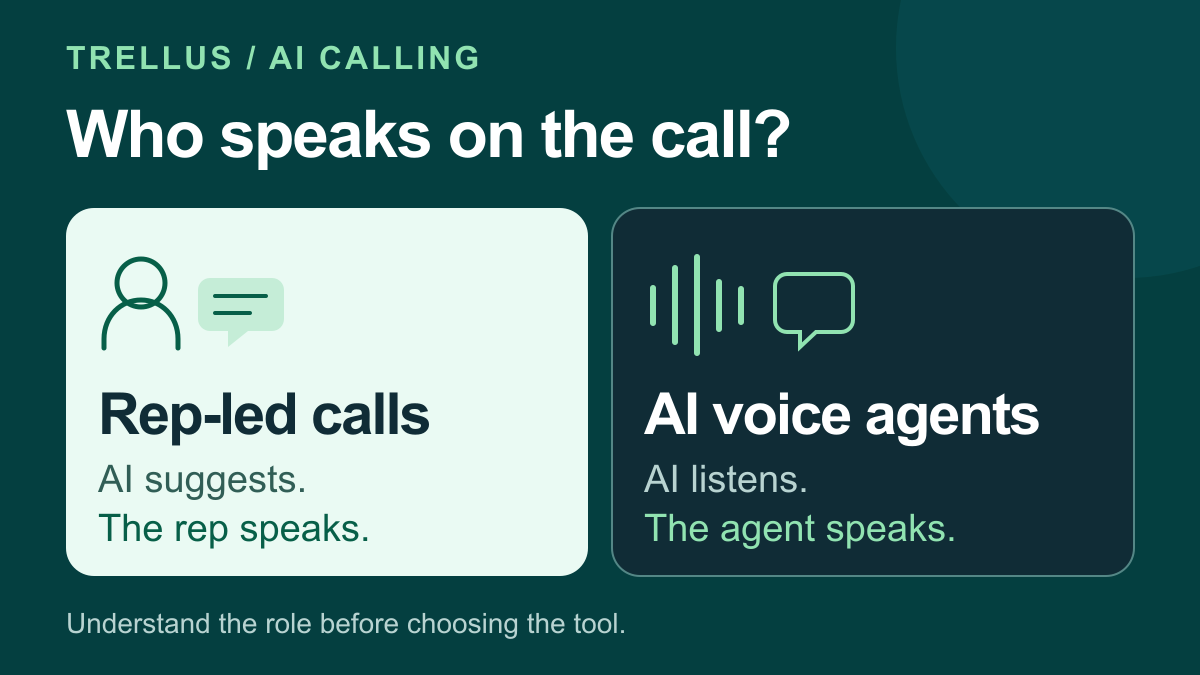
An AI dialer is outbound calling software that adds AI to the calling workflow. AI may help prioritize contacts, transcribe conversations, suggest responses or draft call notes. The label alone does not tell you who speaks: some products assist a human rep; others use an AI voice agent to conduct the conversation. See how Trellus AI voice agents answer inbound calls and place outbound calls.
Start with that distinction. If your team wants reps calling from their CRM with live coaching and less work after each call, evaluate a rep-assisted dialer. If you want software to speak with the recipient, evaluate a voice agent and its handoff behavior.
See the Trellus calling workflow: power or parallel dialing in supported CRMs and sales engagement platforms, with the rep leading the conversation.
What does the AI actually do?
Break the feature into an input, an action and a result the rep can inspect. These are different jobs, even when one vendor sells them together.
| AI role | What it helps with | What to inspect |
|---|---|---|
| Contact prioritization | Ranks a calling list using an estimate such as pickup likelihood. | Which contacts have a score, what informs it and how the queue changes. |
| Live assistance | Transcribes the conversation and suggests a question or response. | Whether the suggestion fits what the prospect just said and arrives while it is useful. |
| Post-call assistance | Drafts a summary or extracts information from the conversation. | Whether the notes are accurate, editable and saved to the intended record. |
| AI voice agent | Listens and speaks to the recipient through a generated voice. | Interruptions, unexpected answers, task completion and transfer to a person. |
Ask the vendor to show the specific role you need. A transcript records what was said; live coaching suggests how the rep could respond. A draft summary still needs review before it becomes a useful record of the call.
AI-assisted dialing vs. an AI voice agent
AI-assisted dialing: the rep speaks
The rep opens a list, starts calls and talks with the person who answers. AI supports preparation, the live conversation or the review afterward. This suits a team that wants people handling discovery, objections and account relationships while software handles more of the surrounding work.
In the Trellus dialer workflow, the rep speaks with the prospect. Live AI coaching supplies a transcript and suggested questions or responses; generated notes are reviewed after the call. A saved voicemail or screener introduction is a separate message tool, rather than an autonomous conversation.
AI voice agent: the software speaks
A voice agent combines speech recognition, a model and generated speech to hold a conversation. For example, Twilio describes ConversationRelay as connecting speech-to-text, text-to-speech and an AI model. Its documentation also covers interruption handling and human transfer.
Evaluate a voice agent with the actual task you want it to complete. Test a recipient who changes the subject, corrects a detail or asks for a person. Inspect what the receiving teammate gets when the conversation is handed over.
Is an AI dialer a power, parallel or predictive dialer?
Power, parallel and predictive describe how calls are placed and paced. AI describes an additional capability. A dialer can combine AI assistance with more than one dialing mode.
- Power dialing in Trellus: call one number at a time from a selected list. This leaves room to review each contact and prepare an individual follow-up.
- Parallel dialing: start multiple attempts for a rep and connect a live answer to that rep. Inspect how the product handles the remaining attempts and two people answering close together.
- Predictive dialing: pace calls using forecasts of agent availability. It is different from predicting which contact will pick up.
Vendor labels vary. PhoneBurner describes power dialing as single-line calling, while WAVV uses Power Dialer for a multi-line product. Ask how many attempts can run for one rep and what triggers the next attempt. Amazon Connect’s documentation explains predictive pacing in terms of agent availability.
Use the auto dialer guide for a fuller explanation of dialing modes and the workflow from list to logged call.
How AI supports a Trellus call block
Trellus combines power and parallel dialing with live AI coaching inside supported CRMs and sales engagement platforms. The useful sequence is specific:
- Choose the audience. Open a supported list or task view in the platform your team uses.
- Prioritize the queue. Hot Numbers can rank eligible contacts by estimated pickup likelihood. That estimate helps order the work; it is not your measured connect rate.
- Choose the calling mode. Use power for one attempt at a time or parallel for simultaneous attempts, with the modes and line count available in your account.
- Lead the conversation. Keep the contact context visible, follow the live transcript and use suggested responses when they help.
- Review and log. Check the summary, select the outcome and record the next step using your integration’s controls.
The HubSpot integration guide shows supported starting views and the call details Trellus can save. Start there if your team uses HubSpot; saved fields and list controls differ across integrations.
A practical test for an AI dialer demo
Bring one familiar account and ask the vendor to follow it through a complete call. Use this scorecard:
- Before the call: show where the contact came from, which number will be called and why any prioritization score changed its place in the queue.
- During the call: use a realistic objection. Does the transcript capture it? Is the suggested response relevant and visible in time?
- After the call: include a corrected detail and an agreed next step. Check whether the summary distinguishes them, and edit it before saving.
- On the CRM record: reopen the contact. Find the outcome, notes and expected follow-up so you can assess what the next rep would see.
- In reporting: find the same call. Separate attempts, human conversations, demo requests and booked meetings.
For a trial, record preparation time, useful conversations and time spent reviewing notes on comparable call lists. Measure the result you are buying the product to improve, alongside the work your team must do to get it.
Questions about AI dialers
Does AI dialing replace a sales rep?
It depends on the product. A rep-assisted dialer helps a person make and review calls. An autonomous voice agent speaks to the recipient. Trellus’s power and parallel dialing workflow keeps the rep in the conversation.
Does an AI dialer supply a prospect database?
Not necessarily. Calling software, contact data and enrichment are separate capabilities. Ask where the list comes from and whether data is included in the product you are evaluating.
Is predicted pickup likelihood the same as predictive dialing?
No. Pickup likelihood estimates which contacts may answer. Predictive dialing controls the pace of calls using expected agent availability. A product can offer one without the other.
Do we need a separate AI dialer for every CRM?
Check the product’s supported integrations and each integration’s workflow. Confirm which lists, calling modes and saved fields are available in the platform your team uses.
See the workflow your team would use
Choose your platform in the Trellus integration directory, then inspect the list, live conversation and saved activity. If the CRM’s existing calling tools already cover your call volume and follow-up needs, use those as your baseline.
Sources
Public product and documentation pages checked October 21, 2026. The vendor examples clarify terminology; they are not an equivalent hands-on product comparison.