Our Top Picks


Imagine stepping into a room where your counterpart is already looking for the exit.
That is the reality of every cold call. It's 2:14 PM on a Tuesday, and Mark is dialing a VP of Engineering who famously hates salespeople. The phone connects. Most SDRs would launch into a feature dump, but Mark takes a breath and executes a calculated pattern interrupt. Within thirty seconds, the VP's defensive posture softens. By minute three, they are actively discussing a workflow bottleneck they haven't admitted to anyone else. This isn't luck; it's a high-stakes chess match played at lightning speed.
High-performing SDR calls are less about selling and entirely about diagnosing. They require the empathy of a therapist, the precision of a surgeon, and the strategic foresight of a grandmaster. From the exhaustive pre-call research that uncovers hidden pain points to the active listening that turns a harsh objection into a stepping stone, elite SDRs control the narrative.
If you want to know how the top 1% consistently hit their quota while others burn out, you have to look closely at the architecture of their conversations. Here is exactly what happens when a master SDR picks up the phone.
What Drives Performance of High-Performing SDRs in 2026?
We are operating in an era of unprecedented buyer skepticism. In 2026, prospects are shielded by advanced spam filters and AI gatekeepers. Getting a prospect on the phone is harder than ever.
Because connections are rare, high-performing SDRs treat every answered call as a high-stakes opportunity. They know that relying on charm or a standard pitch is a guaranteed way to get hung up on.
What separates the top 1% from the rest of the pack is their relentless focus on pre-call context. They don't just know who they are calling; they know why they are calling them today, specifically.
This level of precision is fueled by a few core drivers:
- Intent Data Mastery: Elite SDRs monitor buying signals across the web. They call prospects exactly when their digital footprint indicates they are actively researching a solution.
- Radical Relevance: They craft opening statements that are so specific to the prospect's current business reality that it creates an immediate pattern interrupt.
- Commercial Acumen: They speak the language of the C-suite. Instead of pitching features, they discuss ROI, operational efficiency, and risk mitigation.
The highest performers have evolved. They are no longer just appointment setters; they are the frontline strategists of the revenue engine.
How to Build a Successful and Recurring Process for Pitching Successfully
Building a recurring process for pitching isn't about memorizing a rigid script; it's about constructing a flexible, repeatable framework. The best SDRs rely on systems that allow them to consistently deliver high-quality interactions without burning out.
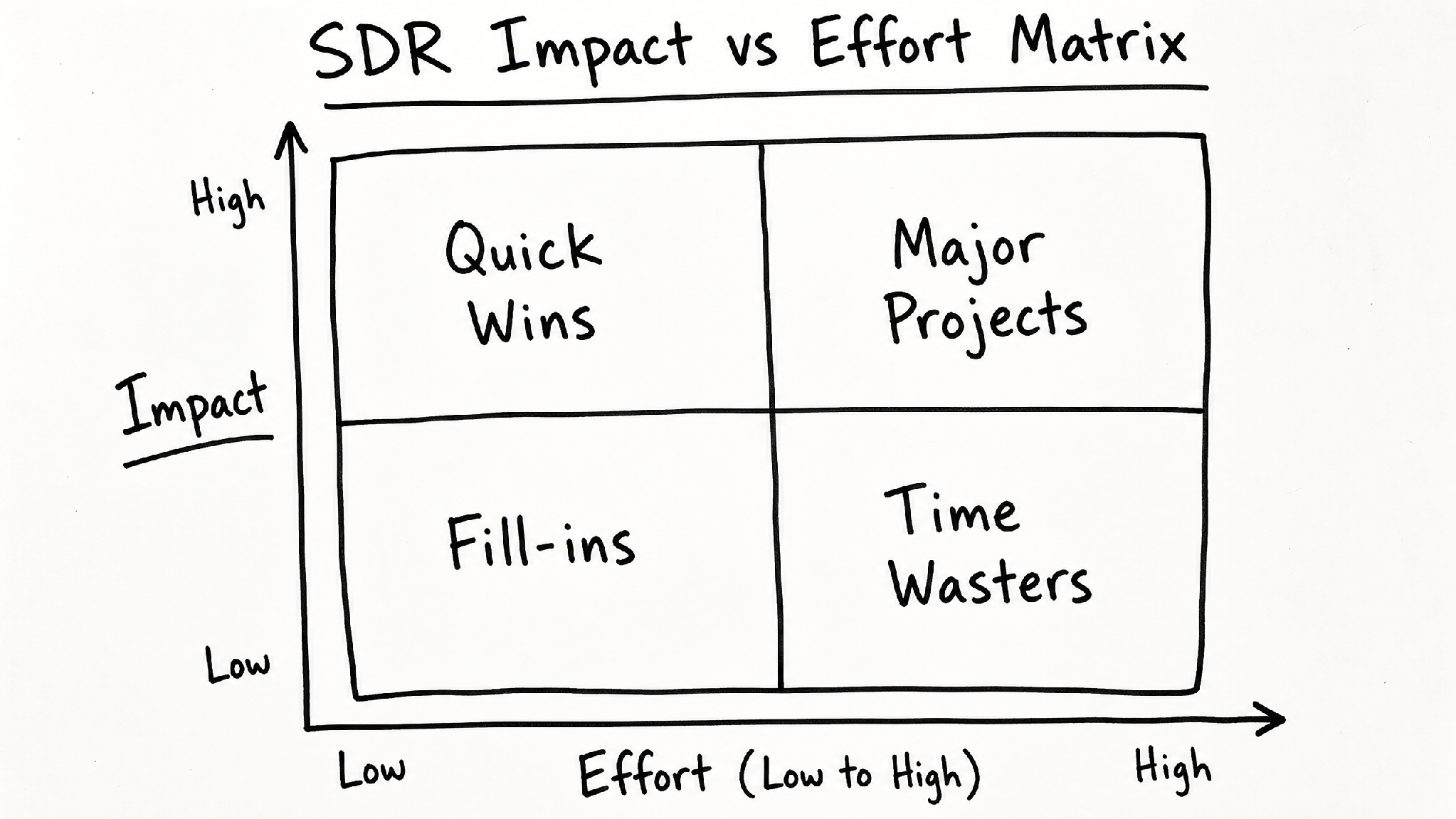
To understand how top performers prioritize their outreach, we can look at the SDR Impact/Effort Matrix.
This hand-drawn matrix illustrates how elite SDRs categorize their daily activities. They spend the majority of their time in the "Quick Wins" (high impact, low effort) and "Major Projects" (high impact, high effort) quadrants, ruthlessly eliminating the "Time Wasters."
A successful pitching process hinges on systematic preparation and execution. It requires a shift from reactive dialing to proactive, targeted engagement.
Consider these two crucial facts about modern sales outreach:
- Fact 1: Buyers are increasingly self-educated. By the time they speak to an SDR, they have often already completed a significant portion of their buying journey independently.
- Fact 2: Personalization at scale is no longer optional. Generic outreach is actively penalized by both prospects (who ignore it) and email providers (who flag it as spam).
The numbers back this up. According to a recent study by SalesLoft, personalized emails deliver a 112% increase in reply rates compared to non-personalized templates. This statistic underscores why a structured, repeatable process for personalization is vital.
Here is how you build that recurring process:
- Standardize Your Pre-Call Research: Create a strict 3-minute checklist for researching prospects. Look for trigger events, recent company news, and mutual connections. Don't fall down the rabbit hole; get the context you need and dial.
- Develop Modular Talk Tracks: Instead of one long script, build modular "blocks" of conversation. Have a specific block for handling the "send me an email" objection, and another for pivoting from a competitor mention.
- Implement Rigorous Time Blocking: Dedicate specific blocks of time solely for dialing, separate from time spent researching or writing emails. Context switching destroys productivity.
- Review and Refine Weekly: The best process is a living document. Every Friday, review your call recordings. Identify which talk tracks resonated and which fell flat, then adjust your framework for the following week.
By treating the pitch as a process to be optimized rather than a performance to be winged, SDRs can create a sustainable engine for generating pipeline.
What Happens During a High Performing SDR Call?

The anatomy of a top-tier SDR call breaks down into these distinct stages:
The Pattern Interrupt (0–15 seconds)
The first fifteen seconds of a cold call are a psychological battleground. When a prospect answers the phone to an unknown number, their brain immediately goes into defensive mode. They are listening for the telltale signs of a salesperson: the overly enthusiastic "How are you doing today?", the rushed introduction, or the immediate pitch. High-performing SDRs know that if they sound like everyone else, they will be treated like everyone else — which usually means getting hung up on.
To survive this initial window, elite reps use a "pattern interrupt." This is a calculated deviation from the expected script designed to jolt the prospect out of their automatic "no" response. It's about creating a moment of cognitive dissonance that forces them to actually listen. You aren't trying to sell anything in these first few seconds; you are simply trying to buy the right to the next thirty seconds. The goal is to sound human, slightly unexpected, and entirely confident. You want to acknowledge the interruption without apologizing for it, showing respect for their time while maintaining your own authority.
Example: Instead of: "Hi John, this is Sarah from TechCorp, how are you today? I'm calling because..."Try: "John? Hi, it's Sarah. Look, I know I caught you in the middle of something and this is a cold call. Do you want to hang up now, or give me thirty seconds to tell you why I dialed your number?" (This radical honesty often earns a chuckle and permission to proceed).
The Tailored Value Hook (15–45 seconds)
Once you've survived the initial defensive wall, the clock is ticking faster than ever. You have roughly thirty seconds to prove that you aren't just another rep dialing down a list. This is where the "Tailored Value Hook" comes into play. A high-performing SDR doesn't talk about what their product does; they talk about the specific problem the prospect is likely experiencing right now.
This stage relies heavily on the pre-call research you conducted. The hook must connect a known trigger event — a new hire, a funding round, a shift in industry regulations — to a common pain point your solution solves. It shows the prospect that you have done your homework and that this call is highly relevant to their current business reality. You are shifting the dynamic from a vendor pushing a product to a peer offering a strategic insight. If done correctly, the prospect should feel a slight twinge of recognition — the feeling that you understand their daily struggles better than they expect a stranger to.
Example:"I saw you just brought on three new enterprise AEs last week. Usually, when VPs of Sales are scaling that fast, they tell me their biggest headache is getting those new reps fully ramped and hitting quota before the end of the quarter. Is that something you're actively trying to solve right now, or do you have onboarding completely locked down?"
Strategic Discovery (45–90 seconds)
If the tailored hook lands, the prospect will usually give a tentative affirmative. Now, the high-performing SDR shifts from talking to investigating. The Strategic Discovery phase is not about running through a BANT (Budget, Authority, Need, Timeline) checklist like an interrogator. It is about asking precise, open-ended questions that encourage the prospect to elaborate on the pain point you just uncovered.
Elite SDRs use this time to quantify the problem. They don't just want to know that a problem exists; they want to know how much it hurts. They ask questions that force the prospect to think critically about their current processes. This is where you separate the casual interest from genuine intent. You are looking for the root cause of their frustration, not just the surface-level symptom. By guiding the prospect to articulate the depth of their issue, you are subtly building the business case for your solution before you've even fully explained what it is.
Example:"You mentioned that getting new reps ramped is taking longer than expected. When you say 'longer,' what does that look like in practice? Are we talking an extra two weeks, or are they missing their first quarter targets entirely? And how is that impacting your overall revenue forecast for the year?"
Active Listening & Empathy (1.5–3 minutes)
As the prospect opens up during discovery, the call enters its most critical human phase: Active Listening and Empathy. This is where average SDRs fail. An average rep listens only to find the perfect moment to interject with a feature pitch. A high-performing SDR listens to understand. They practice active listening by confirming what they've heard, summarizing the prospect's pain, and validating their frustration.
This stage is about building trust. Prospects buy from people who they feel truly "get" them. When a prospect explains a complex operational bottleneck, an elite SDR doesn't immediately say, "We can fix that." Instead, they use empathetic labeling to show they comprehend the emotional and professional weight of the problem. They might say, "It sounds like you're spending half your week just putting out fires instead of actually managing your team." This validation lowers the prospect's guard completely, transforming the call from a sales pitch into a consultative dialogue.
Example:Prospect: "It's a nightmare. I'm pulling data from three different CRMs just to get a basic pipeline report for the board."SDR: "That sounds incredibly frustrating. It seems like you're being forced to act as a data entry clerk rather than a strategic leader. If you're spending hours on manual reporting, you probably don't have the bandwidth to actually coach your reps, right?"
Objection Handling (3–5 minutes)
Even the best calls encounter friction. Around the three-minute mark, as the conversation turns toward securing a meeting, objections will inevitably surface. "We don't have budget," "Call me back in six months," or "We're already using Competitor X." High-performing SDRs don't panic when they hear an objection; they expect it. They view objections not as rejections, but as requests for more information or clarification.
The elite approach to objection handling is never combative. They use frameworks like 'Feel, Felt, Found' or the 'Acknowledge, Isolate, Overcome' method. They validate the concern first, ensuring the prospect feels heard, before gently reframing the issue. They don't try to win an argument; they try to align with the prospect's underlying hesitation. If a prospect says they are too busy, the SDR pivots to show how a brief meeting will ultimately save them time. They use the pain points uncovered in the discovery phase as leverage to justify the next step.
Example:Prospect: "Honestly, this sounds interesting, but we just signed a contract with Competitor X, so we're locked in for the year."SDR: "I completely understand, and I'm not calling to ask you to rip and replace a system you just bought. A lot of the VPs I speak with use Competitor X for their core CRM, but they still struggle with the specific reporting issue we discussed. Would you be open to a brief 15-minute chat next week just to see how we bolt onto your existing setup to solve that specific data gap? No pressure to buy, just comparing notes."
What Should an Elite SDR Do Post-Call with a Prospective Client?
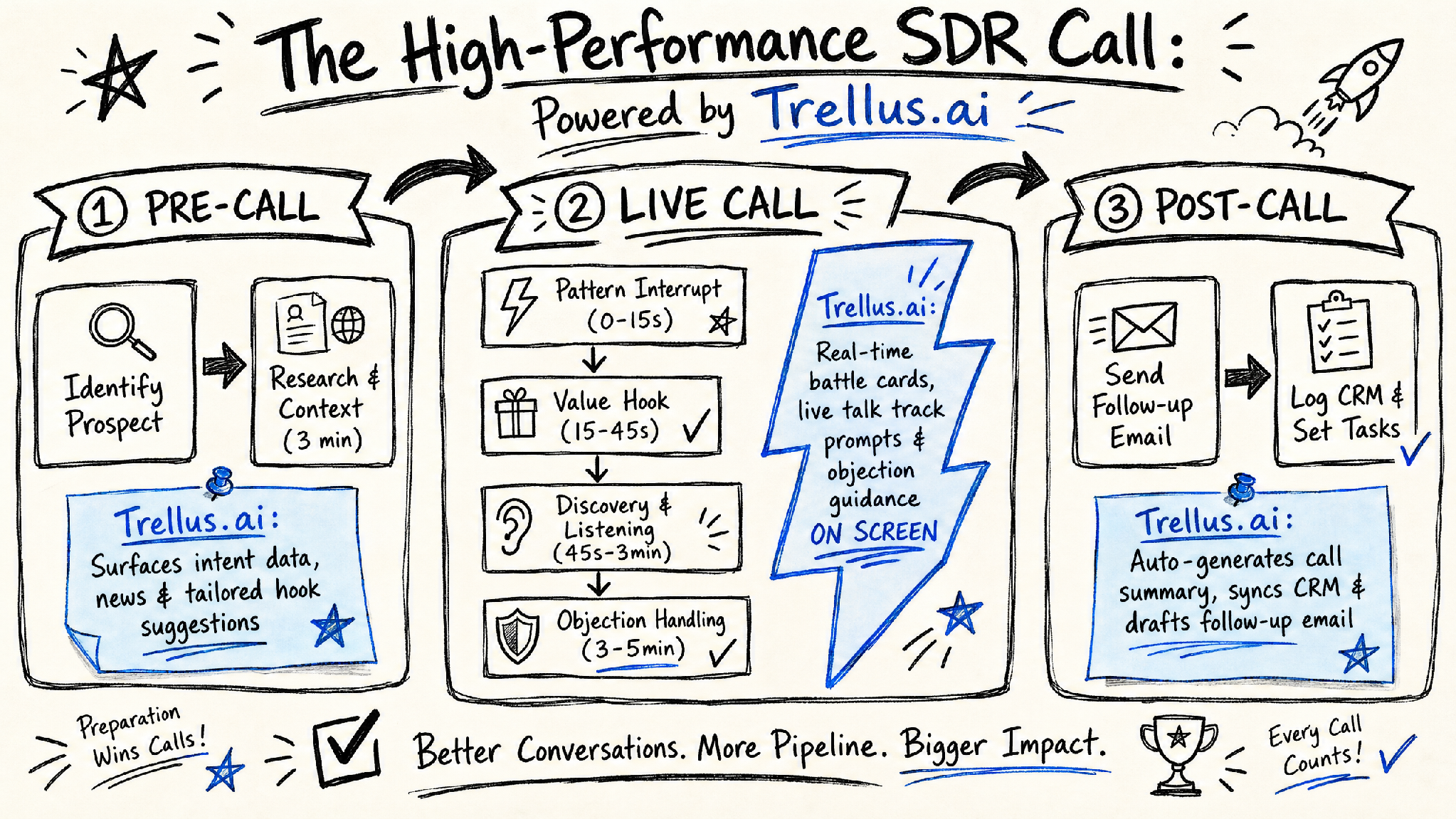
The moments immediately following a cold call are just as critical as the call itself. A high-performing SDR knows that hanging up the phone is not the end of the workflow; it is the beginning of the follow-through. How you manage the post-call process determines whether that great conversation actually converts into a booked meeting or simply fades into the ether.
First, speed is paramount. Elite reps send their follow-up email within five minutes of disconnecting. This email shouldn't be a generic template. It must summarize the specific pain points discussed, reiterate the agreed-upon next steps, and include a calendar link if a time wasn't firmly locked down on the call.
Second, CRM hygiene is non-negotiable. Top performers meticulously log the call notes while the details are fresh. They record the exact objections raised, the current tech stack mentioned, and the personal nuances (like a mentioned upcoming vacation) that can be used to build rapport in future interactions.
Third, they set internal reminders. If the prospect asked to be called back next Tuesday at 10 AM, an elite SDR doesn't rely on memory; they create a hard task in their sequence.
The Magic of Trellus.ai During the Call: Executing this perfectly is tough, but this is where Trellus.ai feels like magic. During the live call, Trellus.ai acts as a real-time co-pilot. It listens to the conversation, instantly surfaces relevant objection-handling battle cards on your screen, and guides you through complex discovery questions. It's like having your best manager whispering the perfect response in your ear right when you need it most.
How Trellus.ai Automates the Post-Call Process: Post-call, Trellus.ai transforms SDR productivity. Instead of spending ten minutes typing up notes, Trellus.ai automatically generates a flawless call summary, syncs the key data points directly into your CRM, and even drafts a highly personalized follow-up email based on the exact context of the conversation. It eliminates the administrative burden entirely.
What Are the 5 Core Personality Traits of High-Performing SDRs?
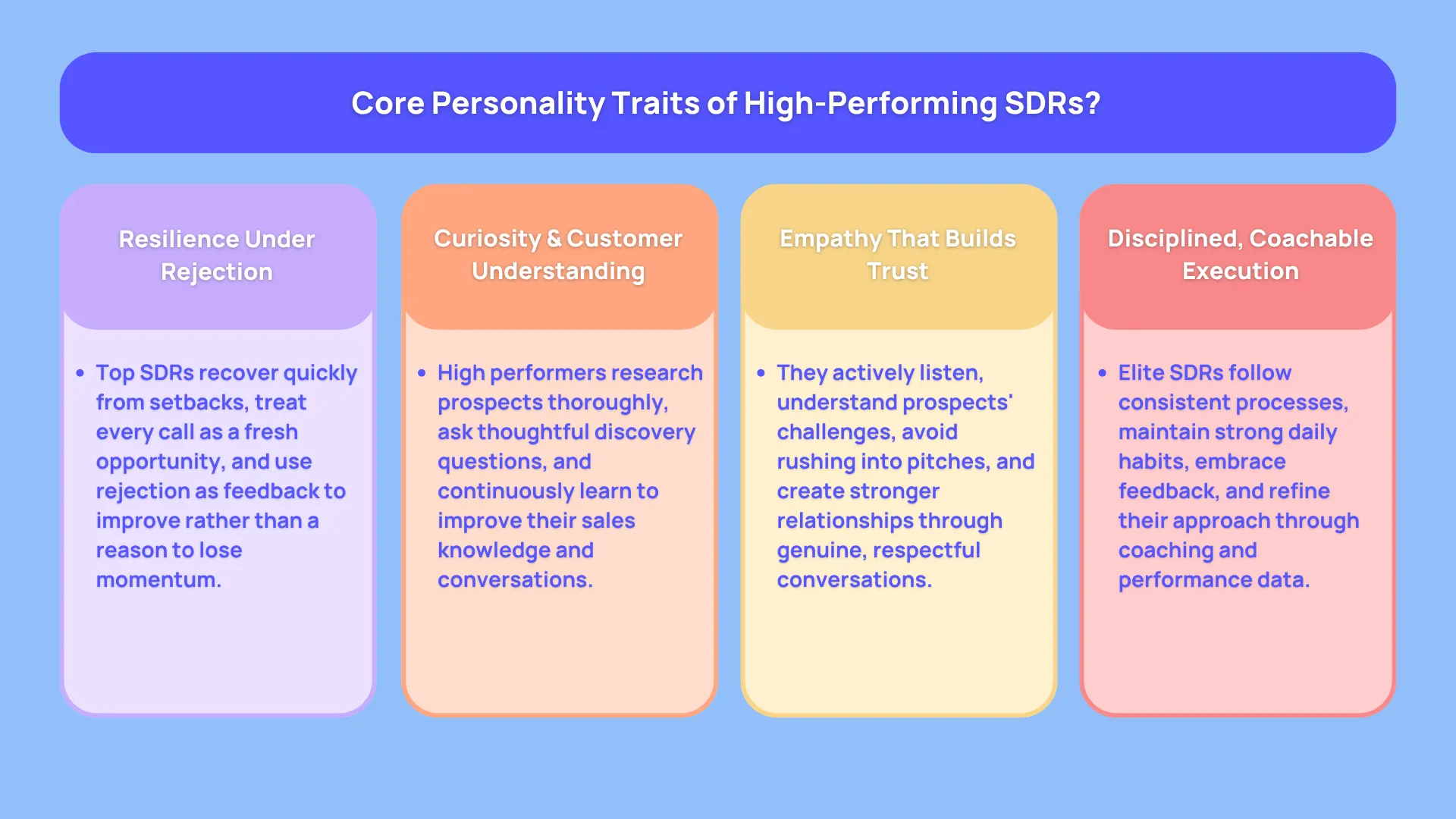
Skills can be taught. Talk tracks can be scripted. But the personality traits that underpin elite SDR performance?
Those run far deeper. After studying the habits and behaviours of top-performing reps across industries, a clear pattern emerges: the best SDRs share a distinct psychological profile that separates them from the pack before they even pick up the phone. These aren't traits you are either born with or without — they are characteristics that can be developed, sharpened, and consciously cultivated over time. Understanding them is the first step to building a team — or becoming a rep — that consistently outperforms expectations.
1. Resilience
Cold calling is, by its very nature, a profession built on rejection. For every meeting booked, there are dozens of hang-ups, voicemails, and flat "not interested" responses. The average SDR hears "no" far more than they hear "yes." What distinguishes the elite from the average is not the absence of rejection — it's the speed of recovery.
High-performing SDRs have developed an almost superhuman ability to compartmentalize. A harsh hang-up at 9:05 AM does not colour the tone of the call at 9:10 AM. They treat each dial as a completely fresh opportunity, uncontaminated by what came before it. This mental reset is not accidental; it is a practised discipline.
Resilient SDRs also reframe rejection productively. Rather than internalising a "no" as a personal failure, they extract the data from it. Was it a bad time? A poor fit? A weak opening? Every rejection becomes a micro-lesson that sharpens the next attempt. This growth mindset is what allows them to sustain high call volumes over weeks and months without burning out.
Building resilience also requires a strong sense of purpose. The best reps connect their daily activity to a larger goal — a promotion, a personal milestone, a team target. That anchor keeps them dialling when motivation alone would have them checking social media.
2. Intellectual Curiosity
The best SDRs are, at their core, deeply curious people. They are genuinely interested in how businesses work, what keeps executives up at night, and why certain companies succeed while others stagnate. This intellectual curiosity is what drives the quality of their pre-call research and the depth of their discovery questions.
A curious SDR doesn't just skim a prospect's LinkedIn profile; they read the company's latest press release, dig into their recent product launches, and notice the subtle signals in a job posting that hint at a strategic shift. They ask themselves, "What is really going on here?" before they ever dial the number.
This trait also transforms the quality of conversations. Curious SDRs ask better questions because they actually want to know the answers. Their discovery isn't a checklist exercise — it's a genuine investigation. Prospects can feel the difference between someone going through the motions and someone who is authentically interested in their business challenges.
Intellectual curiosity also fuels continuous self-improvement. Curious reps read sales books, listen to call recordings from top performers, and actively seek out new frameworks. They are never satisfied with "good enough" because they are always wondering if there is a better way.
3. Empathy
Empathy is perhaps the most underrated trait in a high-performing SDR's arsenal. In a role that is often associated with assertiveness and persistence, the ability to genuinely feel what a prospect is experiencing is a profound competitive advantage.
Empathetic SDRs listen differently. They don't just hear the words a prospect says; they pick up on the frustration behind them, the hesitation in their voice, and the unspoken concerns beneath the surface objection. This emotional intelligence allows them to respond in a way that makes the prospect feel truly understood — which is the foundation of trust.
This trait also prevents the most common SDR failure mode: talking too much. An empathetic rep knows when to pause, when to let silence do the work, and when a prospect needs to vent before they are ready to engage. They resist the urge to immediately pivot to a pitch the moment a pain point is mentioned.
Crucially, empathy extends to handling rejection graciously. An empathetic SDR understands that a prospect's "no" is rarely personal. They are busy, they are bombarded with outreach, and they have their own pressures. This perspective keeps interactions respectful and professional, which often turns a "not now" into a "call me back in Q3."
4. Discipline & Process Orientation
Motivation is unreliable. On a grey Tuesday morning after a string of bad calls, motivation is nowhere to be found. What separates a consistent top performer from a rep who has good weeks and terrible weeks is discipline — the ability to execute the process regardless of how they feel.
Elite SDRs are obsessively process-oriented. They have a structured daily schedule that they follow without exception: a research block, a dialling block, a CRM update block, and a review block. They treat their calendar like a contract with themselves. Context switching — jumping between tasks randomly — is the enemy of productivity, and disciplined SDRs eliminate it ruthlessly.
This process orientation extends to their talk tracks, their follow-up sequences, and their objection-handling frameworks. They don't improvise from scratch on every call; they work from a tested, refined system and make incremental improvements over time. This approach compounds. A rep who is 1% better each week is dramatically more effective by the end of a quarter.
Discipline also shows up in the small things: sending the follow-up email within five minutes, logging the call notes immediately, setting the next task before closing the CRM. These habits seem minor in isolation, but collectively they create a pipeline that never leaks.
5. Coachability
The fastest path to elite performance is not raw talent — it is the willingness to be coached. Coachable SDRs accelerate their development at a rate that naturally talented but stubborn reps simply cannot match. They treat every piece of feedback as a gift rather than a criticism, and they implement changes immediately rather than defensively explaining why they did it their way.
Coachable reps actively seek out feedback rather than waiting for it. They send call recordings to their managers and ask for specific critique. They sit in on top performers' calls and ask pointed questions about their technique. They are voracious consumers of any insight that can sharpen their game.
This trait also manifests in how they respond to data. When their metrics show a low connect-to-meeting conversion rate, a coachable SDR doesn't make excuses about bad leads or a tough market. They examine their opening lines, their value hooks, and their objection-handling responses, and they systematically test new approaches until the numbers improve.
Coachability requires a particular kind of ego management. It demands enough confidence to pick up the phone day after day, but enough humility to accept that there is always room to improve. The best SDRs hold both of these truths simultaneously — and that balance is what makes them exceptional.
It's a Continued Process...
A high-performing SDR call is never an accident. It is the product of meticulous preparation, a disciplined process, sharp emotional intelligence, and the right personality traits firing in unison. From the pattern interrupt in the first fifteen seconds to the empathetic close that secures the meeting, every moment is intentional.
The reps who consistently win are those who treat every call as a craft to be refined. And in 2026, the smartest ones are letting Trellus.ai do the heavy lifting — surfacing real-time guidance during the call, automating post-call admin, and freeing them to focus entirely on the human conversation that actually converts.


Power and parallel dialing in your CRM.