Our Top Picks


A sales engagement platform (SEP) is software that helps sales teams plan, execute, and track every touchpoint with a prospect across channels email, phone, LinkedIn, and SMS from a single workspace.
Instead of reps juggling a dozen tabs and remembering who to follow up with, an SEP orchestrates the entire outreach motion through structured sequences (also called cadences), logs every activity back to the CRM, and surfaces analytics that tell you what's actually working. In short, a sales engagement platform is the execution layer that sits between your data and your CRM, turning a list of contacts into booked meetings.
If you run outbound at any real volume, this is the category that decides whether your reps spend their day selling or their day doing admin. Below, we'll define the category thoroughly: what an SEP does, the core features that separate a true platform from a glorified email tool, how a sales engagement platform differs from a CRM, and how sequencing is being rewritten in the AI age.
We'll also show where a modern calling and coaching layer like Trellus fits into the stack.
What Does a Typical Sales Engagement Platform Help With?
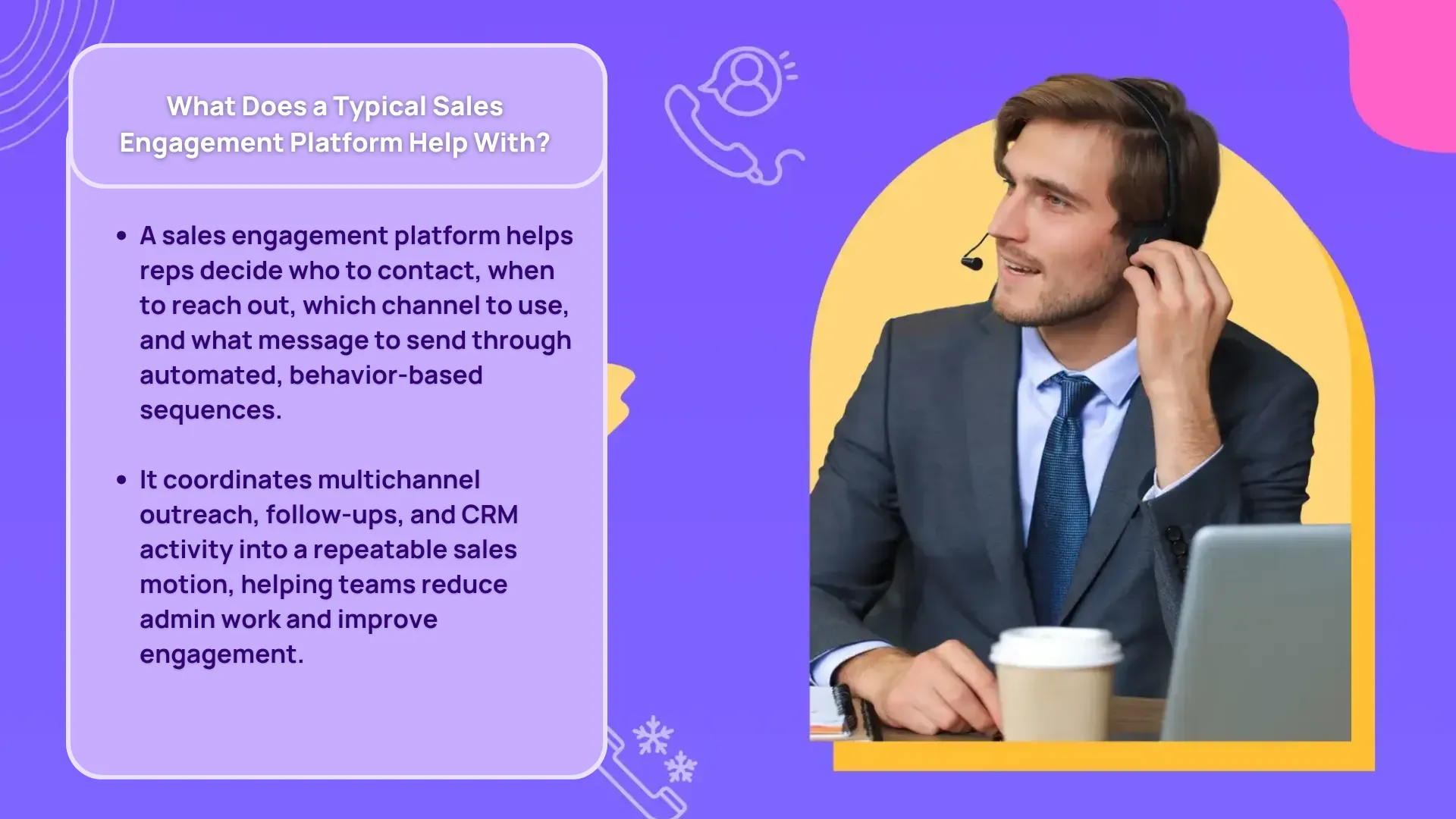
At its heart, an SEP answers a deceptively simple question for every rep, every day: who do I contact next, on which channel, with what message? It replaces sticky notes, spreadsheet trackers, and memory with an automated, repeatable system.
A prospect enters a sequence: a predefined series of steps spread over days or weeks. Step one might be a personalized email on day one, step two a LinkedIn connection request on day two, step three a cold call on day three, and so on.
The platform queues each step at the right moment, tells the rep exactly what to do (or does it automatically), and moves the prospect forward based on their behavior. Someone who replies gets pulled out of the automated track and routed to a human conversation; someone who goes cold gets a different follow up branch.
This is why the category is often described in terms of Adaptive Sales Cadence Orchestration; the platform isn't just firing off blind blasts, it's coordinating timing, channel, and messaging into a coherent motion. Done well, an SEP is the backbone of any serious outbound sales strategy, giving RevOps a single system of record for how the team engages the market.
Core Features of a Sales Engagement Platform
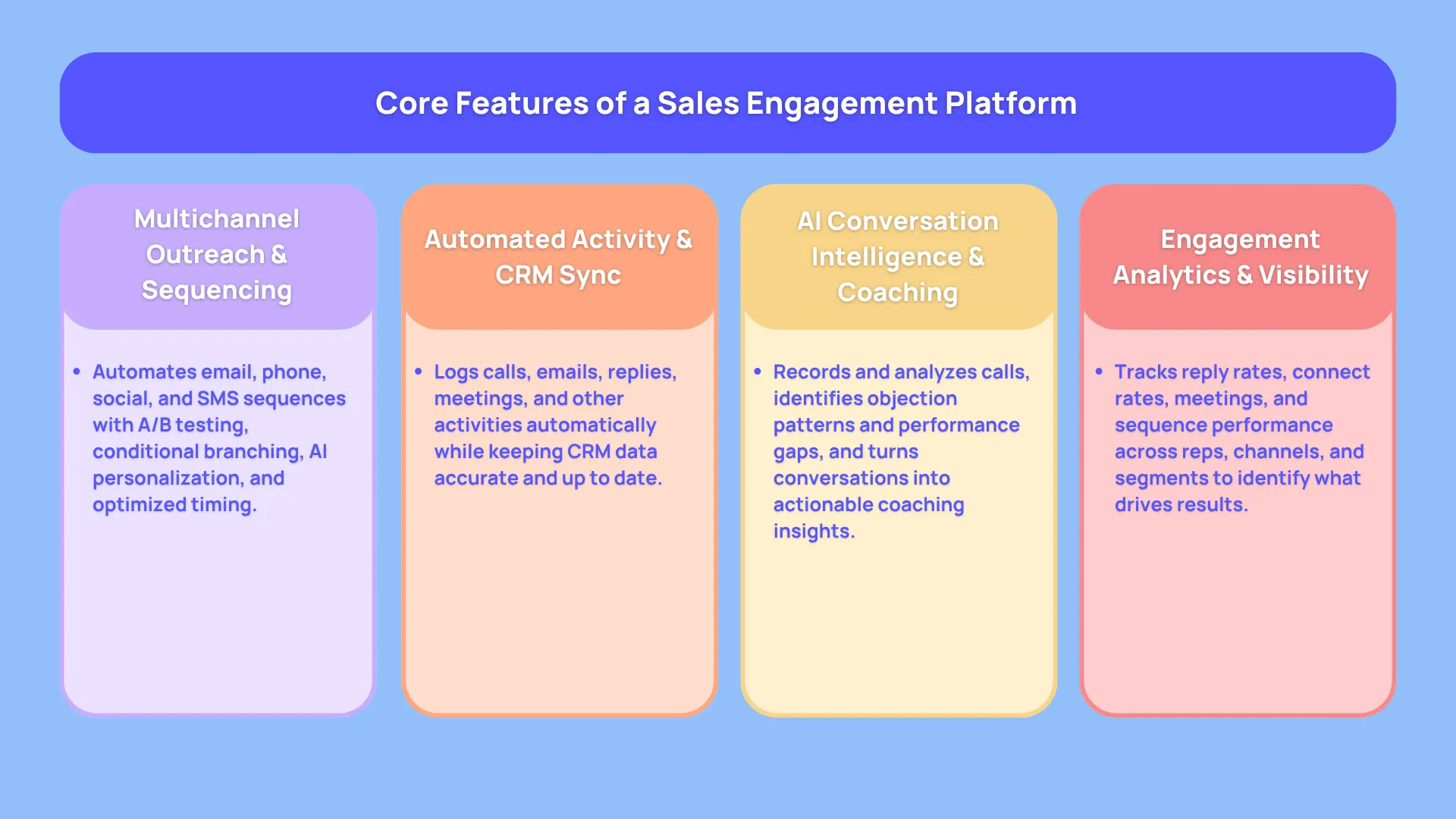
Not every tool that calls itself a "sales engagement platform" earns the name. The strong ones share five capabilities. If a vendor is missing two or three of these, you're really looking at a point solution wearing a category costume.
1. Multi Channel Outreach Automation & Sequencing
This is the defining feature.
A true SEP handles Multi Channel Outreach Automation & Sequencing across email, phone, social, and text not just one channel. Reps build sequences once, and the platform executes them consistently across the whole team so your best performing cadence becomes the default motion for everyone.
Good sequencing supports A/B testing on subject lines and messaging, conditional branching based on prospect actions, and time zone aware scheduling. This is also where AI sequencing is changing the game: instead of static, one size fits all cadences, AI can adjust step timing, recommend the next best channel, and personalize copy at the individual prospect level.
For teams comparing execution engines, our roundup of outbound sales automation tools breaks down how the leading sequencers differ.
2. Sales Activity Tracking & CRM Sync
An SEP is only as valuable as the data it captures. Sales Activity Tracking & CRM Data Synchronization means every email open, call disposition, reply, and meeting is automatically logged no manual data entry. This bidirectional sync with Salesforce, HubSpot, or your CRM of choice keeps pipeline records clean and gives leaders an accurate picture of activity without nagging reps to update fields.
This tight coupling is a big reason sales engagement overlaps with broader sales automation: the platform eliminates the repetitive logging and follow up tasks that quietly eat hours out of every rep's week.
3. Conversation Intelligence & Coaching
Modern SEPs increasingly bundle Conversation Intelligence & Performance Coaching, recording, transcribing, and analyzing calls and demos to surface what top performers do differently.
Instead of managers sampling a handful of calls a month, conversation intelligence can review every conversation, flag objection patterns, track talk to listen ratios, and turn real calls into coaching moments.
This is the frontier where sales engagement meets enablement, and it's a major reason the best AI sales platforms now compete as much on coaching as on outreach volume. A sequence gets the conversation started; conversation intelligence makes each one better than the last.
4. Engagement Visibility & Analytics
You can't improve what you can't see. Prospect Engagement Visibility & Analytics gives reps and RevOps real time dashboards on sequence performance, reply rates, connect rates, and meeting conversion broken down by rep, cadence, segment, and channel. This is how teams find the leaky step in a sequence, kill underperforming messaging, and double down on what books meetings.
Strong analytics also close the loop on forecasting: when engagement data flows cleanly into the CRM, leaders get earlier, more reliable signal on pipeline health. For RevOps leaders specifically, we've compared the reporting depth of the leading platforms in our guide to sales engagement platforms for RevOps teams.
5. Workflow Automation & Lead Distribution
Finally, an SEP handles the operational plumbing: Workflow Automation & Lead Distribution. That means routing inbound leads to the right rep instantly, triggering sequences automatically when a lead hits a certain score or takes an action, enforcing territory rules, and automating handoffs between SDRs and AEs.
This orchestration layer is what lets a growing team scale coverage without proportionally scaling headcount or chaos.
Sales Engagement Platform vs CRM: What's the Difference?
The single most common question buyers ask is sales engagement platform vs CRM because on the surface they seem to overlap. Here's the clean distinction.
A CRM (like Salesforce or HubSpot) is your system of record. It stores accounts, contacts, deals, and history. It answers "what is the state of this relationship and this pipeline?" A CRM is where data lives, but it was never designed to drive high velocity daily outreach.
A sales engagement platform is your system of action. It answers "what should this rep do right now to move deals forward?" It's where sequences run, calls get dialed, emails get sent, and activity gets executed. The SEP writes its results back into the CRM, but the day to day work happens in the SEP.
Think of it this way:
• CRM = the database and the deal ledger. Optimized for storage, reporting, and pipeline management.
• SEP = the outreach engine. Optimized for execution: the sequences, cadences, dials, and touches that generate the activity the CRM records.
They're complementary, not competitive. A CRM without an engagement layer leaves reps improvising their outreach in disconnected tools. An SEP without a CRM has nowhere durable to store relationships and revenue. Most modern stacks run both, tightly integrated, which is exactly why deep CRM sync is a non negotiable SEP feature.
How Sales Sequencing Works in the AI Age
For a decade, sequencing meant building a static, linear cadence five emails and three calls over two weeks and running every prospect through the same steps. It worked because it was consistent. But it also produced the generic, obviously templated outreach that buyers now tune out.
AI has changed what "sequencing" means. The modern motion is defined by four shifts:
Signal triggered engagement. Rather than dumping a list into a cadence, AI monitors buying signals a job change, funding round, website visit, or intent spike and triggers Signal Triggered Prospect Engagement at the moment a prospect is most likely to respond. Timing stops being arbitrary and starts being earned.
AI personalized messaging. Instead of one templated email for everyone, AI Personalized Message Generation drafts copy tailored to each prospect's role, company, and recent activity. Reps review and send rather than write from scratch, keeping personalization at volume.
Dynamic Engagement Learning & Optimization means the platform watches which steps, channels, and timings convert, then reallocates effort toward what works, pruning dead steps automatically instead of waiting for a quarterly review.
Conversation aware coaching. Because AI can now analyze the actual calls a sequence produces, coaching gets folded directly into the loop. A rep isn't just told to "make more dials"; they're shown the specific moments where a deal turned.
The result is a shift from Intelligent Multi Channel Sales Outreach as a blunt volume play to a precise, responsive motion. According to Gartner, the future of B2B sales technology is increasingly defined by AI that augments reps with real time guidance rather than simply automating tasks, and sales engagement platforms are where that guidance is being delivered. For a deeper look at where these tools are heading, see our list of sales engagement platforms to watch.
Where AI Calling Fits: Trellus in the Modern SEP Stack
One thing traditional sales engagement platforms have historically done poorly is the phone. Sequencing email is easy; making the call step actually productive is hard.
Reps burn hours dialing numbers that ring out, land in voicemail, or reach the wrong person, and that dead time never shows up in a sequence report. This is the gap Trellus is built to close.
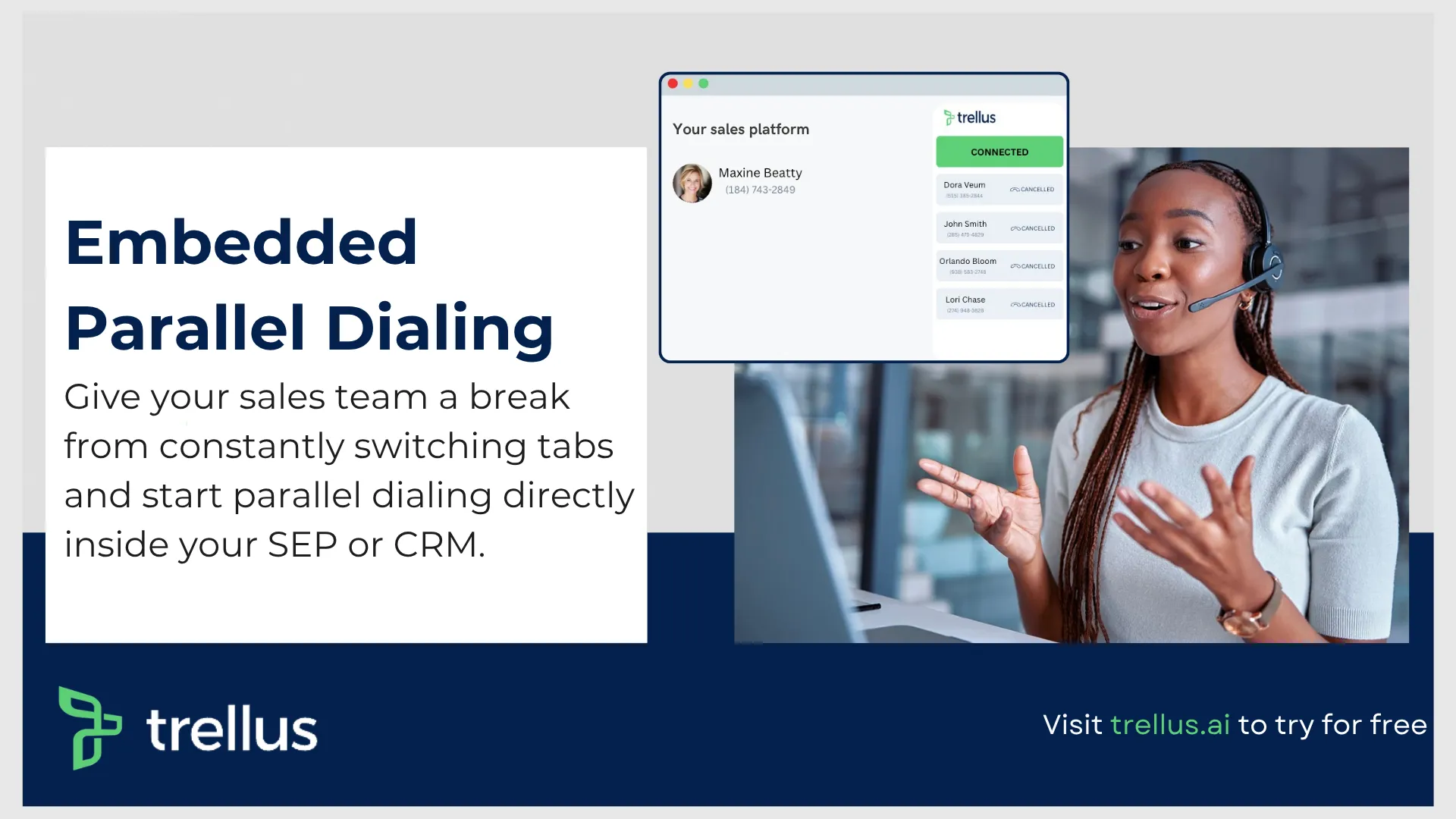
Trellus is an AI powered sales acceleration and coaching layer that works inside the SEP and CRM tools your reps already use Salesloft, Outreach, Apollo, HubSpot, and Salesforce via a Chrome extension.
There's no separate dialer app to switch into. Its embedded parallel dialer dials up to roughly five lines at once to multiply live connects, drops pre recorded voicemails automatically, and logs every call, disposition, and note straight back to your CRM. On top of that sit real time AI coaching (live objection handling and battle cards during the call), AI voice agents that double as 24/7 practice partners, and call scoring that grades 100% of calls, not a sample.
Best for: SDR/BDR and AE teams running high volume outbound calling who want to keep dialing inside their existing sales engagement platform, plus remote and hybrid teams that need live coaching and shared visibility through the Virtual Sales Floor.
Pricing (current):
• Power Plan starts at $99.99/mo: Power dialing, voicemail drop, 5 phone numbers, and the LinkedIn inbox tool. Best for individuals.
• Parallel plan starts at $149.99/mo: Everything in Power plus multi line parallel dialing, unlimited AI practice calls, and 8 phone numbers. Best for individual high volume callers.
• Business/Enterprise plan comes with custom pricing: Everything in Parallel plus customizable AI research, team analytics, custom reporting, and AI modeling. Best for teams.
There's no forced demo; the self serve plans give you immediate access.
Pros: embedded workflow with zero context switching, parallel dialing that multiplies connect rates, real time AI coaching, 100% call scoring, broad SEP/CRM integrations, and an aggressive price point.
Cons (honest caveats): Trellus is a calling and conversation execution layer, not a full CRM or a B2B contact database; you'll pair it with your data provider and your SEP.
Parallel dialing also rewards disciplined list hygiene and TCPA/DNC compliance, and it's a younger brand than some incumbents.
How to Easily Kick Off a Campaign on Trellus?

1. Install the Trellus Chrome extension and sign in.
2. Connect your SEP or CRM (Apollo, Salesloft, Outreach, HubSpot, or Salesforce).
3. Load a call list, or open an existing cadence/sequence step that has calls due.
4. Choose your dialing mode (power or parallel), set the number of lines, and pick a pre recorded voicemail for automatic drop.
5. Turn on real time AI coaching and select the talk track and battle cards for the campaign.
6. Start the dialing session. Trellus auto logs calls, dispositions, and notes to your CRM.
7. Review the AI call scores and Sales Floor analytics after the blitz to coach and iterate.
Used this way, Trellus turns the weakest step in most sequences the phone call into the highest leverage one, without pulling reps out of the sales engagement platform they already live in.
Choosing the Right Sales Engagement Platform
There's no single "best sales engagement platform" for every team the right choice depends on your motion. A few practical filters:
• Channel mix. If your engine is email and social, a sequencing first SEP may be enough. If phone drives your pipeline, prioritize calling depth and pair your SEP with a purpose built dialer. • CRM fit. Depth of native integration with your CRM matters more than a long feature list. Shallow sync creates dirty data and manual cleanup.
• Coaching and analytics. For scaling teams, conversation intelligence and rep level analytics separate a platform you'll grow with from one you'll outgrow.
• Total cost. Seat based SEP pricing adds up fast. Weigh the per rep cost against the productivity, connects, meetings, and pipeline it actually generates.
Category directories like G2 publish grids and verified reviews that are a useful sanity check on how vendors perform in the real world, especially for narrowing a shortlist before you run a trial. Refining your sales outreach strategy around the platform's strengths, rather than forcing a motion the tool wasn't built for, ultimately drives ROI.
Frequently Asked Questions
What is a sales engagement platform in simple terms?
A sales engagement platform is software that automates and tracks how reps reach out to prospects across email, phone, LinkedIn, and SMS.
It runs structured sequences, logs every activity to your CRM, and reports on what's working so reps spend more time selling and less time on admin.
What's the difference between a sales engagement platform and a CRM?
A CRM is your system of record; it stores accounts, contacts, and deals.
A sales engagement platform is your system of action; it executes the daily outreach (sequences, calls, emails) and writes the results back to the CRM. Most teams run both together, tightly integrated.
Is a sales engagement platform the same as sales automation?
It's a subset. Sales automation is the broad practice of removing manual work from the sales process; a sales engagement platform focuses that automation on multi channel outreach, sequencing, activity logging, and engagement analytics.
An SEP is one of the most impactful pieces of a wider sales automation strategy.
Do I still need a dialer if I have a sales engagement platform?
Often, yes. Many SEPs handle email and social well but offer only a basic single line dialer.
High volume calling teams pair their platform with a dedicated parallel or AI dialer, like Trellus, to multiply live connects and add real time call coaching that most SEPs don't provide natively.
How much does a sales engagement platform cost?
Pricing is usually per user per month and ranges widely by feature depth and team size, from budget tools under $40/rep to enterprise platforms well into three figures per seat.
Look beyond the sticker price at connect rates, meetings booked, and CRM data quality to judge real value.
Wrapping It Up
A sales engagement platform is the execution engine of modern outbound the layer that turns a list of contacts into a disciplined, multi channel motion and feeds clean activity data back into your CRM.
Its core value is consistency at scale: every rep running the team's best sequences, every touch logged, every result measured. In the AI age, that engine is getting smarter signal triggered timing, personalized messaging, self optimizing cadences, and conversation aware coaching are replacing the static blast and pray sequences of the past.
The teams that win won't be the ones with the most tools, but the ones that pair the right sales engagement platform with an execution layer that fixes its weakest step.
If that weak step is the phone, as it is for most outbound teams, an embedded, AI coached parallel dialer like Trellus is the fast
.jpeg)

Power and parallel dialing in your CRM.