6 Best Outbound Dialers for Sales Automation in 2026
Looking for the best outbound dialer? Compare Trellus, Orum, PhoneBurner, Five9, Convoso, and JustCall with pricing, pros, cons, and features.
.jpeg)
On this page
Our Top Picks


Sales teams have never had more options when it comes to outbound dialers for sales automation.
Some platforms connect calls quickly but leave long moments of silence before the rep starts speaking. Others pack in AI features but still expect sales teams to manually update CRMs after every conversation. A few protect your caller reputation well enough to keep answer rates healthy over time, while others burn through phone numbers surprisingly fast.
To separate marketing claims from day to day fit, this guide compares six leading platforms on what matters once calls start flowing.
Each platform is compared on the same criteria: dialing approach, connection handling, CRM synchronization, compliance safeguards, caller reputation tools, and total operating cost.
One lesson stands out.
Dialing more numbers rarely solves pipeline problems.
Winning outbound teams rely on software that protects caller reputation, keeps every campaign compliant, removes repetitive admin work, and helps representatives spend more time speaking with qualified prospects.
Here are the platforms worth shortlisting.
1. Trellus: Best Overall Outbound Dialer for Sales Automation
What does it do?
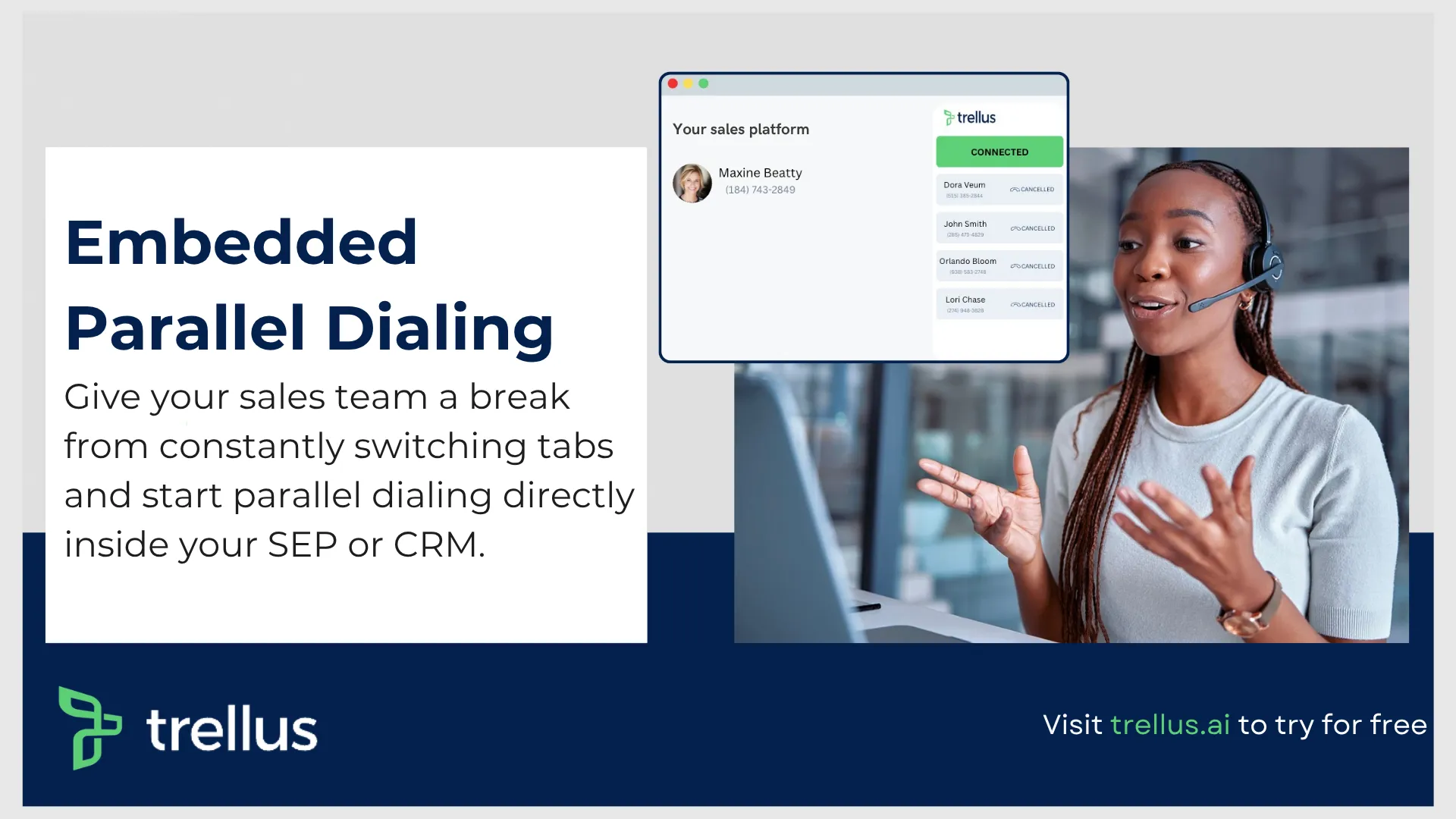
Trellus is a Chrome extension that adds power dialing and parallel dialing (up to five lines at once on the Power + Parallel plan) inside the CRMs and sales engagement platforms reps already use, including HubSpot, Salesforce, Outreach, Apollo, and Salesloft, and logs each call back to the record. Real time AI coaching is available on the Business plan, and every plan includes a LinkedIn inbox for Sales Navigator.
Who is it for?
B2B sales teams, SDR organizations, agencies, and revenue leaders looking to increase conversation volume while giving representatives live coaching, AI assistance, and workflow automation without stitching together multiple platforms.
Because Trellus works inside the tools reps already use, reps move from one call to the next without switching tabs, and call outcomes are logged back to the CRM after each interaction. On the Business plan, AI coaching surfaces guidance while conversations are still happening.
That combination matters more than call volume alone.
Representatives stay in selling mode.
There is less context switching between browser tabs, spreadsheets, CRM records, LinkedIn research, and separate coaching software. Managers can monitor conversations in real time, spot coaching opportunities, and help newer SDRs improve without waiting until the end of the week to review recordings.
The platform is also useful for remote sales organizations where managers cannot physically walk the sales floor.
Compared to traditional power dialer software, the gain comes from reducing administrative work as much as from increasing call volume.
Pros
- AI powered live coaching during active sales conversations (Business plan).
- Parallel dialing on up to five lines cuts the time reps spend waiting on unanswered calls.
- Native CRM synchronization eliminates manual call logging.
- Built in LinkedIn workflow support keeps prospect research close to the dialing experience.
- Excellent value compared with buying multiple standalone sales tools.
Cons
- Teams coming from traditional dialers may need several days to adapt to the AI assisted workflow.
- Organizations that only need basic calling may not take advantage of the broader feature set.
Pricing
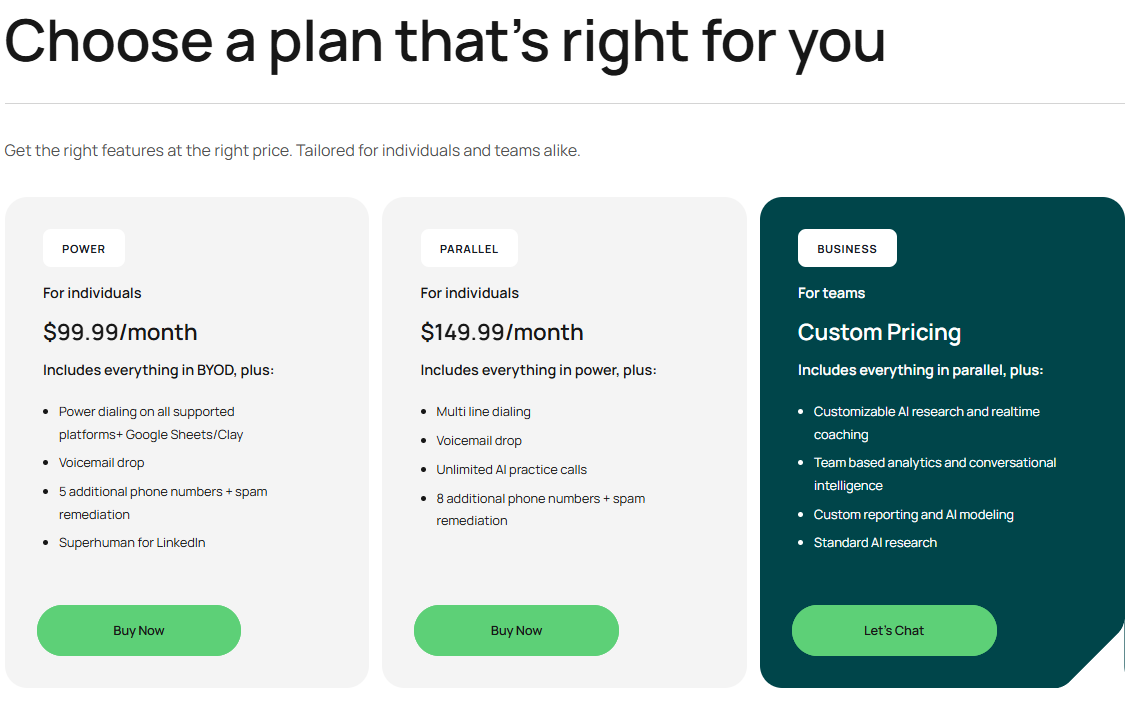
Trellus publishes its pricing: Power is $99.99 and Power + Parallel is $149.99 per seat per month, and Business is custom priced.
Why it ranks first
Many outbound products solve one piece of the workflow.
- Some specialize in dialing speed.
- Others concentrate on coaching.
- Others focus on CRM updates.
This platform brings those capabilities together into a single workflow, which reduces operational complexity while helping sales teams generate more pipeline.
For companies looking for outbound call automation without creating another disconnected sales tool stack, it provides one of the strongest overall combinations of productivity, coaching, automation, and scalability available today.
2. Orum: Best Parallel Dialer for High Volume SDR Teams
What does it do?
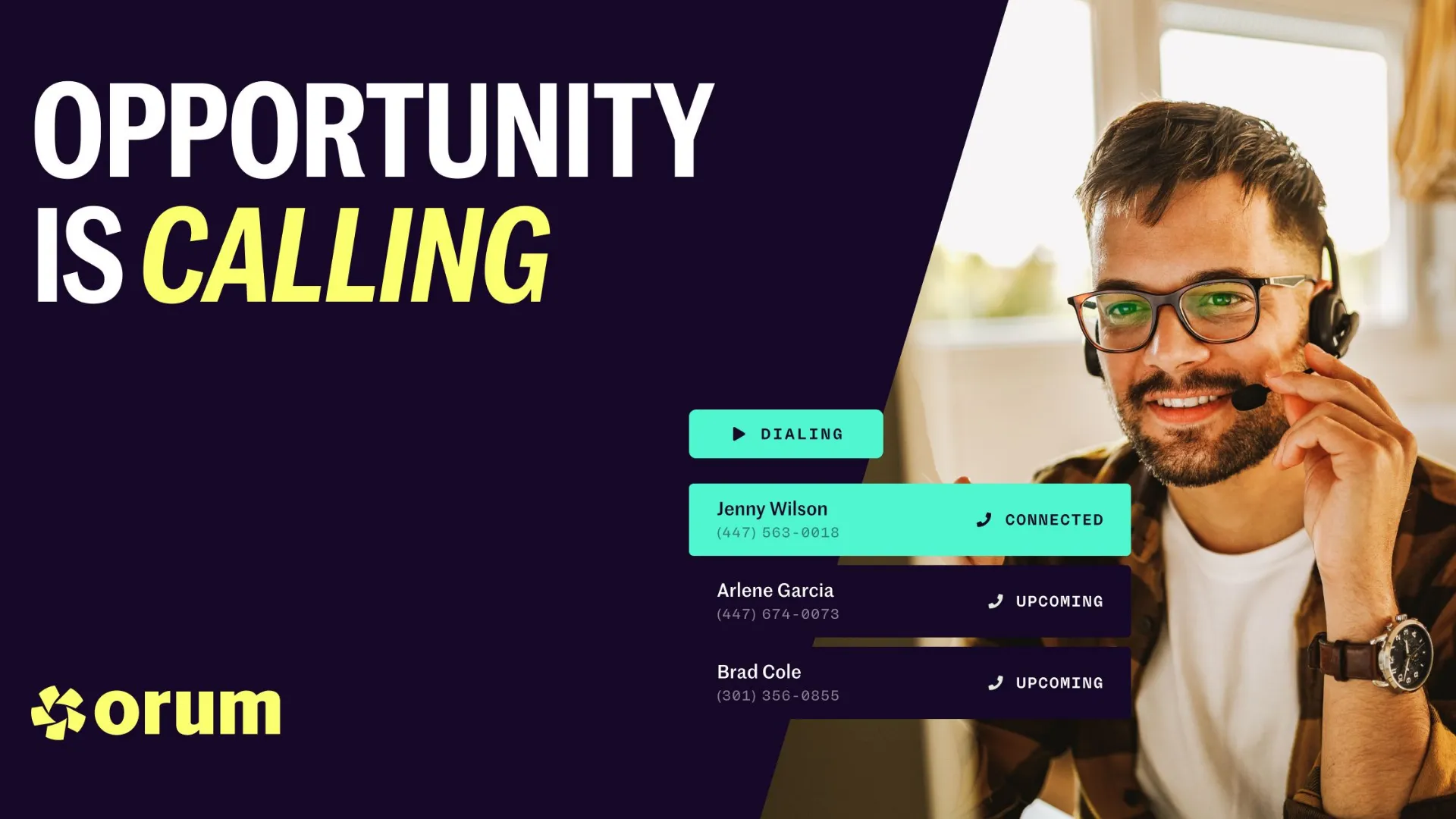
Orum is a parallel dialer built for outbound sales organizations that care about one metric above almost everything else, live conversations per hour. Rather than calling one prospect at a time, the platform dials multiple numbers simultaneously and only connects the representative once a real person answers.
Who is it for?
Mid sized and enterprise SDR teams with ten or more representatives that spend most of the day cold calling B2B prospects and want to maximize conversation volume without hiring additional reps.
For sales teams that prioritize conversation volume above everything else, Orum is one of the first platforms to consider.
It is a common fit for outbound SaaS SDR teams that dial through large prospect lists.
The benefit isn't simply dialing more numbers. With up to five lines dialing at once, representatives spend less time waiting between calls, and the platform handles repetitive steps such as voicemail detection automatically.
Managers also get a built in virtual sales floor. Rather than reviewing recordings several days later, they can jump into active conversations, coach representatives while momentum is still high, and identify patterns across the team.
Those capabilities make Orum one of the strongest options for companies searching for outbound dialers for sales automation where conversation volume directly impacts pipeline generation.
That said, the platform is not without tradeoffs.
As with any parallel dialer, watch the handoff between the prospect answering and the representative joining the call. If a prospect hears silence, they may hang up before the rep delivers an opening sentence.
Dropped conversations add up quickly across thousands of dials.
Data quality also becomes far more important with Orum than many buyers initially expect.
Running large amounts of low quality data through five simultaneous lines can burn through caller IDs and create number reputation problems faster than traditional single line dialing.
Organizations that already maintain clean prospect databases are in a better position to get value from it.
Pros
- Parallel dialing on up to five lines at once cuts the time reps spend waiting on unanswered calls.
- The virtual sales floor gives managers the ability to listen, coach, and review active calls without waiting for recordings after the workday ends.
- AI powered voicemail detection and phone tree navigation remove much of the repetitive downtime that slows outbound prospecting.
- Native Salesforce and Outreach integrations automatically synchronize call outcomes, helping representatives stay focused on selling instead of updating records.
Cons
- Orum publishes no prices (you request pricing) and lists a Minimum 9-Seat requirement, creating a fairly high entry point for smaller sales organizations.
- Calling is still the primary workflow, meaning companies will likely need separate software for email sequencing, prospect data, and CRM management.
Pricing
Orum publishes no prices: its pricing page asks you to request pricing, lists a Minimum 9-Seat requirement and sells AI Coaching as an add-on. Orum details checked October 2026.
Bottom line
Orum earns its reputation because it solves one problem exceptionally well.
It helps SDRs speak with far more prospects during a normal workday.
If your outbound strategy revolves around maximizing conversation volume, it remains one of the strongest auto dialer software options available today.
Companies looking for a complete sales call center software platform with built in email automation, richer multichannel engagement, or AI agents capable of handling conversations autonomously may find themselves adding several complementary tools around it.
That extra software increases overall cost, but for outbound teams where every additional conversation can produce more qualified meetings, many revenue leaders consider that investment worthwhile.
Predictive Dialer vs Power Dialer: Which Is Better for Sales Teams?
One question comes up almost every time companies begin evaluating outbound dialers for sales automation.
Should you choose a predictive dialer or a power dialer?
The answer depends less on company size and far more on how your sales organization operates each day.
A predictive dialer calls multiple prospects before an agent becomes available. Once someone answers, the system routes that live conversation to the next available representative. This approach works extremely well inside high volume call centers where efficiency and conversation volume matter more than personalization.
Power dialers work differently.
They place one call immediately after another without asking representatives to manually initiate every conversation. The rep stays in complete control of each interaction while eliminating the downtime that normally exists between calls.
Teams selling complex B2B products often prefer power dialers because representatives have a few seconds to review account information before speaking.
High volume lead generation teams usually lean toward predictive or parallel dialing because maximizing conversations has a larger impact on revenue than spending extra preparation time before every call.
There isn't one universal winner.
The better choice depends on your sales motion, your compliance requirements, your average deal value, and how personalized each conversation needs to be.
3. PhoneBurner: Best Single Line Power Dialer for B2B Sales
What does it do?
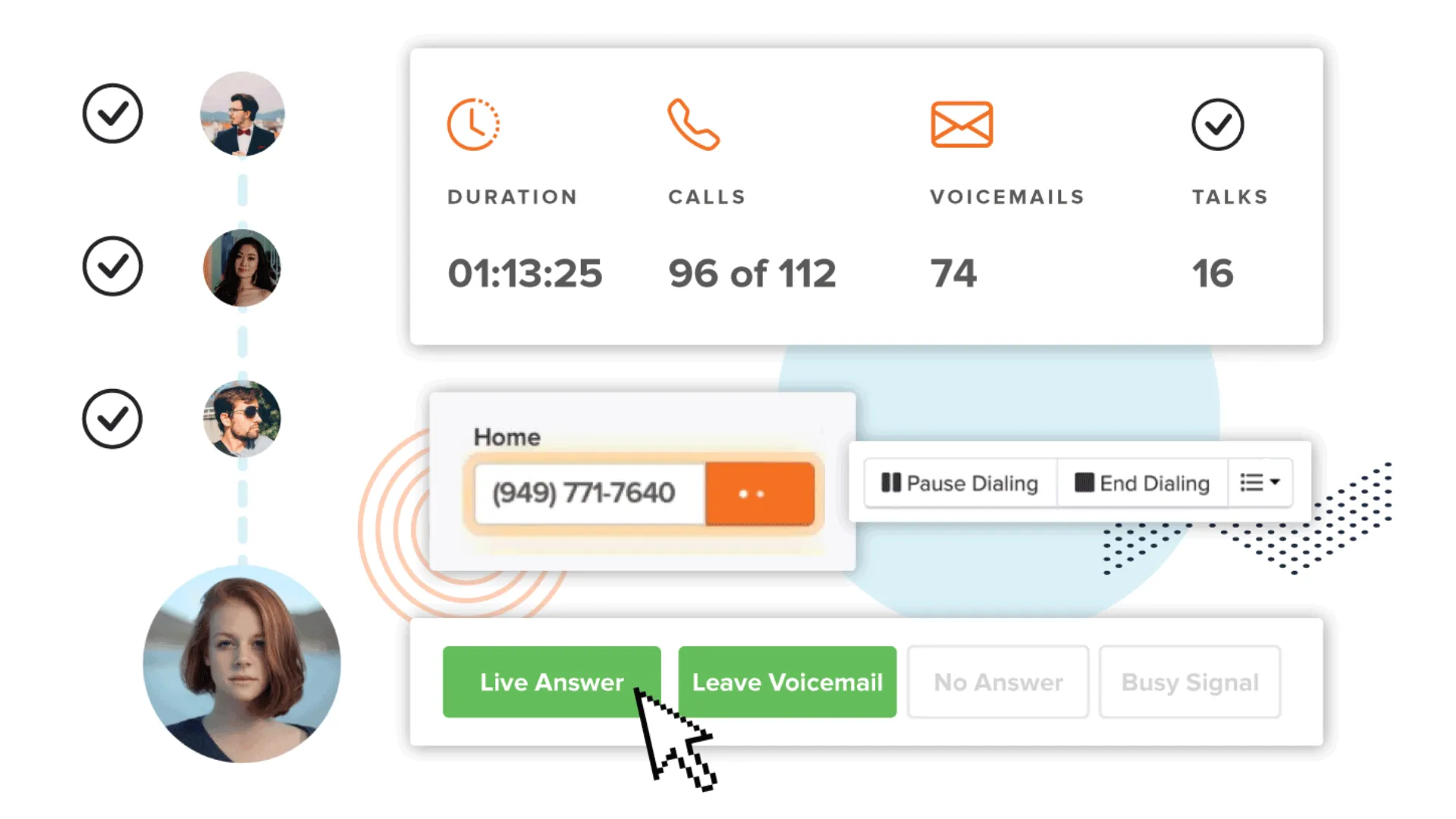
PhoneBurner is a cloud based power dialer software designed to eliminate the downtime between outbound calls. It keeps representatives moving from one conversation to the next without introducing the bridge delays that sometimes appear with parallel dialing platforms.
Who is it for?
Small and mid market B2B sales teams, financial services firms, agencies, and inside sales organizations that value high quality conversations more than dialing as many numbers as possible every hour.
PhoneBurner approaches outbound calling very differently from parallel dialers.
Rather than placing five or ten calls simultaneously, it concentrates on making every live connection feel natural from the moment the prospect answers.
Its bigger emphasis is the quality of the conversations.
Unlike several parallel dialers that introduce a noticeable pause before the representative joins the call, PhoneBurner bridges prospects almost instantly. A short bridge announcement plays while the representative reviews the contact record, giving them enough time to personalize their opening without forcing the prospect to sit through uncomfortable silence.
It sounds like a small design decision.
Those extra couple of seconds can make calls feel considerably more natural.
Prospects immediately hear a confident introduction rather than wondering if someone had accidentally called them.
Another area PhoneBurner focuses on is caller reputation.
Its ARMOR spam protection is designed to keep numbers off spam labeling services, which helps maintain stable answer rates, something many companies overlook when evaluating outbound call automation platforms.
A dialer that delivers high call volume loses much of its value if recipients stop answering because your numbers are flagged as spam.
The platform also simplifies administrative work.
Calls, voicemails, emails, SMS activity, and dispositions synchronize automatically across CRM platforms, allowing representatives to move directly into the next conversation without spending several minutes updating records.
For companies researching the best outbound dialers with CRM integration for sales automation, PhoneBurner remains one of the strongest choices in the mid market.
Pros
- Immediate connection when a prospect answers avoids the awkward silence commonly associated with many parallel dialers.
- ARMOR spam protection and Connect Scores help maintain healthy caller reputation.
- Built in CRM capabilities along with more than 150 integrations automatically logged calls, voicemail drops, emails, and SMS activity.
- Unlimited dialing with no additional per minute charges makes budgeting straightforward for outbound teams placing large call volumes.
- Representatives can review contact information before speaking, leading to more personalized introductions and stronger first impressions.
Cons
- Pricing ranges from approximately $149 to $165 per representative each month, making it a significant investment for smaller teams.
- International dialing is unavailable, limiting adoption for organizations selling outside the United States and Canada.
- The sixty minute trial provides limited opportunity to stress test the platform under real campaign conditions.
- Inbound functionality and more advanced SMS capabilities require the Premium plan, increasing total subscription costs.
Pricing
Standard starts at $165 per user each month, or approximately $140 with annual billing.
Professional costs $195 per user monthly, or around $165 annually.
Premium starts at $215 per representative each month, or roughly $183 with annual billing.
Bottom line
PhoneBurner remains one of the strongest auto dialer software platforms for sales organizations that believe conversation quality matters just as much as conversation volume.
Representatives spend less time waiting between calls, managers spend less time cleaning CRM data, and prospects experience a smoother interaction from the moment they answer the phone.
Companies searching for sales call center software built specifically around outbound prospecting will appreciate its reliability, ease of deployment, and mature CRM ecosystem.
Organizations running global sales teams or looking for extensive multichannel outreach may eventually outgrow its capabilities, but for North American outbound teams it continues to be one of the most dependable options available.
What Is an Outbound Dialer and How Does It Work for Sales Automation?
This is one of the most common questions revenue leaders ask after seeing modern outbound platforms in action.
At a basic level, an outbound dialer automates the repetitive work involved in placing sales calls.
Without one, representatives manually search for contact records, dial phone numbers, wait through ringing, listen to voicemail greetings, leave messages, update the CRM, then repeat the process hundreds of times throughout the day.
Only a small portion of that workflow involves speaking with prospects.
Everything else is administrative overhead.
Modern outbound dialers for sales automation remove much of that repetitive work.
The software automatically places calls, detects answering machines, skips disconnected numbers, records outcomes, updates CRM records, schedules follow ups, and routes representatives directly to live prospects whenever possible.
The amount of automation depends on the type of dialer.
A power dialer places one call immediately after another, helping representatives maintain momentum without manually dialing every contact.
A predictive dialer analyzes agent availability and places multiple calls ahead of time, connecting representatives only when someone answers.
Parallel dialers push that concept even further, dialing several numbers simultaneously to maximize live conversations.
Many modern platforms also include AI capabilities.
These systems can summarize conversations, recommend coaching tips during live calls, generate follow up emails, update CRM fields automatically, and in some cases even conduct conversations without a human representative participating.
4. Five9: Best Enterprise Predictive Dialer for 50 Plus Seat Contact Centers
What does it do?
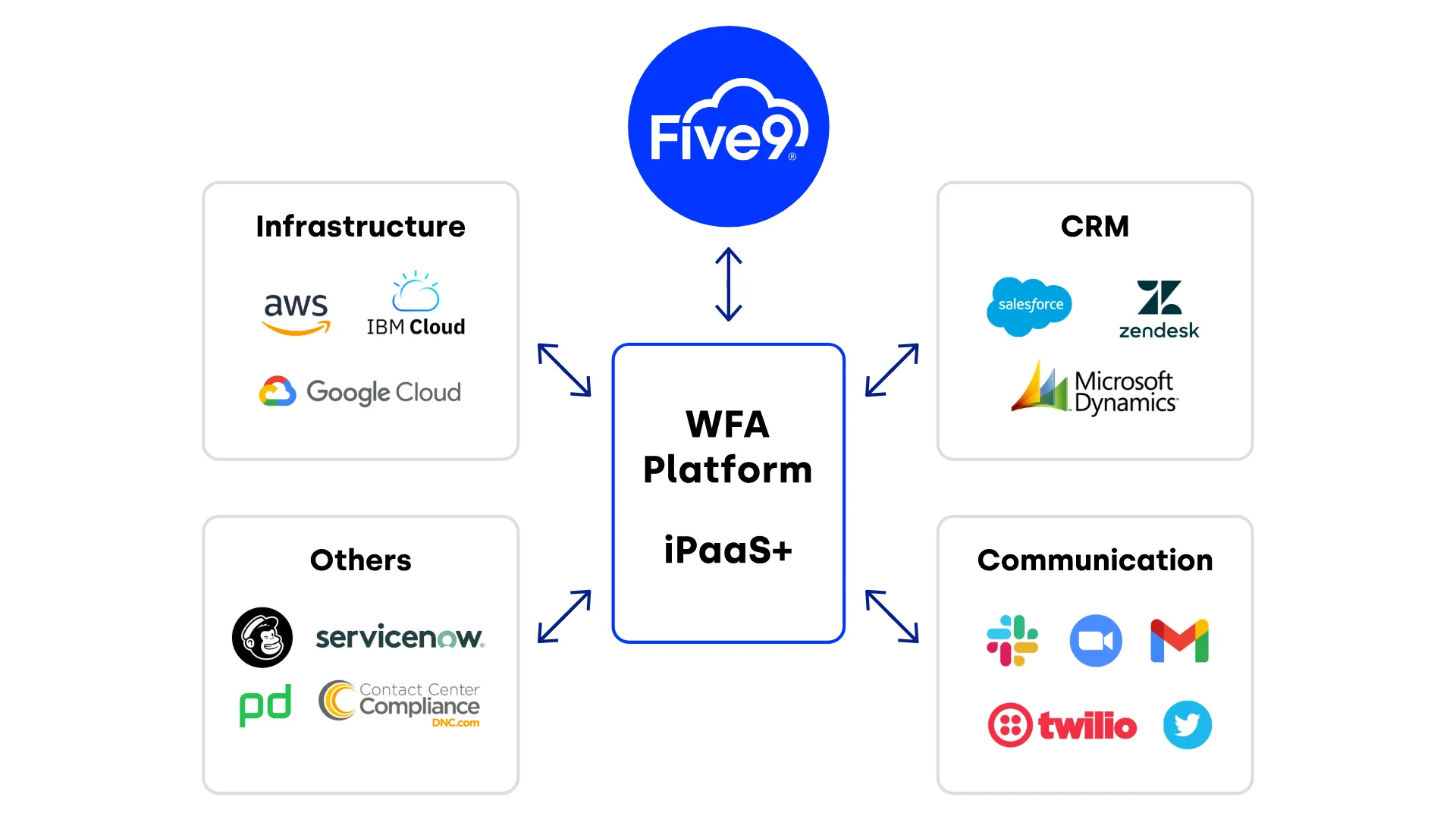
Five9 is an enterprise grade cloud contact center platform that combines predictive, progressive, preview, and power dialing with workforce management, IVR, AI assistance, analytics, and inbound support. It is built for organizations that want most of their customer communication tools inside one platform.
Who is it for?
Large contact centers, insurance providers, financial institutions, healthcare organizations, and enterprise sales teams operating with fifty or more agents.
Five9 has been part of the contact center market for years, and it is clear why so many enterprise organizations continue to rely on the platform.
Its biggest strength is maturity.
Many newer AI platforms specialize in outbound prospecting, while Five9 attempts to cover nearly every communication workflow inside a large organization.
In blended contact centers, agents constantly move between inbound customer conversations and outbound calls, which makes pacing accuracy far more important than raw dialing speed.
Five9’s predictive dialer is built for that balancing act.
Pacing controls help keep abandoned calls below the FTC safe harbor threshold of three percent while still keeping representatives busy throughout the day.
Another notable feature is AI Agent Assist.
Rather than forcing agents to write detailed summaries after every conversation, the platform generates call notes automatically and suggests follow up actions before the next interaction even starts.
Across thousands of customer interactions every month, small savings in post call work add up.
For enterprise organizations evaluating a predictive dialer for sales teams operating at scale, those operational efficiencies matter.
Where Five9 is less attractive is cost.
The advertised subscription pricing only tells part of the story.
Smaller companies should pay close attention to those additional expenses before making a decision.
Pros
- Predictive, progressive, preview, and power dialing are all available inside one enterprise platform, giving managers flexibility across different campaign types.
- Intelligent pacing helps keep abandoned call rates below the FTC three percent guideline.
- AI Agent Assist generated summaries, recommendations, and call notes automatically, reducing post call administrative work.
- Enterprise security features include SSO, HIPAA support, PCI DSS compliance, SRTP encryption, and detailed role based permissions.
Cons
- Public pricing only covers the entry level plans, while many enterprise features require separate quotes from the sales team.
- The recommended deployment begins at approximately fifty seats, making it difficult for growing businesses to justify.
- CRM integrations with Salesforce, ServiceNow, Zendesk, and other platforms often carry additional licensing costs.
- Full implementation commonly takes between six and twelve weeks, considerably longer than many AI native outbound platforms.
Pricing
Digital starts around $119 per user each month.
Core starts around $159 per user each month.
Premium, Optimum, and Ultimate require custom enterprise quotes.
Most organizations receive the strongest pricing under thirty six month agreements with approximately fifty seats or more.
Bottom line
Five9 remains one of the strongest choices for enterprise organizations searching for comprehensive sales call center software rather than a standalone outbound dialer.
Its compliance controls, predictive pacing, security certifications, and blended communication capabilities make it particularly attractive for regulated industries where reliability carries more weight than maximizing outbound conversations alone.
Growing SaaS companies with smaller sales teams may find lighter AI driven platforms easier to deploy and considerably less expensive.
5. Convoso: Best Compliance Heavy Dialer for Lead Generation
What does it do?
Convoso is an outbound contact center platform built around high volume calling. It combines predictive, progressive, preview, power, and manual dialing with reputation management, compliance controls, lead distribution, and reporting tools designed for industries that place thousands of outbound calls every day.
Who is it for?
Insurance agencies, solar companies, lead generation firms, BPOs, financial services organizations, and sales teams where compliance carries as much importance as call volume.
Some outbound platforms win because they produce more conversations.
Convoso earns its place for a different reason.
It helps organizations keep those conversations compliant.
That becomes increasingly valuable as outbound regulations continue becoming more complex across different states and industries.
Purchased lists usually expose weaknesses in dialing platforms very quickly.
Caller reputation drops faster, spam labeling becomes more common, and poor data quality increases compliance risk.
Convoso is built for those conditions.
Dynamic caller ID rotation is designed to protect answer rates when the quality of the underlying data is inconsistent.
The reputation management dashboard is particularly useful.
It identifies outbound numbers that start receiving spam labels so they can be rotated out.
The compliance features matter just as much.
Automatic Do Not Call scrubbing, state specific calling windows, and built in Florida Telephone Solicitation Act settings are built to run without constant supervision.
For organizations placing hundreds of thousands of outbound calls every month, those safeguards reduce both administrative work and legal exposure.
The platform does demand a greater time investment during implementation.
Compared with simpler cloud dialers, administrators need a deeper understanding of campaign configuration before everything begins running smoothly.
Organizations with experienced operations teams usually adapt quickly.
Smaller companies without dedicated administrators may find the learning curve steeper.
Pros
- Predictive, progressive, preview, manual, and power dialing are available inside one platform, giving managers flexibility across different campaign types.
- Reputation management automatically rotates flagged caller IDs before declining answer rates begin affecting campaign performance.
- Automatic Do Not Call scrubbing and state specific calling windows reduce compliance work considerably.
- Answering machine detection keeps representatives off calls that reach voicemail during predictive dialing campaigns.
- Built for industries handling large outbound volumes where compliance requirements are part of everyday operations.
Cons
- Pricing is custom quoted, making budgeting more difficult before speaking with the sales team.
- Free trial availability generally starts around forty seats, limiting accessibility for smaller businesses.
- Initial configuration commonly takes two to three weeks before administrators become comfortable managing campaigns independently.
- The administrative interface requires more training than several newer cloud based competitors.
Pricing
Pricing typically starts around $90 per user each month, based on industry estimates and deployment size.
Final costs depend on seat count, telephony requirements, feature selection, and contract length.
Carrier fees are billed separately.
Bottom line
Convoso shines when compliance sits near the top of the buying criteria.
Companies operating in insurance, solar, healthcare, financial services, and outsourced lead generation often face regulations that leave very little room for error.
Its combination of reputation management, compliance automation, flexible dialing modes, and campaign controls makes it one of the stronger sales call center software solutions for organizations handling large outbound operations.
6. JustCall: Best Mid Market Dialer Under $100 Per Seat
What does it do?
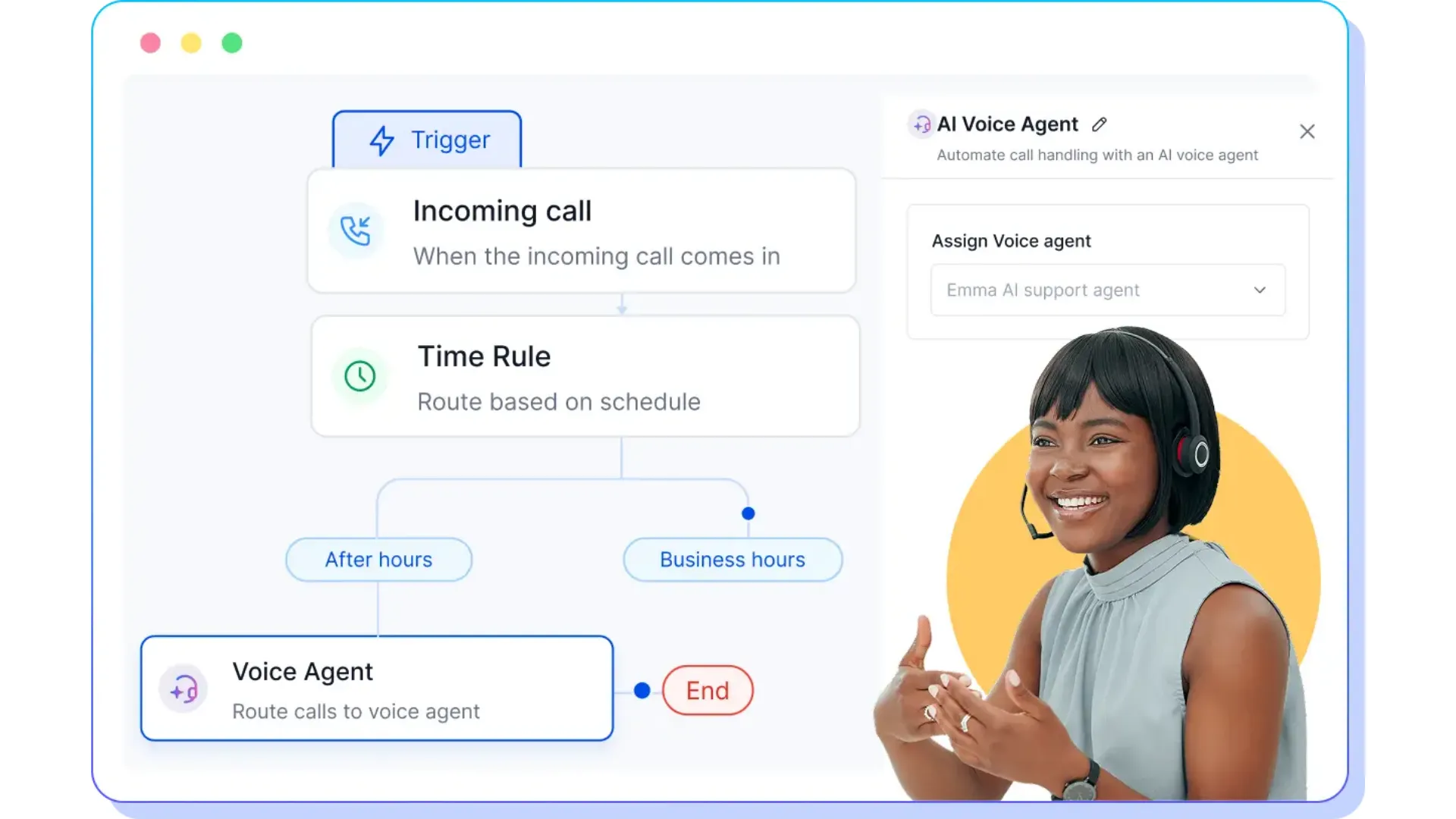
JustCall combines cloud telephony, outbound dialing, SMS, WhatsApp messaging, AI transcription, and CRM synchronization into one affordable communications platform. It offers power dialing, predictive dialing, and dynamic dialing capabilities without enterprise level pricing.
Who is it for?
Sales teams, customer success departments, recruiting firms, agencies, and growing businesses with approximately five to thirty representatives looking for a capable outbound platform without stretching the software budget.
JustCall occupies an interesting position in the market.
Many platforms force buyers into one of two categories.
You either purchase an expensive enterprise contact center platform or settle for a basic business phone system with limited automation.
JustCall sits comfortably between those extremes.
The built in Sales Dialer handles repetitive dialing tasks automatically.
The value comes from more than dialing speed.
Conversations sync with HubSpot, complete with transcripts, dispositions, recordings, and notes.
That removes most of the manual CRM updates after each call.
There are a few limitations worth considering before making a purchase.
HIPAA compliance is reserved for higher tier enterprise plans with minimum license requirements, limiting adoption for smaller healthcare organizations.
The unlimited calling policy also includes fair usage limits.
Heavy outbound teams should keep that policy in mind before assuming unlimited means unrestricted.
Pros
- Competitive pricing makes advanced dialing features accessible to growing sales organizations.
- Strong HubSpot and Salesforce integrations automatically synchronize calls, recordings, transcripts, and dispositions.
- SMS, WhatsApp, voice, and AI transcription work together inside one communication platform.
- Fourteen day trial provides enough time to evaluate the software during live campaigns.
- AI Voice Agent offers an entry point for businesses beginning to experiment with conversational AI.
Cons
- Sales Dialer requires the Pro subscription, while lower priced plans include only basic calling functionality.
- Fair usage limits may trigger additional charges for organizations placing extremely high outbound call volumes.
- HIPAA support requires enterprise licensing with minimum seat commitments.
- AI Voice Agent usage is billed separately from the core subscription.
Pricing
Team starts at $29 per user each month.
Pro starts at $49 per user each month, which includes the Sales Dialer.
Pro Plus starts at $89 per user each month.
Business pricing is available through custom quotes with minimum licensing requirements.
Bottom line
JustCall delivers an impressive balance between features, usability, and affordability.
Growing companies searching for reliable auto dialer software without enterprise pricing will find plenty to like here.
It offers enough automation to improve productivity, enough CRM connectivity to eliminate repetitive administration, and enough communication channels to support modern outbound prospecting without forcing buyers into six figure annual software commitments.
How We Evaluated These Outbound Dialer Platforms?
There is no shortage of software comparison articles that rank products based on feature lists alone.
That approach rarely tells you what it feels like to run an outbound team every day.
Two platforms can both advertise AI coaching, CRM integrations, predictive dialing, and compliance features, yet produce completely different experiences once hundreds or thousands of calls start flowing through the system.
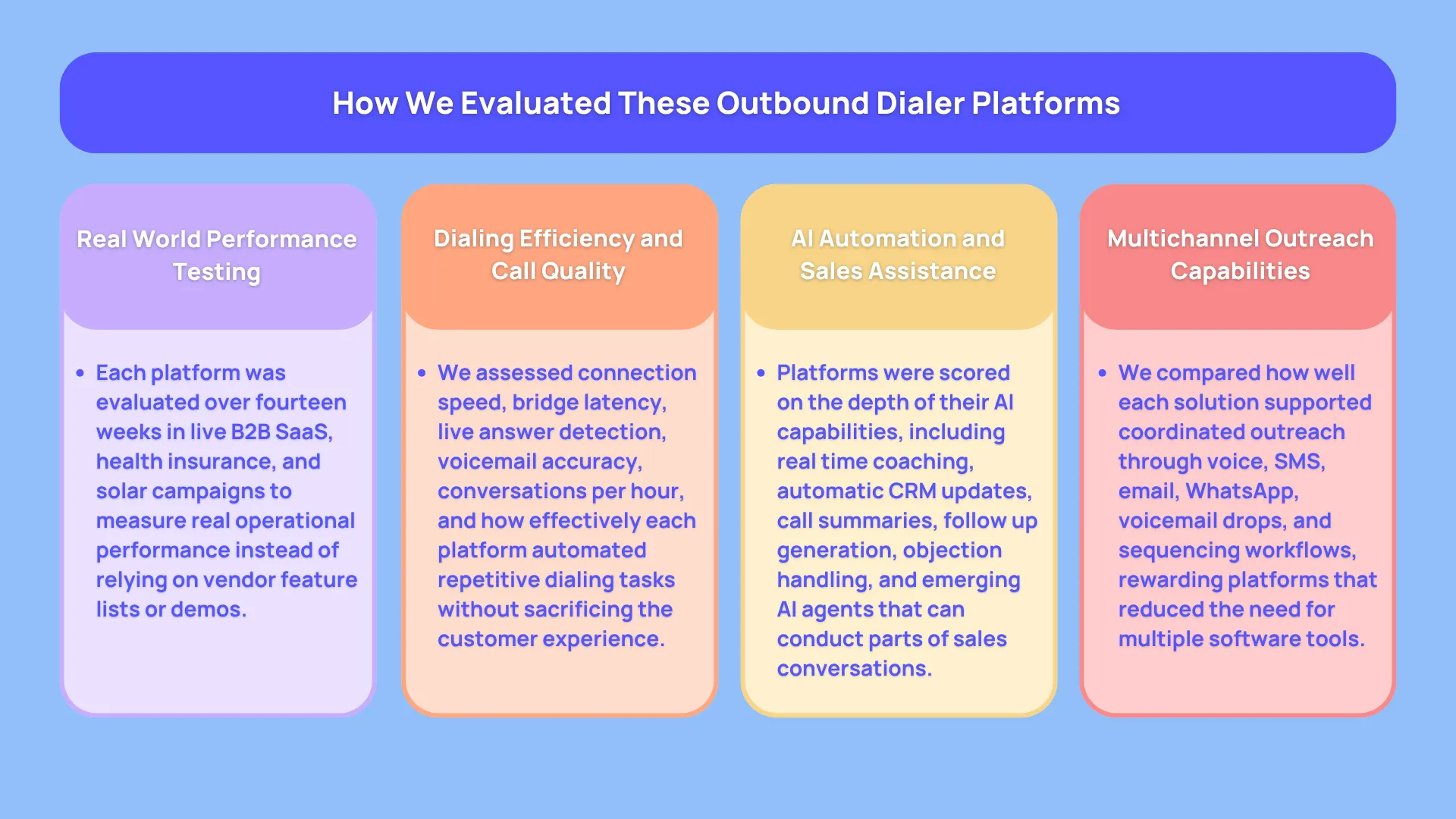
That is why this comparison concentrates on day to day operational fit rather than marketing checklists.
We looked at how each platform is built to handle very different calling environments, from B2B SaaS prospecting to insurance outreach and high volume lead generation.
Every platform was compared across these categories.
1. Dialing speed and automation
The first question is how efficiently each platform moves representatives from one live conversation to the next.
Raw dialing speed tells only part of the story.
Connection quality matters just as much.
Some outbound dialers for sales automation can place several calls simultaneously, but if prospects hear silence before the representative joins, many conversations end before they even begin.
Indicators worth checking include:
- Average time between one completed call and the next outbound attempt.
- Live answer detection accuracy.
- Voicemail detection reliability.
- Bridge latency between prospect pickup and representative connection.
- Average live conversations generated per hour.
Platforms that connect representatives almost immediately after a prospect answers give the prospect a better first impression.
Noticeable delays count against a platform because even a one or two second pause can reduce engagement and increase abandoned conversations.
We also looked at how well each platform automates repetitive dialing tasks without requiring representatives to intervene throughout the day.
2. AI capabilities and automation depth
AI appears in almost every software demo today.
The quality of that AI varies dramatically.
Some platforms simply generate transcripts after conversations finish.
Others actively support representatives while calls are taking place.
The strongest platforms go considerably further.
They provide real time coaching, summarize conversations automatically, update CRM records, generate follow up activities, surface objection handling guidance, and reduce administrative work without interrupting the representative's workflow.
We also considered an increasingly important question.
Can the software conduct conversations on its own?
Several vendors continue positioning AI as an assistant sitting beside human representatives.
Newer platforms have begun introducing conversational AI agents capable of qualifying leads, booking appointments, answering questions, and handling portions of outbound prospecting independently.
As outbound call automation continues evolving, those capabilities will play a much larger role in software purchasing decisions.
3. Multichannel engagement
Cold calling rarely succeeds through one conversation alone.
Many prospects answer after receiving an email.
Others respond after seeing a text message.
Some return calls after multiple touchpoints spread across several days.
That makes multichannel engagement an important part of modern outbound prospecting.
We looked closely at how each platform handled communication beyond voice.
Areas included:
- SMS automation.
- Email follow up.
- WhatsApp messaging.
- Automated voicemail drops.
- Sequencing workflows.
- Follow up scheduling.
Platforms offering several communication channels inside one environment rank higher here because they reduce the need for separate software subscriptions.
Businesses looking for complete sales call center software increasingly expect these capabilities as standard functionality rather than premium add ons.