When Two Buyers at One Account Tell You Different Things
Separate a contact's observation from an account-wide conclusion, with a worked example and a copyable note for the next caller.
On this page
Two people at the same company can give you different answers without either of them being wrong. One says the team is replacing a tool. Another says there’s no project. Before the next call, keep both statements intact and work out what each person was actually describing.
The mistake is turning the more exciting answer into the account’s official position. A promising conversation becomes “active evaluation” in a note, another rep repeats it, and the next buyer has to correct a story they never told you.
Use a short comparison note: who said it, what they were talking about, when it applied, and what needs checking. You’re not trying to decide which colleague to believe. You’re deciding what you can responsibly say and ask next.
Check whether the answers are about the same thing
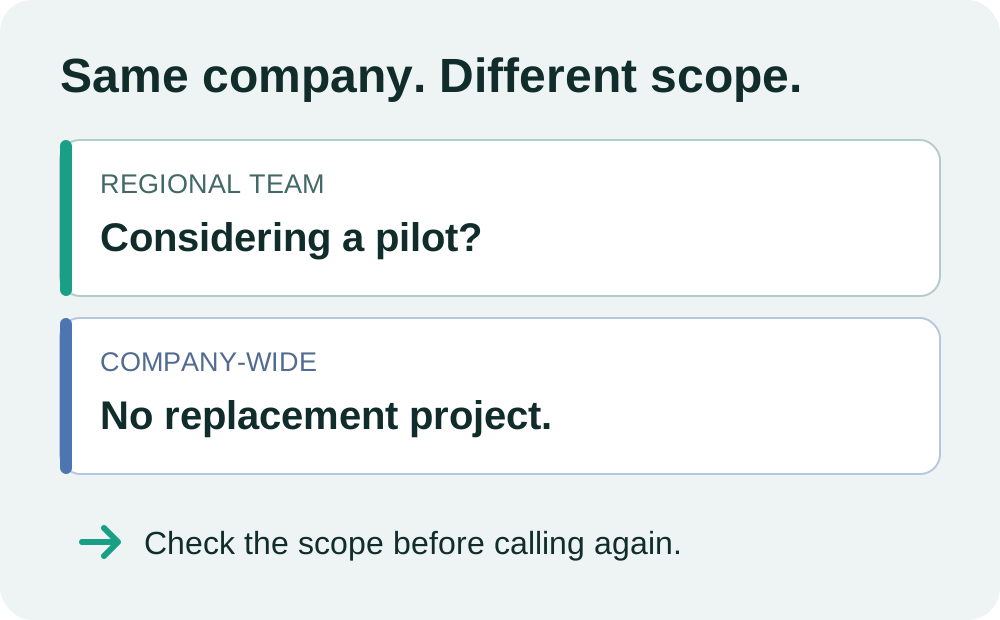
Consider a fictional account, Northbank. On Monday, an operations manager tells an SDR that her team is looking at a different calling tool. On Wednesday, the sales director says the company isn’t replacing its dialer.
Those notes look contradictory until you ask what “team” and “replacing” mean. Operations might be considering a small pilot for one group. The director might mean there’s no company-wide procurement project. Or Monday’s idea might have been stopped on Tuesday. The SDR might also have misunderstood an exploratory question as a decision.
Keep those possibilities as possibilities. Don’t repair the record by choosing the explanation you like best.
Start with four checks. Are they discussing the same business unit? The same workflow? The same period? The same level of commitment? A question about available options, permission to run a pilot and an approved purchase are different things.
Put both conversations in one useful account note
For this fictional example, the useful record could look like this:
- Monday, operations manager: described manual work in the regional outbound team and asked whether a different calling setup could help. SDR paraphrase. No budget or purchasing approval discussed.
- Wednesday, sales director: said there is no company-wide dialer replacement project. No discussion of a regional pilot.
- Unresolved: whether the operations manager is exploring independently, whether a regional pilot is permitted, and whether the director’s statement covers that smaller workflow.
- Next action: the account owner checks the scope with the operations manager before describing this as an evaluation to anyone else.
This doesn’t need a new CRM object. Use the account record and linked contact notes your team already maintains. Preserve access controls and reference the original activity rather than copying private call details into a separate spreadsheet.
Where wording matters, use a short exact quotation only if it is available from a permitted source. Otherwise write “paraphrase.” Memory is not a transcript, and a polished summary should not acquire quotation marks just because it sounds plausible.
Separate three kinds of disagreement
The scope is different
A regional manager’s problem is not automatically a company-wide priority. A salesperson’s interest is not a purchasing committee’s agreement. Keep the local problem useful without enlarging it.
A reasonable next question in the Northbank example is: “When you mentioned looking at the calling setup, was that for your regional team, or is there a wider project?” That gives the manager room to explain the work without asking them to defend what a colleague said.
If the scope is local, change the account summary accordingly: one team is exploring a problem; company-wide replacement is not confirmed. That is still something an AE can prepare for.
The information changed
Dates matter. A project can be paused, an owner can change, or a buyer can discover that a constraint makes the earlier idea impractical. Don’t leave the older note undated next to the newer one and force the next rep to guess.
Ask a neutral update question: “Is the regional pilot still something you’re considering, or has that changed since we last spoke?” If it changed, record when you learned that and what remains agreed. Preserve the original note as history rather than rewriting the earlier conversation.
The interpretation was stronger than the statement
Sometimes the conflict is inside the seller’s notes. “Can you send the integration details?” became “technical evaluation.” “We’re busy this quarter” became “budget next quarter.” Neither conclusion follows on its own.
Return to the buyer’s actual statement. Correct the summary, make the uncertainty visible, and choose a question that fills the gap. You don’t need to make another call just to rescue the original label.
Don’t use one stakeholder’s name as leverage
“Your colleague told me this is a priority” can turn a useful clarification into an internal argument. It can also disclose context that was shared for a narrower purpose.
Explain the workflow you are checking, not the case you are trying to win. For example: “I’m trying to understand whether the regional outbound process is being reviewed separately from the wider calling setup. Which team should I speak with about that?”
If bringing people together would help, ask whether they want a joint conversation and what it should cover. Don’t add a colleague to an invite or forward a recording simply because two accounts of the situation differ. Follow the team’s normal sharing rules.
Give the next caller a question, not a verdict
An account summary is most useful when it distinguishes what the team knows from what the next person must find out. “No interest” and “active opportunity” are both poor substitutes for an unresolved scope question.
For Northbank, the next-call brief might say: “Regional operations manager described manual calling work and requested setup information. Director confirmed no company-wide replacement. Need to establish whether a regional pilot is in scope. No budget, buying timetable or joint meeting agreed.”
That brief tells the AE where to begin without forcing the buyer to undo a fictional consensus. The separate SDR-to-AE meeting brief is useful once a meeting and its agenda are actually agreed.
Use a five-minute account check before the next block
Copy this note into the account record your team uses. Link the original contact activities so the next caller can check the context.
- Statements: Who said each thing, on what date, and where is the original activity? Mark quotations and paraphrases correctly.
- Scope: Which team, workflow, period and level of commitment did each person describe?
- What needs checking: Is this a real disagreement, a change over time, or an interpretation we added? Write the question that would help distinguish them.
- Next caller: Who will check, with whom, and before which agreed next step? Leave any buying decision or timetable unconfirmed until it is actually established.
Pick one account where the notes don’t line up. Read the original contact activities, not just the latest account summary. Fill in the speaker, scope, date and remaining question for each important statement.
Then ask the next caller to explain the account in two sentences. Can they do it without presenting one person’s opinion as the company’s decision? Can they name the question they need to ask?
If two reps are about to contact the same person, resolve that separately with the call-ownership worksheet. Knowing what to ask doesn’t settle who should call. Likewise, an account map helps identify relationships, but a job title does not prove who owns a specific decision.
The goal is a conversation that starts from what the buyer actually said. You can be curious about the rest without writing it down as settled fact.