Shadow a Sales Call Without Taking It Over
Give the rep and observer clear roles before a live call, then turn one specific moment into a useful coaching discussion.
On this page
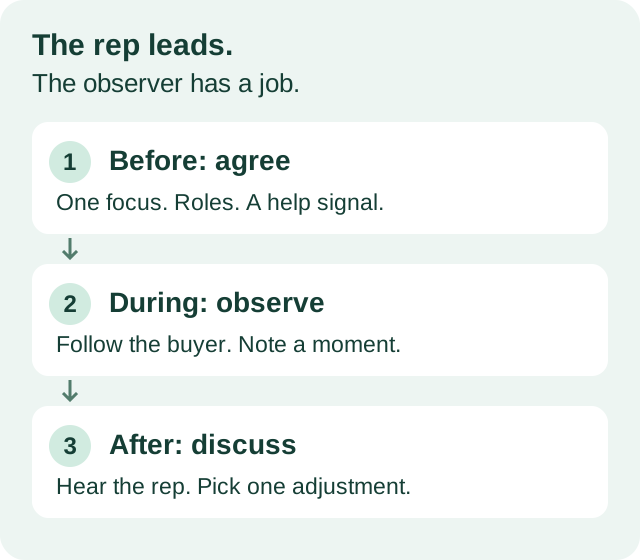
Before someone shadows a sales call, decide who owns the conversation. The rep should not have to guess whether a manager's message is an instruction, a suggestion or a note for later. The observer should not have to guess whether staying quiet is helpful or neglectful.
Agree on one learning focus, a permitted way to observe, a clear way to ask for help and a short review afterward. Most ordinary coaching can wait until the prospect has finished speaking. If the observer needs to become a participant, make that change deliberate rather than quietly handing the conversation to the most senior person.
This guide is for a manager, peer coach or new hire observing a rep's live call. The example and worksheets are suggested working practices, not a report of customer results. Use your organization's approved listening, participation and information-handling procedures.
Choose what the observer is there to learn
“See how I do it” is a loose brief. It can turn into a running commentary on everything from the opener to the rep's typing. Choose a narrower question: How does the rep find out what happens when the current process breaks? How do they respond when someone says they already have a supplier? How do they turn an interested reply into a mutually understood next step?
Give the observer enough context to recognize the moment. Explain whether this is a first call, a promised callback or a conversation about an existing project. The same question can be helpful in one setting and repetitive in another. Don't ask someone to judge discovery as if the rep were starting from zero when the buyer already explained the problem yesterday.
For a new hire, the focus might be noticing the buyer's answer rather than evaluating the rep. Ask them to bring back the question, the answer and what the rep did with it. They don't need to copy the experienced rep's personality or memorize every sentence.
For an experienced rep, agree on the behavior they want help with. “Watch whether I ask what they mean before defending our approach” gives both people something observable. “Tell me if I'm good at objection handling” invites a much less useful verdict.
Check that live observation is the right format
A live call is not a lesson you can pause whenever someone has a question. If the observer needs a detailed explanation of the product, account history or basic calling workflow, cover that before the call. If they need to discuss every exchange, a permitted recording or a fictional practice conversation may be a better starting point.
Use only the listening or meeting arrangements your team is authorized to use. Check required permissions, participant notices and company rules before observation starts. A silent connection or an available recording control does not settle those requirements. If the arrangement is unclear, use a practice session or ask the responsible internal owner rather than improvising on a buyer's call.
Keep the audience small enough to serve the purpose. One new hire learning a question sequence and a manager reviewing an agreed skill have different roles. An unannounced crowd is not a training plan. There may also be calls that are unsuitable for this session because of their subject or the participants' expectations.
If asynchronous review is the better choice, the call-selection guide helps choose a useful complete exchange. Don't make live attendance a requirement just because that is how the session was first scheduled.
Agree how the rep requests help
Agree how the rep can ask for help using the team's existing approved tools. Keep the signal simple enough to use while listening. It might be a short internal message at a natural pause or a request to bring the colleague into the discussion. Verify who can see or hear it. Don't assume a channel is private because it looks separate on your screen.
Also agree what unsolicited guidance means. A suggestion is not an instruction to stop listening to the buyer and read the manager's message aloud. The rep needs room to decide whether the cue still fits. A question sent ten seconds ago may be irrelevant after the prospect answers it.
For ordinary developmental feedback, the observer can save a note instead. Three simultaneous prompts can leave the rep trying to satisfy a coach while the prospect is describing something important. If two observers are necessary, choose one person to coordinate any live guidance. The other can bring observations to the review.
Set a stopping rule for the coaching arrangement, too. If the rep cannot follow both the conversation and the messages, stop the commentary. Finish the call normally, then change the arrangement before the next one. Don't interpret an unread message as resistance to feedback.
Separate a coaching opportunity from a reason to step in
Not every imperfect answer needs an immediate correction. A missed follow-up question usually belongs in the review. A claim the rep cannot verify needs a different response. An urgent concern involving security, sensitive information or a binding commitment belongs with the team's established escalation procedure, not an improvised coaching rule.
- The rep misses a useful question: note the moment and discuss it afterward unless they ask for help. The buyer's next answer may change what question is useful anyway.
- The buyer asks for a technical detail nobody has confirmed: let the rep acknowledge the uncertainty and arrange a follow-up. The observer should not supply a confident guess just to keep the call moving.
- The rep asks the observer to answer: clarify the handover through the approved participation method. Say who is contributing and why, then return the conversation to its agreed owner.
- A serious concern needs immediate attention: follow the existing company process. The developmental goal does not override it.
These are decision prompts, not universal instructions for interrupting a call. The relevant product controls and company rules can differ. Before the session, ask the rep what situations they want help with and which situations require a different response regardless of preference.
A fictional call: the observer has a better question
Imagine Priya is making a first call to an operations manager. Her colleague Ellis is observing. Their focus is how Priya explores a problem before describing a replacement. They agree that Ellis will save ordinary suggestions for the review; Priya can ask for help if she needs it.
The buyer says, “We already use another supplier.” Priya answers, “That makes sense. What happens when a request changes after you've sent it over?” The buyer describes an exception that takes several emails to resolve. Ellis thinks Priya should ask how often it happens and starts writing a cue.
Before the message is ready, the buyer adds that this occurs only during a particular seasonal project. Priya asks who handles those projects. Ellis keeps the frequency question in the observation note instead of sending a stale instruction. Priya has followed the answer toward the people and work it affects.
Later, the buyer asks whether a specific system connection is available. Priya does not know. Ellis does not know either. Priya says she will check that exact requirement and return with an answer. The call does not need a rescue from someone who is equally uncertain.
When the buyer agrees to receive that answer, Priya confirms what information to send and the appropriate next contact. She records the promised follow-up through her normal workflow. Ellis's observation note is for the coaching discussion; it is not a substitute for the buyer's account record or an instruction to create another task.
The point of this example isn't that Priya handled every moment perfectly. It is that the observer had a useful thought without needing to take control. The review can examine whether frequency was worth asking about and what Priya learned from the seasonal detail. Neither person can infer the eventual sales result from this one conversation.
Write what happened before explaining what it means
A useful observation is small enough to check. “Asked who handles seasonal projects after the buyer described an exception” is more useful than “good discovery.” “Moved to a product explanation before asking about the buyer's process” gives the rep something to discuss; “talked too much” doesn't identify the choice you want them to reconsider.
Keep observation and interpretation separate. For the fictional call, Ellis might write:
Observed: the buyer introduced seasonal projects; Priya asked who handles them.
My question: would asking frequency here have clarified the importance, or interrupted a useful explanation?
Ask Priya: what were you trying to understand at that moment?
If you didn't hear part of the exchange, mark the gap. Don't fill it with a confident account of what the rep must have said. If you are paraphrasing, say so. Keep private buyer details in the appropriate approved record and use a permitted call reference in the coaching note.
Developmental observation is also different from formal scoring. If two reviewers need to apply the same criterion consistently, use a shared definition and the calibration process. Don't turn an informal shadowing visit into a surprise performance assessment.
Copy this short shadowing agreement
Complete the first part before the session. One agreement can cover a small group of suitable calls; revise it when the roles or purpose change.
Rep leading the conversation: ____
Observer and reason for attending: ____
Call context and one learning question: ____
Approved listening/participation arrangement checked by: ____
What the observer will record, and where: ____
How the rep asks for help: ____
When an unsolicited cue is appropriate: ____
How a deliberate handover works: ____
When to stop live commentary or use the existing escalation process: ____
Review time after buyer follow-up is handled: ____
For Priya and Ellis, the help entry could read: “Priya requests help through the approved internal channel at a natural pause. Ellis saves other suggestions for afterward. If Priya wants Ellis to answer, she introduces that contribution through the team's approved participation method.” This is a suggested agreement, not a claim about a particular calling tool's controls.
Afterward, add the observed moment, the rep's explanation and one thing to try. If the focus never arose, record that. A session without the relevant objection or question is not evidence that the rep has mastered or failed the behavior.
Let the rep explain the choice first
Start the review with the rep's account: “What were you trying to learn when you asked that?” Then offer the observation and your question. This gives the rep a chance to explain context the observer may not have had. It also makes it easier to distinguish a deliberate choice from a missing skill.
Choose one adjustment that fits a future situation. “When the buyer mentions a workaround, ask what happens when it fails before describing our approach” is usable. “Be more consultative” isn't. If the real problem was missing account context or an unanswered technical question, give that work an owner rather than assigning the rep a speaking exercise.
For a whole team closing a shared call block, use the Salesfloor debrief instead of repeating each person's detailed review in public. A sensitive individual discussion belongs in the appropriate private setting.
Trellus Salesfloor provides shared room chat and live listening alongside supported calling workflows. Confirm the listening permissions and setup for your team; a room does not decide when an observer should speak. Bring the shadowing agreement to a demonstration and ask how the rep requests help, how the observer follows the call and how both return to their own work.