
Sales Forecast Data Leakage: Could You Have Known It Then?
Separate event time, recorded availability, frozen forecasts and later labels before scoring historical opportunity forecasts.
On this page
A historical sales forecast should use information that was available when the forecast was made. If you rebuild it from today's CRM, later stage changes, corrected close dates and newly logged activities can slip into the inputs. The resulting score may describe hindsight rather than forecasting ability.
This is a form of data leakage. The scikit-learn guidance on leakage explains the general problem: using information that would not have been available at prediction time can make evaluation look too optimistic. The sales examples below apply that principle to historical opportunity records.
We will use a fictional two-opportunity example, then build a practical input audit. There is no real model, customer dataset or Trellus forecasting feature behind these numbers.
Write down when the prediction was supposed to happen
“Last month's forecast” isn't a complete specification. Choose the forecast cutoff, the outcome deadline and the question. A prediction made at the start of a month has different information available from one made on its final afternoon.
For this example, the team saves probabilities on March 1, 2026, at 09:00 UTC. Each row predicts whether an opportunity will be recorded as won by March 31 at 23:59:59 UTC. Later dated records establish the answer. The positive outcome is 1 for won by that deadline and 0 for not won by it.
An opportunity that wins in April is still 0 for this March question. A missing or disputed outcome is unresolved; it doesn't become 0 because the analyst can't find a record. Keep the eligible opportunities and the outcome rule fixed before comparing scores.
The outcome is supposed to become known later. Leakage happens when that later knowledge influences a prediction presented as having been made earlier. Keeping labels separate from historical inputs is therefore essential.
Two rows can reveal the hindsight shortcut
Imagine that both fictional opportunities were open and eligible on March 1. The team preserved its probabilities. After March ended, an analyst also exported the CRM's current probability field, which now reflects each opportunity's final status.
| Opportunity | Saved March 1 probability | Won by March 31? | Later CRM probability |
|---|---|---|---|
| A | 0.30 | 1 | 1.00 |
| B | 0.80 | 0 | 0.00 |
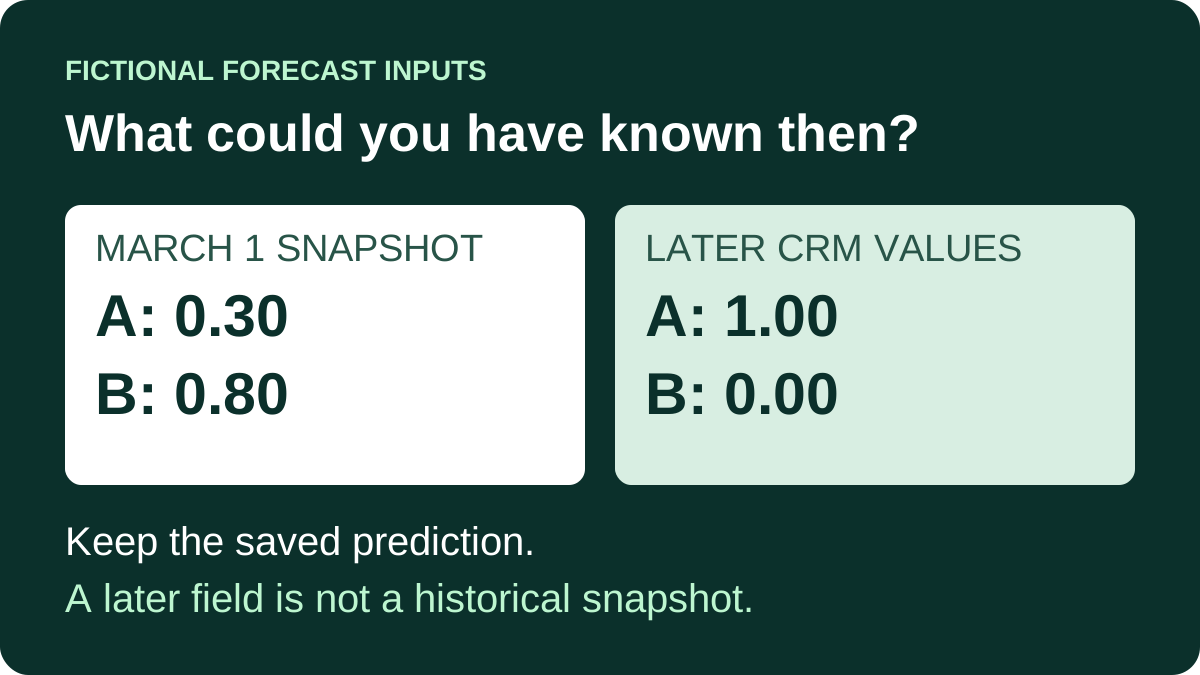
Using the binary Brier score, the saved forecasts have squared errors of (0.30 − 1)² = 0.49 and (0.80 − 0)² = 0.64. Their average is 0.565.
Substituting the later values gives (1 − 1)² = 0 and (0 − 0)² = 0, for an average of 0. The arithmetic is correct, but those values weren't the March 1 forecasts. A perfect result obtained by using final status isn't evidence of a perfect forecasting method.
This deliberately simple example shows the mistake. Two invented opportunities establish no real-world accuracy difference. In practice, leakage may be less obvious: a later close-date edit or a meeting logged after the cutoff can make a historical row look more informative without directly replacing the probability with the answer.
Check when the information became available
For each input, ask two questions: when did the underlying event occur, and when could the forecasting process actually use the information? Those timestamps can differ.
Suppose a fictional meeting happened on February 28 but wasn't entered into the system until March 3. A backtest reconstructed from the current activity list might include it in the March 1 inputs. A model reading that system on March 1 could not have used the newly entered record.
A rep might have known about the meeting at the time. If you are evaluating the rep's saved forecast, preserve that forecast. If you are reconstructing a system's historical inputs, use the information available to that system. Don't silently switch between the two questions.
Likewise, a field labelled “last contacted” may describe the latest contact as of today. It isn't automatically the value that existed at the old forecast cutoff. A current export with an old opportunity creation date does not establish a historical snapshot of every field.
Inspect the opportunity set as well as the columns
Even accurate historical field values won't fix a sample chosen with hindsight. If you select only opportunities that eventually closed, you may drop the ones that were open at the cutoff and remained unresolved for a long time.
Define which opportunities would have been eligible on the forecast date. Preserve their identifiers in an approved internal record so you can match the original set to later outcomes. Track records that were deleted, merged, transferred or could not be resolved; don't simply remove inconvenient rows and call the remainder the whole pipeline.
Use the same opportunity set and outcome definition when comparing two forecasting methods. If one method lacks a saved value for some rows, report that coverage problem. A score calculated on its smaller available subset cannot be compared casually with another method's score on all eligible rows.
A time-based split helps, but doesn't repair every leak
When evaluating a model intended to predict later periods, keep future periods out of its training information. The TimeSeriesSplit documentation describes this time-order problem. Its specific splitter assumes equally spaced samples for comparable fold durations; an irregular opportunity history needs a split design suited to its own timing.
For a sales evaluation, establish what training labels had become available before each simulated forecasting date. An old opportunity may have an early creation date but a win outcome that wasn't known until much later. Its eventual label should not be treated as knowledge available to a model trained before that outcome.
Fit data preparation, feature selection and model choices using the permitted training information. Repeatedly adjusting the method after inspecting the held-out results lets the evaluation influence the method. The leakage guidance above discusses this problem for preprocessing and selection.
Chronological rows alone aren't enough. A dataset ordered by creation date can still contain current probability fields, later activity totals or labels learned after the simulated training cutoff. Check field availability and label availability alongside the split.
Use this input audit before trusting the score
Take one evaluated forecast date and follow a small documented sample from source history to the final input row. The purpose is to discover an impossible historical value before scaling the evaluation.
- Question: What event or amount was predicted, by which deadline and timezone?
- Cutoff: At what exact time was the prediction made or simulated?
- Eligible set: Which opportunities belonged in the evaluation at that time? What later records are missing or unresolved?
- Input: What does each field mean, and which historical version supplied it?
- Availability: When was the value recorded and available to the process being evaluated? Is that timing demonstrated or assumed?
- Preparation: Which earlier rows and outcomes were used to learn transformations or choose the method?
- Outcome: What later record establishes the answer? When did that answer become known?
- Coverage: How many predictions and outcomes can be matched, and which exclusions remain?
If history is unavailable, say what cannot be reconstructed. You can start preserving dated forecasts and inputs for a future evaluation. Relabelling today's export as last month's snapshot doesn't recover missing history.
Keep probability scoring separate from amount forecast error, and use the broader forecasting techniques guide when choosing the question to evaluate. When collecting calling information inside a CRM or sales engagement platform, confirm which dated records your setup actually retains; a current call report isn't automatically a historical opportunity forecast.
Finish the review by naming the forecast cutoff, the information demonstrably available then and the unresolved history. A less flattering score on an honest historical reconstruction is more useful than a polished score that could only have been produced after the result was known.