Cold Calling vs Cold Emailing: The Ultimate Showdown for 2026
Not sure whether to cold call or cold email? Learn which channel delivers better response rates, conversions, and ROI for modern B2B sales teams.
.jpeg)
On this page
Our Top Picks


Cold calling vs cold emailing: which one wins?
Both of them have a very convoluted relationship, where the pros and cons of each approach outweigh one another.
I’d say either one of the strategies can be a breadwinner, as long as you have covered all the bases right.
How so?
If you were to ask a high revenue + high profit company that relies mostly on cold emailing, they are more than likely to favor the email approach over cold calling. Similarly, if you were to pitch the same question to another company that depends on cold calling for better results, while keeping in mind that cold emailing is also part of their sales stack, they are more than likely to respond in favor of their call based campaigns.

That ONLY means that in isolated cases, both companies have their KPIs, sub-level strategies, and targets set for emails or cold calls. In fact, both of those can work side by side and bring in even better results, alongside oodles of revenue, of course.
We are here to fill you in on both sides of the coin, leaving the decision making process to you. At this point, we also feel obligated to tell you that we’ve been part of the sales calling and emailing circle for a couple of years now.
Trellus itself operates as a SaaS cold calling software company with tons of worldwide clients. These clients are either solopreneurs or business owners who have reportedly managed outbound campaigns, booked 100s of meetings and closed over with a very high success/ conversion rate.
Their results DID not, in fact, come from choosing one side of the debate. As we mentioned earlier, the best output came from a very smart combination of cold calling, cold emailing, LinkedIn outreach, follow ups, and careful personalization into one repeatable system.
That experience also exposed another important lesson.
Most people who say cold calling no longer works usually make poor calls. They dial unqualified prospects, read robotic scripts, and give up after hearing a few objections.
The same thing happens with email.
Sales representatives purchase outdated lists, send generic templates to thousands of contacts, ignore deliverability best practices, and then conclude that cold email has stopped working.
Neither channel is broken; Poor execution is.
Period…
We doubled down on both strategies and wanted to share these key learning points with you:
Key Learning Points:
- The complete difference between cold calling and cold emailing
- The strengths and weaknesses of both approaches
- Cold calling vs cold emailing: which has a higher response rate?
- When should you cold call vs cold email a prospect?
- Is cold calling or cold emailing more effective for B2B sales?
- How successful teams combine both into one predictable sales cadence and follow up sequence
- Best practices and performance benchmarks for 2026
What Is Cold Emailing?
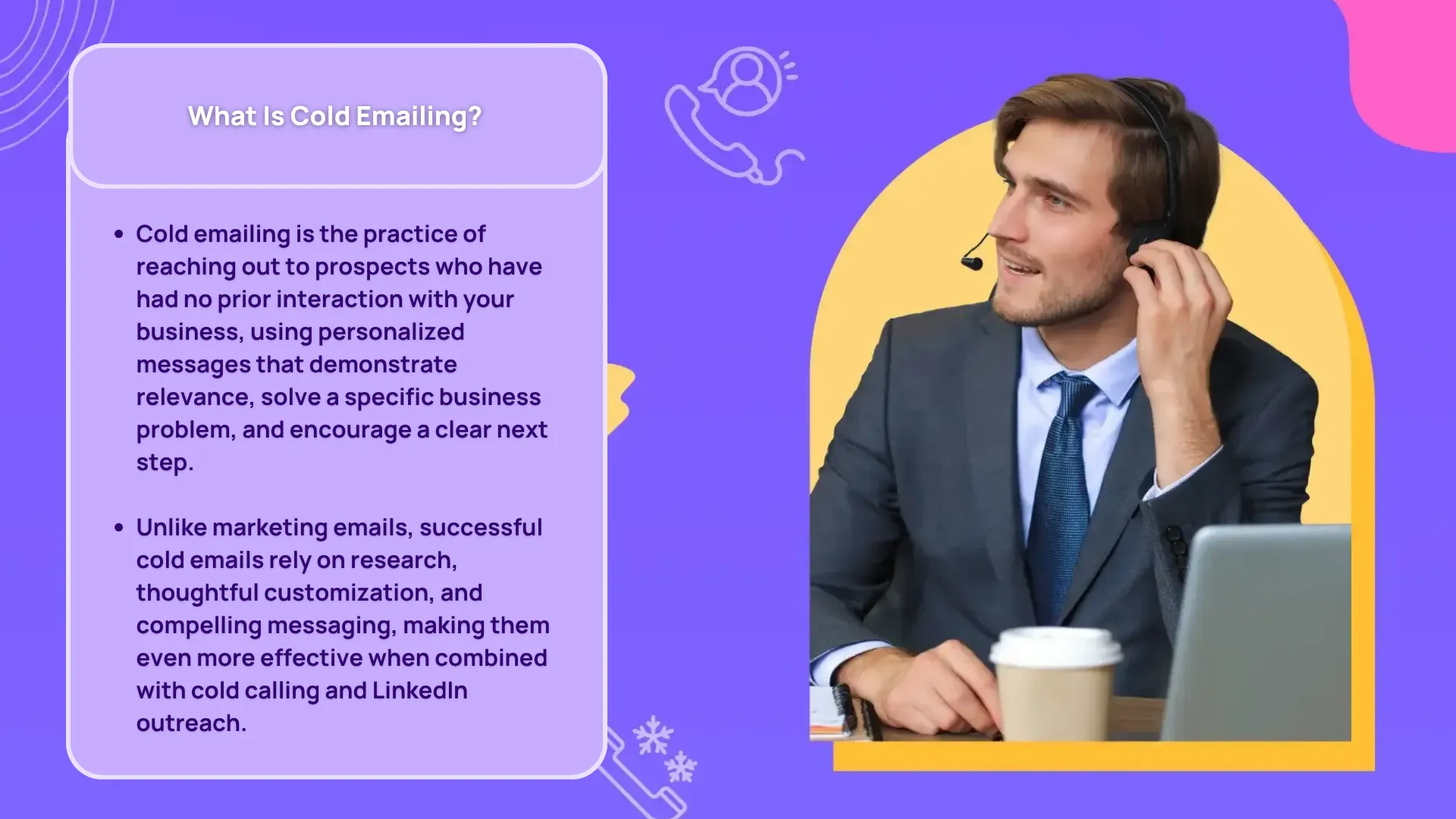
A cold email is simply a message sent to someone who has never interacted with your company before. That person has not filled out a contact form, booked a demo, or requested information. You are reaching out because your research suggests there is a genuine business fit.
That sounds simple enough, but successful cold emails are built very differently from promotional marketing emails.
Marketing emails are designed for subscribers who already know your company. Cold emails begin with zero trust. The recipient has no reason to care about your business, which means every sentence has to earn attention quickly.
On the contrary, what usually happens with beginner level solopreneurs and marketers is that they sign up for a cold email outreach software. So far so good!
These programs aren’t inherently good or bad. Their effectiveness depends on the features. But coming to the point, these software, or SaaS platforms, have built in cold email templates that you can supposedly customize. Most of the programs automatically pick up on the first and last name of the leads from your lead list, while the subject and the rest of the email body generally cover the purpose of your email.
Don’t send those emails as is!
Customize them because personalization is not only NOT optional, but it will get you better open and conversion rates.
A well written cold email usually answers four simple questions.
- Who are you?
- Why are you reaching out specifically to this person?
- What business problem can you help solve?
- What action would you like them to take next?
Those four questions sound basic, yet many outbound campaigns fail because they never answer them clearly.
For example, compare these two opening messages.
Poor approach
Hi, I'm reaching out because we help companies improve operational efficiencies with our innovative platform.
There is nothing memorable here. The message could have been sent to ten thousand companies without changing a single word.
Now compare that with this.
I noticed your SDR team has doubled in size over the past six months. Companies at that stage often struggle with reply rates because new representatives follow different outreach processes. I thought I'd reach out because we've helped several SaaS teams solve that exact problem.
The second version immediately feels more relevant because it speaks directly to something happening inside the prospect's business.
This explains why cold email continues to play a central role in modern outbound sales prospecting, especially when combined with phone calls and LinkedIn outreach.
Cold Calling vs Cold Emailing Statistics for 2026
Numbers tell a much more balanced story than opinions.
Every year, someone claims cold calling has disappeared. Someone else argues email has become too crowded to produce results anymore. Yet companies continue booking meetings through both channels every single day.
According to Cleanlist's 2026 cold email benchmark report, high-performing email campaigns can still achieve reply rates between 8% and 12%, though those results typically require excellent targeting, personalization, and deliverability.
Phone outreach faces an equally difficult environment.
GrowthList's 2026 research reports that 87% of Americans routinely ignore calls from unknown numbers, making it increasingly difficult for sales teams to reach decision makers. The data paints a clear picture: cold outreach still works, but earning attention is becoming more competitive every year.
What Is Cold Calling?
Unlike email, where you might wait several days for a reply, a phone call creates immediate interaction.
Cold calls are basically all those calls that go out to different prospects on your lead list. As far as the latter is concerned, ALWAYS have a verified lead list that’s catered to your business requirements, or whatever product you’re selling.
How does that happen?
You need to start off with ICP research and document creation that’s specific to your business workflow and requirements. If you don’t know what an ICP is, or how to go on about creating one, you should read this post from Trellus.ai experts:
Moving on, based on your cold call, if the prospect answers, you can introduce yourself, ask questions, respond to objections, and qualify the opportunity within minutes.
Despite countless predictions about its decline, cold calling continues to perform well across enterprise software, professional services, commercial real estate, financial services, manufacturing, and many other industries where trust plays a major role in purchasing decisions.
The biggest misunderstanding about cold calling comes from outdated stereotypes.
Many people picture aggressive sales representatives interrupting strangers with long scripted pitches.
Modern cold calling looks very different.
The conversation feels natural because it is built around relevance, not pressure.
A phone call works much better when it appears within a broader multichannel sales outreach strategy. The prospect may have already seen your LinkedIn profile, received a personalized email, or visited your website before answering the call.
Several best practices continue to separate productive cold calling teams from average performers.
- Research every high value account before calling.
- Keep opening conversations concise and respectful.
- Speak calmly and naturally.
- Make every call relevant to the prospect's business.
- Leave professional voicemail messages when appropriate.
- Follow regional compliance requirements, including TCPA and Do Not Call regulations.
- Continue the conversation through email and LinkedIn after the call.
Pros of Cold Emailing
Cold email has remained one of the strongest pillars of outbound sales prospecting because it gives sales teams something every growing business wants, reach without proportional cost.
That does not mean sending thousands of generic templates and hoping someone replies. Those days are disappearing quickly. Modern cold email succeeds because personalization has become easier, AI can reduce research time, and sales teams have much better visibility into campaign performance than they did a few years ago.
For companies selling SaaS products, agencies, consulting services, enterprise software, financial services, or almost any B2B solution, cold email continues to generate qualified conversations every day.
Here are the biggest advantages.
1. You Can Reach Thousands of Prospects Without Building a Huge Sales Team
One of the biggest strengths of cold email is scale.
A salesperson has only so many hours available each day. Phone calls require uninterrupted attention, while emails can be prepared, scheduled, and delivered throughout the day without someone sitting beside the keyboard.
This allows a relatively small sales team to reach a very large market.
With proper personalization and healthy sending practices, one SDR can comfortably manage outreach to hundreds or even thousands of qualified prospects every week. AI research tools make this even more practical because they can gather company information, identify recent hiring activity, summarize news, and suggest personalized opening lines within minutes.
That does not mean every email should sound automated.
The companies seeing the strongest results are the ones combining automation with thoughtful personalization. Their emails still feel like they were written for one specific recipient.
This approach allows growing companies to expand their pipeline without immediately hiring large outbound teams.
2. Cold Email Is One of the Lowest Cost Lead Generation Channels
Every outbound activity has a cost.
Phone calls require representatives to spend time dialing, leaving voicemails, speaking with gatekeepers, handling objections, and documenting conversations.
Email requires preparation too, but once campaigns are built properly, the cost per prospect becomes dramatically lower.
A single sales representative can continue generating opportunities while spending much less time repeating the same introductory conversation.
That efficiency has made email one of the most affordable B2B lead generation strategies available today.
Many companies invest their savings into better prospect research, stronger personalization, and improved sales technology, which creates an even healthier return over time.
The financial advantage becomes even more noticeable for startups and smaller businesses operating with limited sales budgets.
Instead of hiring several representatives immediately, one experienced SDR supported by the right tools can generate a surprisingly healthy pipeline.
3. Prospects Can Respond When It Suits Their Schedule
One reason buyers appreciate email is flexibility.
Executives spend much of their day in meetings, traveling, managing teams, or solving operational problems. Answering an unexpected phone call is not always convenient.
An email allows them to engage when they have a few quiet minutes available.
They can read it during their commute, after finishing meetings, early in the morning, or later in the evening without feeling interrupted.
This flexibility becomes even more valuable for companies selling internationally.
A business based in North America may be prospecting across Europe, Asia, Australia, and the Middle East at the same time. Coordinating phone calls across every time zone becomes difficult very quickly.
Email removes that obstacle.
Messages can be scheduled according to each recipient's local business hours, helping outreach arrive when buyers are most likely to check their inbox.
4. Every Campaign Produces Useful Data
Another major advantage of cold email is measurement.
Every campaign generates information that helps sales teams improve future outreach.
- You can compare subject lines.
- You can measure reply rates.
- You can evaluate different calls to action.
- You can identify which industries respond more positively.
You can discover which messaging performs best for founders, sales leaders, marketing executives, or operations teams.
This continuous learning process makes email an excellent channel for refining messaging before rolling it out across larger campaigns.
Small improvements across hundreds or thousands of emails often produce significant increases in cold outreach response rates over several months.
5. Sales Representatives Experience Less Emotional Burnout
Outbound sales is mentally demanding.
Cold calling exposes representatives to frequent rejection.
Some prospects hang up immediately.
Others refuse to continue the conversation.
Some are polite, while others are not.
Handling that level of rejection every day requires resilience.
Cold email reduces much of that emotional pressure.
Representatives spend more time researching accounts, improving personalization, analyzing campaign performance, and refining messaging than recovering from constant rejection.
That usually creates a healthier working rhythm.
Salespeople can concentrate on writing stronger emails and developing better outreach strategies rather than worrying about every unsuccessful interaction.
This often improves consistency over the long term, which is one of the biggest drivers of successful outbound prospecting.
Cons of Cold Emailing
Cold email remains incredibly effective, but it also comes with limitations.
Many of the disadvantages are not caused by email itself. They come from poor data quality, weak messaging, poor deliverability practices, or unrealistic expectations.
Understanding these weaknesses allows sales teams to avoid common mistakes before they damage campaign performance.
1. Your Email Competes With Hundreds of Others Every Day
Modern buyers receive an overwhelming number of emails.
Internal communication, customer requests, newsletters, marketing campaigns, invoices, calendar invitations, and vendor outreach all compete for attention.
Your cold email enters that crowded environment with one major disadvantage.
The recipient has never heard of you.
That means every sentence must earn attention immediately.
Long introductions, generic value propositions, and obvious templates rarely survive beyond the first few seconds.
Many emails disappear without being opened.
Others are skimmed briefly before being archived.
Some are deleted almost instantly.
That is why relevance has become one of the strongest drivers of cold outreach response rates.
Sales representatives who demonstrate genuine research consistently outperform those relying on generic messaging.
2. Deliverability Can Destroy Even Great Campaigns
Writing an excellent email means very little if nobody receives it.
Deliverability has become one of the biggest concerns in outbound sales.
Mailbox providers continue strengthening spam detection.
Google, Microsoft, and other providers evaluate domain reputation, authentication settings, complaint rates, bounce rates, engagement history, and sending behavior before deciding where your email appears.
A poorly managed campaign can quickly damage domain reputation.
Recovery often takes weeks or months.
Healthy outbound programs invest considerable time in maintaining proper infrastructure.
That includes authenticated domains, verified prospect lists, inbox warm up, gradual volume increases, and careful monitoring of campaign health.
Many businesses focus heavily on copywriting while overlooking these technical foundations.
Unfortunately, outstanding copy cannot compensate for poor inbox placement.
Pros of Cold Calling
Cold calling has survived every prediction about its disappearance for one simple reason.
It continues to create conversations that turn into revenue.
Technology has changed dramatically over the last decade. AI can research accounts, write personalized emails, summarize company news, and even recommend the best prospects to contact. None of those advancements have changed one basic fact. Business is still built on conversations.
A live discussion allows you to understand the buyer's priorities, answer questions, handle objections, and establish credibility far faster than an email thread.
That is why cold calling continues to play an important role in outbound sales prospecting, especially for companies selling complex services, enterprise software, consulting, agencies, financial services, manufacturing, and other high value B2B solutions.
Here are the biggest reasons experienced sales teams continue investing in cold calling.
1. You Can Qualify Prospects Within Minutes
One of the biggest advantages of cold calling is speed.
Email often requires several touchpoints before you know if someone is interested. A prospect might open your message today, reply three days later, request information next week, and finally agree to a meeting after another follow up.
A phone conversation compresses that entire process.
If the right person answers, you can quickly understand their situation, ask thoughtful questions, identify business priorities, and determine if there is genuine potential for a future opportunity.
You also gain information that email rarely provides.
- How urgent is the problem?
- Who makes the buying decision?
- Are they already evaluating other vendors?
- What solution are they currently using?
- Is there a budget available?
These answers help sales representatives prioritize the strongest opportunities while removing poor fit accounts from the pipeline much earlier.
That makes cold calling one of the fastest qualification tools available in modern sales.
2. A Phone Conversation Commands More Attention
Emails compete with hundreds of other messages every day.
Phone calls create a different experience.
When someone answers their phone, they are giving you their full attention, even if only for thirty seconds.
Those few seconds matter more than you probably think.
A calm introduction, a relevant observation, and a thoughtful question can quickly determine if the conversation deserves another few minutes. Even when the prospect cannot speak immediately, your company name becomes familiar.
The next email they receive from you no longer comes from a complete stranger. The next LinkedIn connection request feels more recognizable.
Every touchpoint begins reinforcing the previous one. This is one of the reasons multichannel sales outreach performs better than relying on only one communication channel.
Recognition builds trust long before a meeting is scheduled.
3. Trust Develops Much Faster Through Voice
Buying decisions involve people.
People evaluate confidence, professionalism, sincerity, and credibility during conversation.
Voice communicates those qualities much better than written text.
A calm, respectful conversation allows prospects to hear your personality, ask questions naturally, and judge your expertise in real time.
This becomes especially valuable in industries where purchases involve significant financial investment or operational risk.
- Enterprise software.
- Financial services.
- Healthcare.
- Professional consulting.
- Commercial real estate.
- Managed IT services.
Buyers in these industries rarely make purchasing decisions based solely on email exchanges.
4. Objections Can Be Handled Immediately
Every buyer has concerns. Phone calls create immediate dialogue.
If a prospect says they are already working with another provider, you can ask what they like about that relationship. If they mention budget limitations, you can understand their purchasing process.
If timing is the concern, you can identify when a future conversation would make more sense. This natural exchange prevents misunderstandings from growing into lost opportunities.
Also Read:
It also helps sales representatives understand which objections appear repeatedly across different industries.
That information improves future messaging across the entire sales organization.
5. You Can Reach Decision Makers More Directly
Senior executives receive enormous volumes of email every day.
Many messages never receive a reply. Some are delegated; others remain unread for weeks.
A carefully timed phone call often provides a faster path to the decision maker.
Founders, owners, managing directors, and executives still answer their phones, especially when caller identification appears local or familiar.
That does not mean every executive welcomes cold calls.
Far from it.
It simply means that a respectful, relevant conversation still has a place in executive outreach.
When supported with research and good timing, cold calling often creates access that email alone struggles to achieve. For organizations selling premium services or enterprise solutions, that access can make an enormous difference.
Cons of Cold Calling
Cold calling continues to produce excellent results, but no outbound channel is perfect.
It demands preparation, resilience, patience, and discipline.
Many organizations underestimate these requirements, which explains why some teams abandon cold calling long before they begin seeing meaningful results.
Understanding these limitations allows businesses to decide where cold calling fits within their broader outreach strategy.
1. Connecting With the Right Person Takes Time
One of the biggest frustrations in cold calling is simply reaching someone.
Many calls end in voicemail. Others are answered by gatekeepers, and they normally keep you on the hook by saying that either they’ll pass your message on to the concerned person, or someone will get back to you.
But, it never, or rarely happens!
Even highly experienced representatives spend much of their time attempting connections rather than holding conversations. That reality surprises many companies entering outbound sales for the first time.
Success in cold calling comes from persistence and consistency rather than immediate results.
A representative may need dozens of quality dials before speaking with someone who matches the ideal customer profile.
The stronger your prospect list, the more productive every calling session becomes.
2. Frequent Rejection Can Affect Performance
Occasionally, representatives encounter frustration or irritation from buyers who were interrupted during a busy moment.
Handling these interactions day after day requires emotional resilience.
Without strong coaching and supportive leadership, motivation can begin to decline.
That is why successful outbound organizations invest heavily in regular coaching sessions, call reviews, role playing, and skill development.
Representatives who receive constructive feedback usually recover much faster after unsuccessful conversations.
Over time, they become more confident, more adaptable, and significantly more effective.
3. Cold Calling Requires Strong Communication Skills
Sending a good email demands careful writing.
Holding a productive phone conversation requires several skills working together at the same time.
- Representatives must listen carefully.
- They need to ask thoughtful questions.
- They must think quickly when unexpected objections appear.
- They need confidence without sounding aggressive.
- They must guide conversations naturally while remaining respectful of the prospect's time.
These abilities improve with practice.
Companies expecting immediate success from inexperienced callers are often disappointed because effective cold calling remains a learned skill.
Regular coaching, call recordings, peer feedback, and repetition make a substantial difference.
Wrapping It Up
As we mentioned at the beginning of this insightful post, it’s all about using either a blend of both approaches or taking either one as the first step. But customization and proper research, alongside KPIs, are the main key players here.
Otherwise, you’re just going to be missing out on opportunities that could’ve been seized from the very beginning.