When Your Sales Research Is Wrong: Recover Without Bluffing
Acknowledge the correction, check whether your reason for calling still fits, and keep the next rep from repeating the same mistake.
On this page
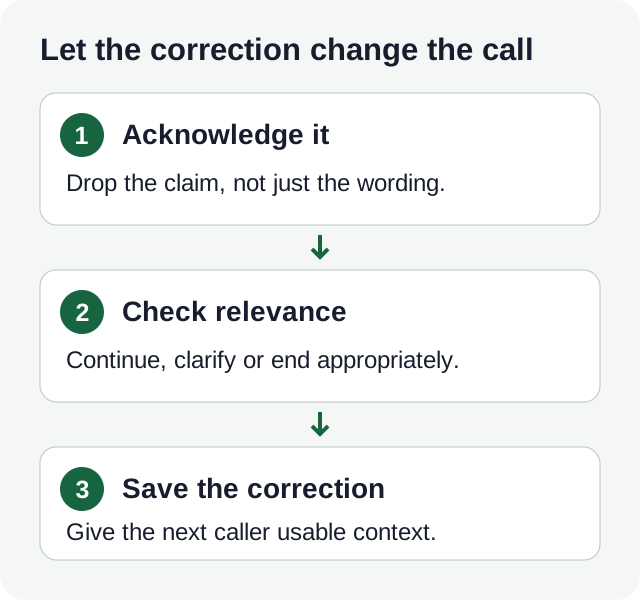
When a prospect corrects your research, stop using the claim they just corrected. Acknowledge the mistake briefly, work out whether your reason for calling still makes sense, and let the answer change what you do next. You don't have to rescue the opening at the expense of the conversation.
“Thanks for correcting me. I had that wrong” is often enough to start. The harder part is what follows. A rep can apologize and still carry on with a pitch built around the same false assumption.
This guide covers mistakes such as an outdated hiring plan, a misunderstood job title or an incorrect assumption about a team's current tools. The exchanges are fictional examples, not customer conversations or claims about results. If you've made an inaccurate product commitment or exposed information that shouldn't have been shared, use your team's appropriate correction or escalation process instead.
Correct the premise, not just the wording
Suppose you call because you think a company is hiring a new outbound team. The prospect says the vacancies are replacements, not an expansion. Changing “new team” to “growing team” doesn't repair the mistake. Your reason for calling rested on something that isn't established.
First identify what changed. Did you get a factual detail wrong, infer too much from a true detail, or contact someone who doesn't handle the work? Those call for different next moves.
- The detail is outdated: acknowledge the update and stop describing the old information as current.
- Your inference was wrong: own the inference. A job posting, funding announcement or new office isn't proof of a particular problem or buying project.
- The person or scope is wrong: clarify only if they are willing. Don't replace one guessed responsibility with another.
You may have a reasonable source for the original detail. That doesn't make the conclusion reasonable. “I saw the roles and assumed you were adding a team” is more honest than blaming a database for an interpretation you supplied.
Don't turn the correction into a debate about your source
“But your website says…” asks the prospect to defend the difference between a public page and their working reality. Even if the page is still visible, that is rarely the useful subject of an unsolicited sales call.
If the prospect asks where the detail came from, answer accurately and briefly. You can say that you saw a particular public posting, if that's actually what happened. Don't invent a source, imply that a colleague supplied private information, or read out a trail of personal details to prove how much research you did.
You don't need to treat every new statement as an independently verified fact, either. On the call, accept that the premise isn't a sound basis for your pitch. In the record, write that the prospect said the roles were replacements. That preserves the correction without turning one person's statement into a claim about the whole company.
Keep the apology proportionate. A long explanation of your research process makes the prospect spend more time on your mistake. Acknowledge it once, then either ask a relevant question with their permission or end the call.
A fictional example: the hiring signal wasn't an expansion
Imagine Maya sells a tool for outbound teams. She calls an operations manager at the invented company Harborline after seeing several sales vacancies.
Maya: “I noticed you're building out the outbound team, so I wanted to ask how you're setting up the calling workflow.”
Prospect: “We're not building a new team. Those roles are replacements.”
Maya: “Thanks for correcting me. I saw the vacancies and assumed you were expanding. I had that wrong.”
At this point, Maya has corrected her claim. She hasn't earned another five minutes or established a new problem. If the manager is still willing to talk, she can make the remaining question explicit:
“Is the calling setup something you look after, or have I reached the wrong person for that too?”
That question is appropriate only if the person hasn't already declined the conversation. It checks responsibility rather than pretending a replacement hire creates a reason to buy.
If the manager says they handle the setup and are happy with it, Maya can leave it there. If they describe a real difficulty, she can follow that answer. If they say it's someone else's responsibility, she shouldn't demand a name or turn a correction into a referral obligation.
A bad recovery would be: “Exactly, replacing reps is why you need to improve productivity.” That converts an ordinary correction into a new diagnosis the prospect never offered. The rep has kept the pitch alive by making another unsupported assumption.
Check whether there is still a reason to continue
After a correction, the relevant question isn't “How do I get back to my script?” It's “What is left of my reason for calling?” Sometimes the answer is enough to support a short conversation. Sometimes it isn't.
If only a minor detail changed, acknowledge it and return to the real subject. For example, a prospect might correct a team name while confirming that they manage the workflow you called about. You don't need a new discovery sequence just to demonstrate humility.
If the correction removes the reason for calling, say so. “Understood. That was the reason I reached out, so I won't keep you on a conversation that doesn't fit” is a reasonable ending. It doesn't need a last-minute request for a meeting.
If the relevance is uncertain and the prospect is open to a question, ask about the work rather than naming a new pain. “Is this process part of your remit?” is different from “So your real problem must be onboarding.” Let them supply the situation.
A refusal to discuss it settles the immediate decision. Don't use a recovery technique to push past a clear decline or a request not to be contacted. Follow your team's established contact-preference process.
A tool correction isn't an invitation to attack the tool
Consider a second fictional exchange. A rep says they understand the team uses one calling system. The prospect explains that they moved away from it months ago.
The useful response is not a speech about why the old system was bad. Nor is it a guess that the replacement must have a particular weakness. Both responses ignore the update.
“Thanks—that information is out of date. I shouldn't have presented it as your current setup. Is reviewing the calling workflow relevant for you now, or is it already settled?”
If it's settled, respect that answer. If the buyer wants to explain a remaining issue, ask what happens in that workflow before comparing products. The correction tells you which premise to drop; it doesn't tell you what the buyer dislikes, what they pay or when their contract ends.
Keep any later product comparison attached to what you can substantiate. Recovering from one uncertain claim by confidently making another is not an improvement.
Leave a correction the next caller can use
A courteous recovery doesn't help much if the next rep reads the same opening from the account record. Before moving on, update the working context your team actually uses, within your normal editing responsibilities. Don't scatter the correction across an unrelated personal spreadsheet.
Keep the old source as history where appropriate, but distinguish it from the current call brief. “Bad data” is too vague. What was wrong, who corrected it, and which next action should change?
Premise used: Assumed the open sales roles meant a new outbound team.
Correction and source: Operations manager said on today's call that the roles are replacements. Paraphrase; no wider hiring plan confirmed.
Effect on outreach: Don't use team expansion as the reason for the next contact. No buying project or meeting established.
Next action and owner: Maya updates the call brief before the next account touch; any further contact follows the account owner's plan and recorded preferences.
This is a suggested manual note, not a required CRM field mapping or an automatic Trellus update. Use the same distinction in a call log: what the buyer said is different from the conclusion the seller drew.
If another stakeholder has given a different account, don't silently erase one statement to make the notes agree. The conflicting buyer-notes guide covers checking speaker, scope and dates before the next conversation.
Practise the moment after “that's not right”
For coaching, give a colleague a fictional correction that changes the caller's next decision. Try one minor detail, one lost reason for calling and one unclear responsibility. The goal is to notice what changed, not to find a clever line that keeps every call going.
Ask the rep to explain their choice afterward. Which part of the original premise survived? What new information did they hear? Why did they continue, clarify or stop? A smooth apology followed by the unchanged pitch is worth discussing, even if the delivery sounded confident.
Use the two-sided role-play brief if you want the buyer-player to hold information the caller doesn't know. Keep real prospect details in their approved records. A fictional exercise can teach the decision without exposing a customer conversation or pretending it predicts results.
When you're choosing a calling workflow inside your CRM or sales engagement platform, include this ordinary task in the discussion: how will the rep see the latest account context and leave a clear correction for the next person? The calling tool doesn't decide whether a premise is true. The seller still has to listen when the person on the other end says it isn't.