When a New Stakeholder Joins a Sales Evaluation
A short orientation, one shared example and a meeting sheet for bringing a buyer’s colleague into an evaluation already underway.
On this page
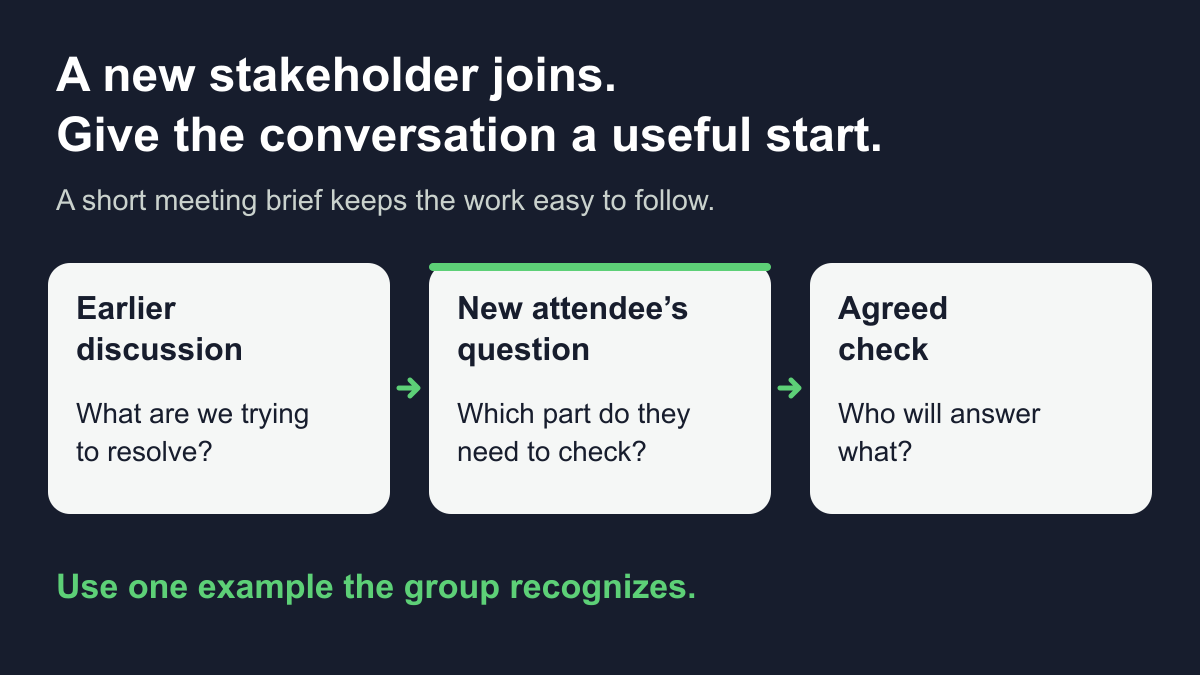
When a buyer adds someone new to a sales evaluation, find out what that person needs from the conversation before adding more slides. Give them a short account of the work so far, make room for their question, and agree which parts of the plan still make sense.
The original buyer shouldn’t have to sit through the same discovery call again. A short introduction can give their colleague enough context to contribute, with room to correct what you learned earlier.
Ask why they’re joining
A new name on an invitation tells you very little. The person might use the product, manage the work around it, help answer one question, or simply want to understand what their colleague is considering. Their attendance doesn’t tell you which responsibility they have.
Ask your existing contact before the meeting: “What would be most useful for Alex to get out of this session?” That’s easier to answer than a long qualification questionnaire. Follow with a practical choice: do they need an introduction to the problem, a look at one workflow, or a chance to ask about something specific?
If you don’t get an answer before the call, leave the first few minutes open for it. Don’t fill the gap with a confident account of Alex’s priorities based on a job title. The broader account-mapping guide can help organize relationships; you still need to ask what this person owns in this evaluation.
Send an orientation they can actually read
The new attendee shouldn’t have to reconstruct the evaluation from a recording, a forwarded email chain and a large deck. Offer a short note with the current question, the relevant work already discussed and the purpose of the next meeting. Let your contact correct it before it becomes the introduction.
Describe the open question plainly. “How would this fit your team’s follow-up process?” gives the new attendee a useful starting point. “The team has selected our approach” is a different statement and needs to be true before you write it.
Here’s a fictional example. Nia, an operations manager, has been discussing how her team records follow-up after sales calls. She invites Alex, a team lead who would handle the daily work, to the next session. A seller could send:
For Alex’s introduction: Nia and I have been looking at how a rep’s agreed next step gets back to the person who will follow up. We’ve discussed the current process, but haven’t chosen a replacement. Thursday’s session is to walk through one completed-call example and check what the team lead would need afterward. Alex, please bring a different example if that would be more useful.
That note gives Alex something to respond to. It doesn’t turn Nia’s interest into the team’s approval, and it doesn’t presume that a product demonstration will answer the operational question.
Let the buyer reopen the context
Start the meeting by checking the purpose together. Ask your original contact to explain why they invited their colleague, then add only the context that’s missing. The buyer’s explanation may be more current than the note you prepared yesterday.
In the fictional meeting, Nia might explain that she wants Alex to assess the handoff between reps and team leads. The seller can then ask Alex: “What would you need to see today to judge whether that handoff would work for your team?”
Give them time to answer. They may care about a different part of the work than Nia does. That doesn’t automatically mean one of them misunderstood the project. A team lead who has to maintain a process may have questions that never came up in an earlier conversation with its sponsor.
Keep the introduction short enough that the new attendee can change its direction. If you spend ten minutes presenting the story before letting them speak, their first contribution has to undo the agenda.
Build the session around one example
A concrete example gives the group something shared to discuss. Use a situation the buyer recognizes, with materials they are comfortable sharing. If you need to demonstrate a workflow, fictional records are often enough to make the question clear.
For Nia and Alex, the example could be a rep who finishes a conversation and promises to send setup information. Walk through who records that promise, who receives the follow-up and how the team lead checks whether someone owns it. Ask Alex where the process would fit or break in the team’s working day.
You don’t need to repeat every feature shown in earlier sessions. Pick the part that answers the agreed question. If the new attendee asks for background on a particular step, supply it there rather than restarting the entire presentation.
For a 25-minute session, a suggested agenda might allow a few minutes to confirm the question, most of the time to work through the example, and the final minutes to decide what remains open. Ask at the start whether that leaves enough time for the buyer’s main concern. If it doesn’t, choose what to leave out together.
Notice when the evaluation has changed
Suppose Alex says the real difficulty isn’t finding an owner for the follow-up. It’s that several team leads cover the same group on different days. The earlier example assumed one continuing owner.
Pause there. A reasonable response is: “That changes the example we were using. Should we work through a shift change today, or do you need us to check something before another session?”
The answer might change the next demonstration, introduce an unanswered question, or show that the proposed approach isn’t suitable. Don’t promise support for the new requirement just to keep the original plan intact. Name the question, who will check it and what information they need.
Some new questions will sit outside the work this group agreed to consider. Ask whether it belongs in this evaluation before adding it to the plan. A useful question doesn’t become an agreed requirement simply because it came from the most senior attendee.
If two people describe genuinely different situations, keep their accounts separate while you clarify the scope. The guide to conflicting buyer notes covers that narrower problem. You don’t have to settle a disagreement during the introduction.
Use this new-attendee meeting sheet
Put the answers beside the meeting notes your team already uses. You should be able to read it before the call and update it afterward.
- Work already discussed: What question brought the original buyer into the evaluation? Which conclusions have they actually confirmed?
- Reason for the new invitation: Why is this person joining now, and what responsibility have they described?
- Their question: What would they need to understand or check during this session?
- Example to use: Which familiar situation will help the group discuss that question? What background does the new attendee need first?
- What changed: Did the conversation add a requirement, correct an assumption or leave the original plan intact?
- Next step: What has each person agreed to do, and what still needs an answer before another decision?
Leave an answer blank if you don’t know it. You can still hold a useful conversation without assigning a purchasing role to every attendee.
Send a recap of what changed
The follow-up should make it easy for everyone to check what they heard. Start with the question the group worked on, explain what changed, then list the agreed work. A general “great meeting” recap gives the new participant little to confirm.
For the fictional example, the seller’s recap could read:
Today we looked at the follow-up after a rep promises to send setup information. Alex explained that team leads rotate coverage, so our example with one continuing owner was incomplete. We haven’t established whether the proposed workflow covers that change. I’ll check that question and send the answer to Nia and Alex before we decide whether another demonstration would help. Please correct anything I’ve misunderstood.
Send that only to the people who should receive it, using the sharing arrangements you’ve agreed with the buyer. If another seller will take over the next session, give them the relevant context through the normal meeting handoff, including the new question.
Record attendance and the result of the discussion separately. Alex joining the meeting is an activity. Alex identifying a missing requirement is new information. The group agreeing to a check is a next step. None of those alone means the evaluation has been approved.
If you’re evaluating calling software, bring the workflow the new attendee would actually own: the list before the call, the conversation, or the follow-up afterward. Their contribution is useful when it changes what the group understands, even if the result is a smaller plan or a decision to stop.