Our Top Picks


For a high revenue; high profit sales business, sales coaching isn’t something that’s optional these days. Ask any revenue leader, and they’ll agree on the overall importance of sales training, but it’s not that simple.
Couple of reasons add to the complexity of training. Let’s take a look below…
For starters, managers spend their days juggling forecasts, pipeline reviews, hiring, customer escalations, executive meetings, and one on one sessions. Somewhere between all of that sits a growing library of sales calls waiting to be reviewed. Unfortunately, most of those recordings never see the light of the day!
What does that mean?
SDRs, especially the ones who have to meet a quota on a high volume cold calling campaign, are time bound. They barely have time slots for previous calls’ feedback review sessions. That doesn’t mean that these individuals don’t go through their managers’ input. It’s just that most of these review calls or detailed notes are missed or overlooked due to a resource allocation issue.
In this case, “time” is the biggest resource. Top it off with software that requires more manual work than automation, and you’re looking at a sales outreach and enablement team that’s struggling to consistently set the bar at an all time high.
The end result is an ever expanding coaching gap.
According to Gartner's 2026 Sales Enablement Report, companies that adopt real time AI coaching improve sales win rates by 8 percent to 12 percent within their first three months, while new sales hires reach full productivity between 30 percent and 50 percent faster than teams relying on traditional coaching methods.
In other words, we see these numbers explaining why revenue organizations of every size are investing in Real time AI sales coaching platforms instead of relying solely on manual call reviews.
Understanding the aforementioned concept is one half of the equation.
The other half is finding a digital solution or some kind of Modern AI conversational coach for sales that works like a charm. Ideally, it would mean operability within a budget capacity that you can easily pay to the vendor in exchange for the signed up ai coaching digital services, overall future proof software features, workflow optimization, and SDR performance enhancement, etc.
With that being said, the platforms covered here represent different coaching philosophies. Some coach sellers during live conversations.
Others specialize in post call analytics, structured enablement, or AI powered roleplay. Each serves a different type of sales organization, making it easier to match the software with your team's coaching style and sales process.
How We Evaluated These AI Sales Coaching Platforms
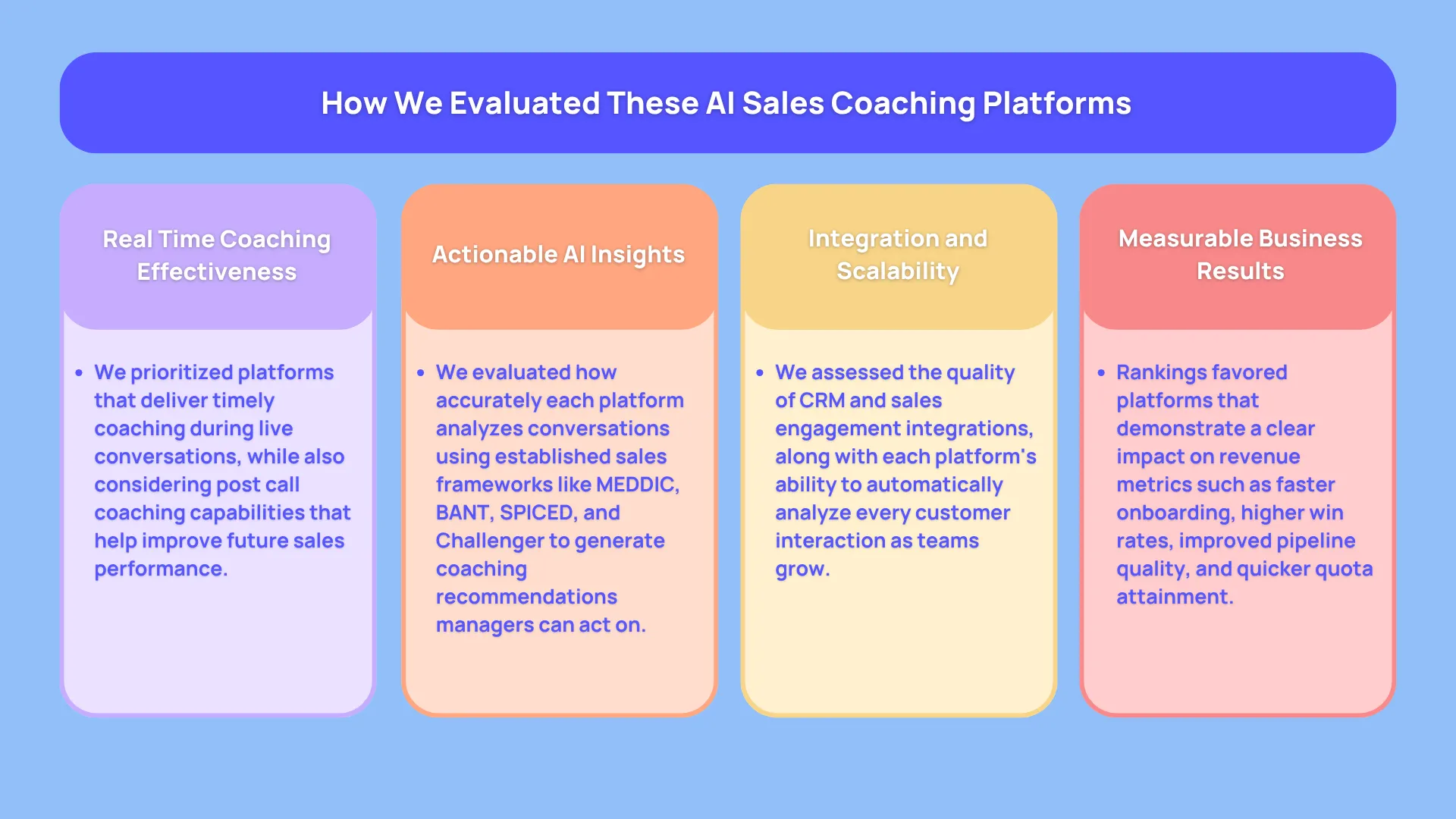
Choosing an AI conversational coach for sales is not as simple as comparing feature lists.
Our rankings are based on what matters most to modern revenue teams in 2026. Rather than rewarding software with the longest feature list, we looked at how well each platform helps representatives perform better during customer conversations and how easily managers can scale coaching across an entire organization.
Here are the five areas that carried the most weight.
Coaching delivery
The timing of coaching makes a huge difference.
Some platforms provide guidance while the representative is still speaking with a prospect. Others wait until the meeting ends before offering suggestions. Both approaches have value, although they solve different problems.
Real time coaching can improve the outcome of the current conversation. Post call coaching prepares representatives for future conversations.
Organizations looking for Real time AI sales coaching usually benefit most from platforms capable of supporting both.
Conversation scoring
Not every coaching score means the same thing.
Some products simply measure speaking time, keyword frequency, or meeting length. Those metrics provide useful context, although they rarely explain why a conversation succeeded or failed.
The strongest platforms score calls against proven sales frameworks such as MEDDIC, BANT, SPICED, Challenger, or customized qualification models built around a company's own sales process.
That creates coaching feedback managers can immediately act upon.
CRM integration
Sales coaching becomes much more valuable when conversation data connects directly with opportunity data.
We looked closely at how deeply each platform works with Salesforce, HubSpot, and leading sales engagement platforms.
Strong integrations allow managers to understand which coaching behaviors contribute to higher win rates, larger deal sizes, and shorter sales cycles.
This also answers a common buying question.
Which AI sales coaches integrate with your existing sales engagement platform?
Most enterprise platforms connect with Salesforce and HubSpot, although the depth of those integrations varies considerably. Native integrations typically provide richer reporting and more reliable automation than third party connectors.
Scalability
Many companies begin with a handful of sales representatives.
A year later, they may have fifty.
The coaching platform should grow alongside the business.
We favored platforms capable of automatically reviewing every customer interaction instead of requiring managers to manually choose recordings for analysis.
Complete conversation coverage creates a much more accurate picture of team performance and coaching opportunities.
Business impact
Sales managers care about more than activity metrics.
They want to know if coaching improves pipeline quality, increases close rates, shortens onboarding, and helps representatives reach quota sooner.
The highest ranked platforms connect coaching insights with measurable revenue outcomes, making it easier for leadership teams to justify continued investment.
Top Real Time Sales Coaching Tools
Before kicking off with our list of the best real time sales coaching tools, here’s the thing you need to understand…
The term “best” doesn’t have to coincide with a long list of features. Maybe your business requirements are a better fit for a software that isn’t as expensive or doesn't come with high tier pricing plan, etc.
Similarly, for another company, the situation might be different. For their requirement, they need an enterprise level Intelligent sales call assistant that helps representatives respond confidently during difficult conversations while giving managers a complete view of team performance. In addition to that, you might be looking for better integration, better workflow optimization, ability to set custom KPIs, spam call filters, etc.
So, the bottom line is to carefully evaluate your business requirements first and then select a feasible solution, both in terms of features and pricing.
Each platform below brings something different to the table, making it suitable for different sales environments.
1. Trellus.ai
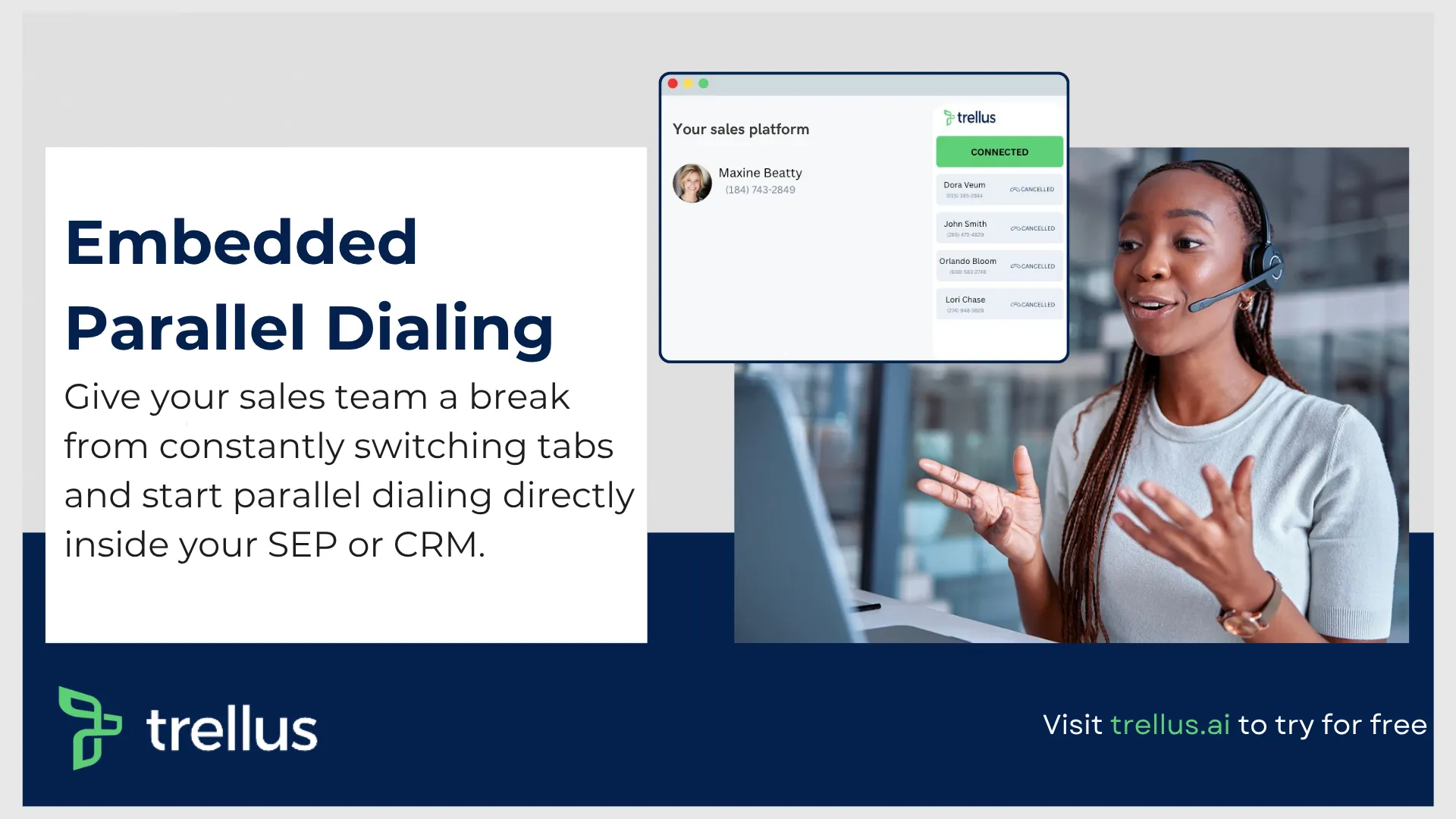
When most people think about coaching software, they picture managers reviewing recordings after meetings have already ended. Alternatively, it could be a solution that enables managers to leave post call reviews in the form of notes that are passed on to the concerned SDR.
In Trellus’s case, the approach is entirely different.
It’s an end to end solution with an AIO sales enablement experience. In other words, we built the platform around helping representatives perform better during the conversation, have increased outreach, better conversion rates, automations, custom KPIs, and tons of other things.
The live AI coaching part of Trellus enables it to act as an AI conversational coach for sales that supports sellers while they are speaking with prospects. Representatives receive live coaching, contextual recommendations, objection handling guidance, CRM insights, and AI generated prompts without disrupting the natural flow of the conversation.
For managers, this creates visibility into how representatives perform.
For representatives, it feels like having an experienced coach available during every customer interaction.
Another major strength of this tool is reducing mental load during live conversations.
Representatives no longer need to remember dozens of discovery questions, pricing responses, competitive positioning points, and qualification frameworks while also trying to build rapport.
The platform surfaces relevant guidance naturally as conversations progress, allowing representatives to stay focused on listening instead of searching through notes or documentation.
This makes Trellus an outstanding choice for organizations searching for AI powered call coaching software that combines coaching with outbound execution.
Key Features
• Real time coaching prompts during live sales conversations
• AI generated objection handling recommendations
• AI roleplay sessions for onboarding and continuous practice
• Parallel dialing and power dialing capabilities for outbound teams
• Live conversation insights and coaching suggestions
• AI research before calls for stronger personalization
• Automatic CRM updates and call summaries
• Native integrations with Salesforce, HubSpot, Salesloft, Outreach, Apollo, and other major sales engagement platforms
Why it stands out
Many coaching platforms tell representatives what they should have said after the conversation finishes. Trellus helps them while the opportunity is still active.
That difference has a meaningful impact on outbound performance because coaching happens when representatives need it most.
Sales managers also gain access to coaching insights across the team without spending hours reviewing recordings manually.
Organizations looking for an AI objection handling coach often appreciate Trellus because representatives receive immediate support during pricing discussions, competitive comparisons, and difficult buying questions.
It also addresses another important question many revenue leaders ask.
How to use AI coaching to maintain conversation quality while scaling outbound volume?
Trellus makes that possible through live guidance, automated note taking, AI coaching, and outbound productivity tools working together inside a single workflow.
Representatives can increase activity levels without sacrificing conversation quality because the platform reduces administrative work while supporting every customer interaction.
Trade offs
Every platform has limitations.
Organizations looking purely for deep historical conversation analytics across several years of customer interactions may find dedicated conversation intelligence platforms such as Gong more specialized in that area.
Companies running highly regulated compliance environments may also require industry specific quality assurance capabilities depending on their workflow.
Who is it best for
It is an excellent fit for SDR teams, BDR organizations, inside sales teams, outbound agencies, and revenue organizations that want coaching during live conversations instead of waiting until calls have already ended.
The smart combination of coaching, dialing, AI assistance, and workflow automation makes this digital solution one of the strongest all around platforms available for modern sales teams in 2026.
2. Gong

Gong has become one of the most recognizable names in conversation intelligence, and for good reason.
If your leadership team wants to understand what separates top performers from the rest of the sales organization, Gong provides one of the deepest analytical engines available today.
Unlike platforms built around live assistance, Gong concentrates on what happens after customer conversations end. Every meeting, phone call, and video conference becomes a source of coaching data. Over time, the platform builds a detailed picture of how successful representatives communicate, what questions they ask, how they respond to objections, and which conversation patterns produce the highest win rates.
That information helps managers coach with evidence rather than instinct.
Imagine discovering that your highest performing account executives spend more time discussing business outcomes than product features, or that deals tend to stall whenever pricing is introduced before qualification. Gong surfaces those trends automatically, allowing managers to coach the entire team around behaviors that have already proven successful.
For organizations building structured coaching programs, this level of insight is incredibly valuable.
Key Features
• AI powered conversation analysis across phone calls, video meetings, and emails
• Behavioral benchmarking against top performing representatives
• Deal intelligence highlighting opportunities at risk
• Coaching scorecards measuring talk time, discovery questions, and conversation quality
• Keyword tracking for competitors, objections, pricing discussions, and important topics
• Salesforce integration for opportunity visibility and pipeline reporting
Why it stands out
Gong excels at identifying patterns across thousands of customer interactions.
Rather than reviewing isolated conversations, managers gain visibility into organization wide trends that would otherwise remain hidden. This makes coaching more objective because recommendations are backed by conversation data rather than personal opinions.
Sales leaders looking to improve forecasting accuracy also benefit from Gong's deal intelligence capabilities, which connect conversation quality with pipeline health.
Trade offs
Gong does not provide Real time AI sales coaching during live customer conversations.
Representatives receive coaching after meetings have already concluded, making the platform better suited for improving future performance rather than influencing active opportunities.
Pricing also places Gong firmly in the enterprise category, making it difficult for many smaller organizations to justify the investment.
Who it's best for
Gong is an outstanding choice for enterprise revenue teams with fifty or more sales representatives that want deep conversation intelligence, large scale coaching analytics, and stronger forecasting across complex sales organizations.
3. Chorus by ZoomInfo
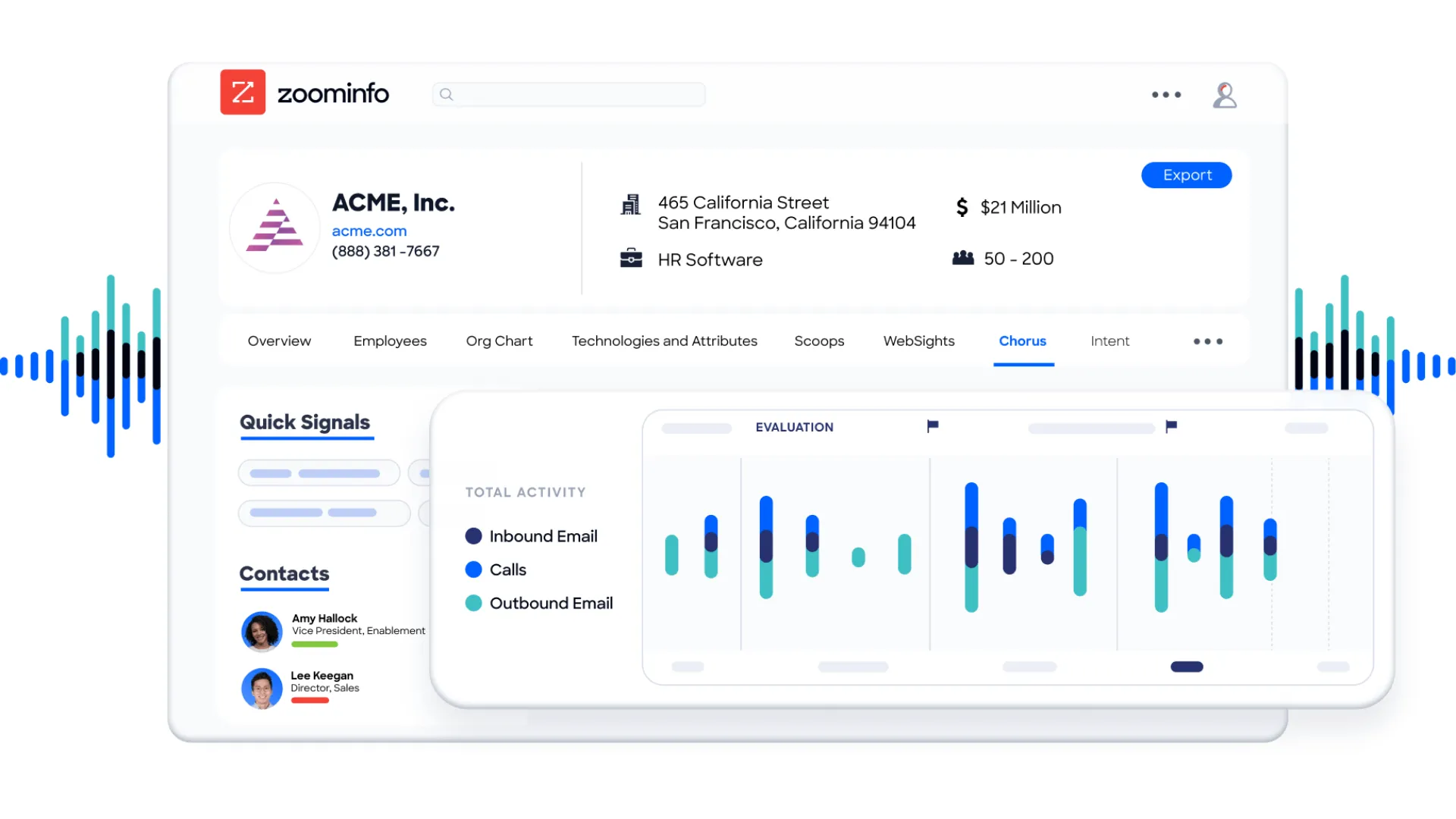
Chorus takes traditional conversation intelligence and strengthens it with buyer intelligence from the broader ZoomInfo ecosystem.
That combination gives managers valuable context beyond the conversation itself.
Rather than simply reviewing what happened during a meeting, sales leaders can connect conversations with buying committee activity, contact information, stakeholder engagement, and account level intelligence.
This broader perspective becomes especially useful during enterprise sales cycles involving multiple decision makers.
Managers can quickly understand who participated in meetings, who remained silent, which stakeholders still need attention, and how engagement changes throughout the buying journey.
For companies already invested in ZoomInfo's go to market platform, Chorus fits naturally into existing workflows.
Key Features
• AI powered call recording and transcription
• Conversation analysis with searchable call libraries
• Coaching scorecards and collaborative call reviews
• Stakeholder mapping supported by ZoomInfo buyer intelligence
• Keyword tracking across objections, competitors, and customer questions
• Salesforce integration connecting conversations with opportunities
Why it stands out
Chorus combines conversation intelligence with buyer intelligence.
Managers receive coaching insights alongside account level context, making it easier to understand why opportunities are progressing or slowing down.
Organizations selling into large buying committees often appreciate this broader perspective because conversations rarely happen with just one decision maker.
Trade offs
Chorus concentrates on post call coaching rather than live assistance.
Companies searching for an Intelligent sales call assistant that supports representatives during conversations may find other platforms more suitable.
Many organizations also purchase Chorus as part of a broader ZoomInfo subscription, which can reduce flexibility for companies looking for standalone coaching software.
Who it's best for
Sales organizations already using ZoomInfo that want conversation intelligence enriched with buyer data, stakeholder visibility, and coaching insights throughout complex enterprise sales cycles.
4. Salesloft
Salesloft has always been known as a sales engagement platform.
Over the past few years, its coaching capabilities have grown into an important part of the overall experience.
Rather than separating outreach from coaching, Salesloft brings both together inside one platform. Managers can review conversations, evaluate messaging effectiveness, monitor cadence execution, and coach representatives without jumping between multiple systems.
This unified approach appeals to organizations that already manage prospecting, email sequences, and customer outreach inside Salesloft.
Managers gain visibility into the complete selling journey, from the first outbound email through discovery calls and deal progression.
That broader view helps identify coaching opportunities that go beyond individual conversations.
Key Features
• Conversation intelligence with call recording and transcription
• AI generated conversation insights
• Coaching annotations and collaborative feedback
• Outreach analytics connected with conversation performance
• Salesforce integration for activities and opportunity tracking
Why it stands out
Salesloft connects coaching with outbound execution.
Managers can evaluate how prospecting activities influence conversation quality and identify patterns linking outreach behavior with successful sales meetings.
Organizations wanting coaching inside an existing engagement platform often appreciate this all in one approach.
Trade offs
Coaching remains one component of a much larger platform.
Companies looking specifically for advanced AI powered call coaching software may find dedicated coaching platforms offering richer coaching capabilities.
Salesloft also focuses primarily on post call analysis rather than live conversational guidance.
Who it's best for
Revenue teams already running their outbound programs inside Salesloft that want coaching insights connected with prospecting activity, engagement performance, and pipeline progression.
5. Mindtickle

Mindtickle approaches coaching from a very different angle.
Rather than concentrating on individual customer conversations, it focuses on long term sales readiness.
Large organizations invest enormous amounts of time and money onboarding new representatives.
Training materials, certifications, product education, competitive positioning, messaging frameworks, and coaching sessions all contribute to preparing new hires for customer conversations.
Mindtickle brings those elements together into one structured enablement platform.
Managers can measure learning progress, assign certifications, monitor coaching exercises, evaluate roleplay sessions, and understand how prepared each representative is before they begin handling live opportunities.
Its AI powered readiness scoring gives leadership teams much better visibility into onboarding progress than traditional training programs.
Key Features
• Structured learning paths and certification programs
• AI powered readiness scoring
• Interactive AI roleplay exercises
• Video coaching and practice sessions
• Centralized playbooks and sales content management
• Salesforce integration connecting readiness with revenue performance
Why it stands out
Mindtickle excels at structured learning.
Companies hiring large numbers of sales representatives throughout the year benefit from standardized onboarding, measurable certifications, and continuous skill development.
The platform answers another common question revenue leaders ask.
Can AI sales coaches help new reps ramp faster and reduce time to productivity?
Mindtickle supports that objective through continuous learning, structured assessments, and AI powered practice environments that help representatives build confidence before speaking with customers.
Trade offs
Mindtickle emphasizes enablement more than live coaching.
Organizations searching for Real time AI sales coaching or an AI objection handling coach during active customer conversations may find live coaching platforms better aligned with those needs.
Its enterprise feature set can also feel larger than necessary for smaller sales teams.
Who it's best for
Large enterprise organizations with extensive onboarding programs, distributed sales teams, and dedicated enablement departments looking for structured coaching, certification, and readiness management.
Honorable Mention: Balto
Balto has built its reputation around one thing.
Helping representatives perform better while customer conversations are still happening.
The platform listens during live phone calls and displays relevant guidance as discussions unfold. Representatives receive prompts, recommended responses, compliance reminders, and objection handling suggestions without needing to search through documents or playbooks.
This makes Balto particularly popular in industries where consistency matters as much as persuasion.
Financial services, insurance, healthcare, telecommunications, and customer service organizations often need representatives to communicate required information accurately on every call.
Balto helps maintain that consistency while reducing the pressure placed on individual representatives.
Key Features
• Live coaching prompts throughout customer conversations
• Dynamic talk tracks based on conversation context
• Automated quality assurance scoring
• Compliance monitoring with instant alerts
• Manager notifications during active conversations
• Salesforce integration for reporting and activity tracking
Why it stands out
Balto performs exceptionally well in structured selling environments where representatives follow established talk tracks and compliance standards.
Its live guidance reduces mistakes, improves consistency, and gives managers confidence that required messaging is delivered correctly.
Trade offs
Balto concentrates more heavily on scripts and compliance than consultative enterprise selling.
Organizations looking for deeper conversation intelligence or broader outbound coaching capabilities may find platforms such as Trellus or Gong offering greater flexibility depending on their sales process.
Who it's best for
High volume sales teams, customer support organizations, contact centers, and regulated industries requiring live guidance, quality assurance, and consistent customer conversations.
How to Successfully Implement AI Sales Coaching
Choosing the right software is only one part of the journey. The companies that see the biggest improvements in quota attainment, rep confidence, and customer conversations are usually the ones that treat coaching as an ongoing process rather than a one time rollout.
Even the most advanced AI conversational coach for sales cannot improve performance if representatives are unsure how to use it or managers continue coaching the same way they always have.
A thoughtful rollout gives your team time to build confidence, fine tune coaching frameworks, and demonstrate early wins before expanding across the organization.
Here are the steps that tend to produce the strongest results.
Review Your Current Sales Conversations
Before introducing any new platform, spend time understanding how your team performs today.
Listen to discovery calls, demos, cold calls, and follow up conversations. Look for recurring patterns rather than isolated mistakes.
You may notice that representatives struggle to uncover business pain early enough. Some may rush into product demonstrations before qualifying the opportunity. Others may lose momentum when pricing comes up.
Understanding these patterns makes it much easier to configure your coaching platform around genuine business needs rather than assumptions.
The better your starting point, the more meaningful your coaching improvements become over the coming months.
Start With a Small Pilot Group
Rolling new technology out to every representative on day one often creates unnecessary resistance.
A smaller pilot team gives managers room to refine coaching workflows, gather feedback, and identify practical improvements before expanding to the wider organization.
Choose representatives who are open to experimenting with new technology and willing to share constructive feedback.
Their success stories help build confidence across the rest of the sales team, making future adoption much smoother.
Create Clear Coaching Standards
Artificial intelligence performs best when it understands what success looks like.
That means agreeing on the sales methodology your organization already follows.
Some teams qualify opportunities using MEDDIC.
Others rely on BANT, SPICED, Challenger, or internally developed qualification frameworks.
Once those standards are defined, your AI powered call coaching software can evaluate conversations against the same expectations managers already use.
This creates more consistent coaching across the entire revenue organization.
Representatives also gain a much clearer understanding of how their conversations are being evaluated.
Connect Your CRM and Sales Stack
Sales coaching becomes much more valuable when conversation insights connect with the rest of your revenue data.
Linking your coaching platform with Salesforce, HubSpot, and your existing sales engagement software allows managers to connect conversation quality with pipeline movement, deal progression, and revenue outcomes.
It also answers one of the most common buying questions.
Which AI sales coaches integrate with your existing sales engagement platform?
Most leading platforms support native integrations with Salesforce and HubSpot, while many also connect with Salesloft, Outreach, Apollo, Microsoft Dynamics, and other popular revenue tools.
Choosing software that fits naturally into your existing workflow reduces manual work and improves adoption across the sales organization.
Encourage Coaching Every Week
One of the biggest advantages of AI coaching is that learning becomes continuous.
Managers no longer need to wait for quarterly performance reviews before discussing improvement opportunities.
Schedule regular coaching sessions using conversation insights generated throughout the week.
Review successful customer conversations alongside challenging ones.
Celebrate progress as often as you discuss areas for improvement.
Representatives respond much more positively when coaching feels like ongoing development rather than performance criticism.
That steady rhythm creates stronger habits over time and keeps improvement moving in the right direction.
The ROI of AI Sales Coaching
Organizations adopting Real time AI sales coaching frequently report improvements across onboarding, conversation quality, selling efficiency, and revenue generation within a relatively short period.
The financial impact extends well beyond coaching itself.
It influences productivity across the entire sales organization.
Faster Onboarding
New representatives often spend months developing the confidence needed to handle customer conversations independently.
An Intelligent sales call assistant shortens that learning curve by providing guidance throughout early customer interactions.
Representatives receive reminders, coaching prompts, and structured feedback after every conversation, helping them learn much faster than relying solely on manager availability.
According to Gartner's 2026 Sales Enablement Report, organizations adopting real time AI coaching reduce ramp time significantly, allowing new hires to reach full productivity between 30 percent and 50 percent faster.
For growing sales organizations, that acceleration translates directly into earlier pipeline generation and faster quota attainment.
What Is AI Sales Coaching?
Sales coaching has traditionally depended on managers listening to recorded calls, writing feedback, and hoping representatives remember that advice during future conversations.
That approach still has value, but it struggles to keep pace with modern sales teams. A manager with fifteen or twenty account executives simply cannot review every customer interaction. Important coaching moments get missed, and performance improvements happen much slower than they should.
AI sales coaching changes that completely.
An AI conversational coach for sales analyzes every conversation automatically, evaluates how a representative performs against predefined sales methodologies, highlights coaching opportunities, and delivers actionable feedback without requiring a manager to review every single call.
Think of it as having an experienced sales coach sitting beside every representative throughout the day.
The software listens carefully, understands the conversation, identifies areas where the rep is doing well, spots moments where the conversation starts drifting, and recommends improvements based on thousands of previous customer interactions.
Most modern platforms combine several capabilities into one coaching experience.
Real time call guidance
During live conversations, the AI monitors what both parties are saying.
If a prospect raises a pricing concern, asks about competitors, or requests technical information, the platform immediately recommends relevant responses, objection handling techniques, or supporting content.
This is where AI powered call coaching software provides its biggest advantage.
Rather than receiving coaching tomorrow, the representative receives support while the opportunity is still alive.
This directly answers one of the biggest questions sales leaders ask.
How does AI conversational coaching improve sales rep performance in real time?
The answer is simple.
It reduces hesitation, keeps conversations on track, reminds representatives about proven talk tracks, and helps them respond confidently without interrupting the natural flow of the discussion.
Automated conversation scoring
Every sales organization has its own definition of a quality discovery call.
Some follow MEDDIC.
Others prefer BANT, SPICED, Challenger, or custom internal frameworks.
AI coaching platforms automatically score conversations against those standards.
Managers no longer need to listen to every recording manually because the software evaluates consistency across every call.
That creates far more objective coaching than relying on occasional call reviews.
Conversation intelligence
Beyond individual coaching, AI identifies patterns across the entire sales organization.
It can answer questions such as:
- Which objections appear most frequently?
- Which questions produce the highest conversion rates?
- Which discovery topics successful representatives discuss more often?
- Which competitor comes up most during enterprise deals?
Those insights help managers coach entire teams based on evidence rather than assumptions.
AI roleplay and practice sessions
Several platforms now include AI generated roleplay scenarios.
Representatives can practice difficult conversations before speaking with real buyers.
That makes onboarding far more interactive than watching recorded videos or reading playbooks.
It also answers another common buying question.
Can AI sales coaches help new reps ramp faster and reduce time to productivity?
For many organizations, the answer has been yes.
New representatives receive immediate feedback after every practice conversation, helping them correct mistakes early rather than developing habits that become harder to change later.
AI Sales Coaching Versus Traditional Sales Training
Traditional sales training usually happens at specific moments during the year.
- New hire onboarding.
- Quarterly workshops.
- Annual sales kickoffs.
- Manager call reviews.
Those events remain valuable, but they happen only occasionally.
Learning slows down between those sessions because representatives receive limited feedback during everyday selling.
AI coaching works very differently.
Every conversation becomes a coaching opportunity.
Every objection becomes a learning moment.
Every discovery call contributes data that helps improve future conversations.
Rather than waiting several weeks for a manager to review one recording, representatives receive feedback after every interaction, and in many cases while they are still speaking with the customer.
That constant reinforcement helps build stronger selling habits much faster.
Managers also benefit because their coaching conversations become far more productive.
Rather than spending time identifying problems, they can spend their coaching sessions discussing solutions already highlighted through AI generated insights.
Live Coaching Versus Post Call Coaching
Not every coaching platform works the same way.
Understanding this difference makes choosing software much easier.
Live coaching
Live coaching platforms support representatives while conversations are taking place.
These systems often function as an Intelligent sales call assistant, listening in real time and surfacing relevant guidance as the discussion unfolds.
That guidance may include:
- Objection handling recommendations
- Discovery questions
- Pricing guidance
- Competitive battle cards
- Product information
- Compliance reminders
Platforms offering AI objection handling coach capabilities are particularly valuable for outbound sales teams because objections happen unexpectedly.
Rather than relying on memory under pressure, representatives receive contextual assistance at exactly the right moment.
When people ask,
What are the best AI coaches for handling sales objections and closing deals?
they are usually referring to software capable of providing this kind of live conversational support.
Post call coaching
Post call coaching begins once the meeting has ended.
The platform analyzes recordings, generates summaries, scores conversations, identifies coaching opportunities, and recommends areas for improvement.
This approach helps managers understand long term performance trends across their teams.
Many conversation intelligence platforms fall into this category.
They excel at helping organizations improve future conversations, although they cannot influence the outcome of the conversation that already happened.
Robust platforms combine both aspects!
The highest performing sales organizations rarely choose one approach over the other.
They combine live guidance with post call analysis.
Representatives receive support during customer conversations, while managers receive detailed coaching insights afterward.
.jpeg)

Power and parallel dialing in your CRM.