A Prospect Sends You to a Colleague: What to Say Next
A name, permission to mention someone and a promised introduction call for different next steps. Keep the distinction in your opener and your notes.
On this page
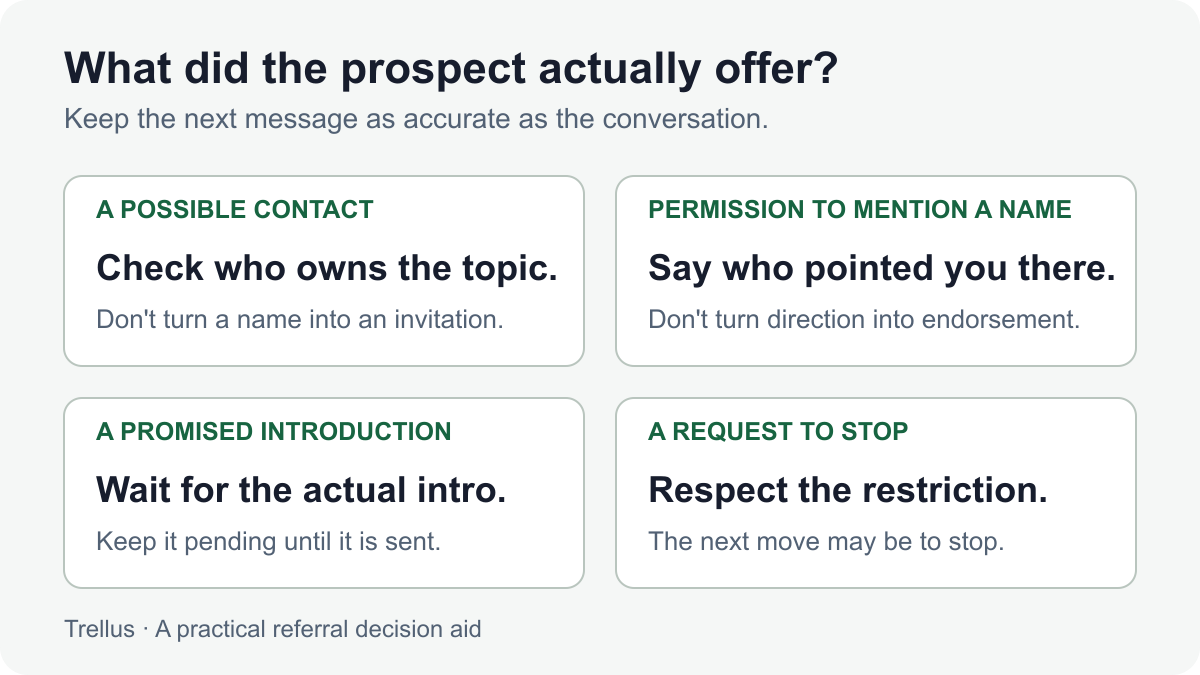
“You should speak to Maya” gives you a possible next contact. It doesn't tell you that Maya wants a call, that the person speaking has introduced you, or that anyone has agreed to a meeting.
Before ending the conversation, clarify the next step: “Would you prefer to introduce us, or should I contact Maya directly? And is it okay to mention that you pointed me her way?” Then use the answer you actually receive.
The wording matters because your next opener starts with someone else's name. A useful referral can become an awkward conversation if you turn a suggestion into an endorsement. You don't need a clever way around that problem. You need an accurate account of what happened and a sensible next action.
Find out what the person is offering
There are several different offers hiding inside “talk to my colleague.” Someone may be correcting your choice of contact. They may be volunteering an introduction. Or they may simply be ending a conversation they don't want to continue.
Don't make them complete a qualification interview to help you. Ask only what you need to avoid a misleading next message. The most useful details are why the colleague might be relevant, whether to contact them directly or wait for an introduction, and whether you may use the first person's name.
For example, “Maya looks after our outbound team” gives you a reason to check your understanding with Maya. It doesn't establish her budget, authority, interest or buying timetable. Those questions belong in a conversation with her, not in an embellished note about the referral.
If the person sounds hurried, shorten the question: “Should I reach out directly, or wait for your introduction?” If there isn't time for an answer, keep the uncertainty in your note. Don't silently choose the version that makes your next call sound warmer.
Four fictional referrals, four different next moves
The examples below are invented teaching scenarios. They aren't customer conversations or tested scripts. Adapt the language to what was actually said and to your team's contact rules.
A name and a role, but no introduction
A prospect says, “Maya handles that team.” You ask whether to contact Maya directly and whether mentioning the conversation is okay. The prospect says, “You can reach out, but there's no need to bring me into it.”
Your next message should stand on its own:
“Hi Maya, I'm trying to understand who looks after the outbound calling workflow. Is that something you handle, or have I got the wrong person?”
Don't open with “Your colleague asked me to call you.” They didn't. You have a direction to a possible contact, not Maya's invitation or consent to be contacted. Whether and how to approach her still depends on your team's contact rules. If Maya says the subject belongs elsewhere, correct the contact information rather than leaning harder on a referral you were asked not to use.
Permission to mention the person
A prospect says, “Maya owns the process. You can say I pointed you her way.” There is no introduction or promised meeting.
“Hi Maya, Alex pointed me your way as the person who looks after outbound calling. I was asking about how reps move from a call list to their follow-up. Is that the right subject to bring to you?”
This states the direction and the topic. It doesn't say Alex recommended the product, approved a project or arranged your call. Avoid adding “Alex thought you'd be interested” unless Alex actually said that. Even then, let Maya describe her own interest.
If Alex only identified Maya as a possible contact, say “suggested I check with you,” rather than presenting the role as settled. A small qualification in the opener is easier than explaining a confident claim that turns out to be wrong.
A promised introduction
The prospect says, “Send me a short note and I'll introduce you.” Ask what they would find useful to forward. Keep it easy to assess, and let them choose whether and when to send it.
“Thanks for offering to introduce us. Here's a short version you can use or change: I'm hoping to ask Maya how the team handles calling and follow-up in its current CRM. A short conversation would help me understand whether there's a relevant fit.”
Send the requested note through the agreed channel. Record the introduction as pending until it exists. Don't contact Maya immediately with “Alex is introducing us” as though she has already received something. If a follow-up was agreed, record who owns it and when. If none was agreed, don't manufacture a deadline for Alex.
When the introduction arrives, read the actual message before replying. It may be narrower than the conversation you remember. Respond to the question or context that Maya was given, not to the stronger introduction you hoped for.
A direction without an invitation to continue
The person says, “That's another department,” declines to name anyone and asks you not to contact them again. That is a restriction on further contact with that person, not an introduction or an invitation to keep questioning them.
End politely, record the restriction through the team's normal process, and don't try to obtain a colleague's details by challenging it. Any later account research or outreach needs its own legitimate basis under your team's rules. A vague department reference doesn't supply one by itself.
The right next move may be to stop. A referral worksheet shouldn't become a device for turning every refusal into another sales task.
Keep the source wording separate from your interpretation
Suppose your note reads, “Alex referred us to the decision-maker.” That sentence combines an event with two interpretations. Did Alex name someone, offer an introduction or endorse a purchase? Is the colleague actually the decision-maker?
A more useful note might say:
“Alex said Maya looks after outbound calling and allowed us to mention that Alex pointed us her way. No introduction sent and no meeting agreed. Maya's role and interest still to confirm. Priya owns one direct approach using the calling-workflow question.”
A teammate can act on that without retelling the whole call. It also leaves Maya room to correct your understanding. Don't paste a long private transcript into every tool involved in the follow-up; keep the necessary detail in the team's approved record and use its link where appropriate.
If two buyers later describe the account differently, preserve both statements rather than overwriting the first one with the latest opinion. The guide to conflicting buyer notes addresses that separate problem.
Choose one person to make the next approach
A colleague's name can travel quickly through a sales team. One rep adds it to a list, another sees a promising note and a third assumes an introduction is underway. The named person then hears several inconsistent versions of the same story.
Before creating more work, check the existing contact and account history for an active conversation or promised callback. Agree who owns the next approach and how other reps should see it. Don't treat a referral as permission to bypass a colleague's existing commitment.
If ownership conflicts, resolve that before placing the next call. The duplicate-calling worksheet helps separate a shared account from an actual collision over the same person. A list entry is not a complete handoff.
Use the CRM or sales engagement platform's actual process for notes, tasks and ownership. Don't assume that adding a name to a note assigns follow-up, or that every dialing integration creates the same fields. The team should be able to find the next owner and action in the system it relies on.
Copy this referral card before the next call
Keep the card short enough that the next rep will read it. Use the exact words where a small change would alter the meaning; a clear paraphrase is fine for ordinary context.
Who pointed us elsewhere, and when: ____
What they actually said about the colleague or department: ____
Reason the colleague might be relevant: ____
Direct approach, promised introduction or still unclear: ____
Permission to mention the first person, including any limits: ____
Existing conversation or callback to preserve: ____
One next owner and action: ____
What remains unconfirmed: ____
For the second example, the unconfirmed field should still include Maya's role and interest. For the promised-introduction example, it should include whether the introduction was sent. Don't remove those unknowns just because the account now looks more promising in a review.
If the conversation becomes an agreed meeting, prepare a proper SDR-to-AE meeting brief. The referral card explains how you reached the person; the meeting brief explains why they agreed to meet and what the next seller needs to know. They aren't interchangeable.
Give the colleague an honest starting point
Before using another person's name, read your opener once and ask: would the person who helped us recognize this version of the conversation?
If the answer is no, change the opener. State the direction you received, ask whether the subject is relevant, and let the colleague decide what happens next. That gives you a conversation you can continue without defending a promise nobody made.