AI Outbound Calling: How Modern Sales Teams Use AI to Book More Meetings Without Burning Out SDRs
Discover how AI outbound calling combines intelligent dialing, AI voice agents, and real time coaching to help SDRs book more meetings and scale outbound sales.

On this page
Our Top Picks


A typical SDR spends hours dialing numbers, leaving voicemails, navigating receptionists, logging call outcomes, updating CRM records, switching between browser tabs, and hearing "I'm busy" dozens of times before finding someone willing to have a conversation.
Even highly motivated representatives eventually feel the mental fatigue that comes with repeating the same routine hundreds of times every week.
Bottom line: it’s called the burnout factor, and it’s very common, regardless of whether you’re a sales rep or anyone else working a job. We’re all humans, and we get tired of the mundane processes, if there aren’t any smart solutions to escalate the overall output.
To keep things on point, sales managers responsible for heading different SDR teams see the symptoms everywhere.
How so?
For starters, they’ve been there during the early stages of their career, alluding to the fact that they’ve faced similar challenges and have overcome them efficiently.
Particularly speaking about the overall slow pace, there are a lot of things that impact stuff in a loop shape.
Normally, we see the hiring process taking longer than expected. Then you have to factor in the ramp time, as in training those reps and bringing them up to speed, in terms of whatever products they’re going to be selling, scripts, max time to spend on each call and vice versa.
There’s a lot that could go into the training factor.
But to keep things on point, if you are looking for budget based hiring, then expert SDRs are definitely going to come onboard with a higher payroll requirement. Usually, businesses want to keep the expense side of things low, so budget underlines decision making process and impacts how things eventually pan out.
At some point, simply asking people to work harder stops producing better results.
This is exactly why AI outbound calling has become one of the biggest conversations in modern revenue teams.
It is changing far more than the way calls are placed. It is changing how outbound sales is designed from the ground up.
Rather than asking one SDR to manually complete one hundred phone calls every day, companies can now let intelligent systems handle repetitive conversations while human sellers spend more time speaking with prospects who already have genuine interest.
That changes everything in a lot of ways.
Sales teams are discovering that AI powered voice calling for sales creates opportunities that were almost impossible only a few years ago. Large prospect lists become manageable. Response times shrink dramatically. Representatives spend less time performing repetitive work and more time building relationships that close revenue.
The conversation has moved far beyond simple automation.
Modern platforms now combine Intelligent phone dialing and calling systems, Automated call handling and routing, Real time call coaching and guidance, and highly capable AI voice agents and virtual sales assistants into one connected outbound workflow.
Those capabilities allow organizations to scale conversations without sacrificing quality.
That naturally leads to an important question many revenue leaders are asking.
How do modern sales teams use AI to book more meetings without burning out SDRs?
The answer has very little to do with replacing people.
More robust organizations are giving repetitive activities to AI while allowing experienced sales professionals to spend their energy where humans create the greatest value.
Throughout this series, we'll walk through every stage of that process, beginning with the biggest reason traditional outbound prospecting struggles today.
Why Traditional Outbound Is Becoming Harder Every Year?
That’s a very common question that circulates the industry way more frequently than you’d anticipate.
Outbound sales have never been easy. With a higher call volume, and a naturally ocurring low cold call conversion rate, a lot has to go into the planning and exrcution phase behind each call. On top of that, SDRs are on a time crunch, so there’s only a specific amount of time they can allocate to the call + conversion ratio.
Does the time spent on research part count? No, not really. Your manager may acknowledge the fact that you, as an SDR, do due diligence on pulling up research concerning prospects’ pain points, but at the end of the day, it’s the conversion that matters. And it also impacts your sales closing goals, quota and overall incentivization system.
Low closure will eventually result in a lay off. But that’s also part of the game because SDRs end up learning stuff before they start applying for a new role in another company.
Cold calling has always required persistence, resilience, confidence, and a willingness to hear rejection over and over again.
The difference today is that nearly every obstacle has become larger.
- Buyers receive more emails than ever.
- Phone numbers are screened.
- Spam filters continue improving.
- Receptionists receive better training.
Decision makers protect their calendars much more aggressively than they did several years ago.
All of that means SDRs have to work significantly harder just to create the same number of conversations.
The frustrating part is that most of an SDR's work never involves selling.
Think about what happens during a typical workday.
A representative opens the CRM, reviews a prospect list, copies contact information, launches the dialer, waits for the connection, reaches voicemail, leaves a message, updates the record, schedules another follow up, moves to the next prospect, and repeats that cycle dozens of times.
- Hours disappear before meaningful conversations even begin.
- The workload feels productive because there is constant activity.
- Unfortunately, activity and pipeline are very different things.
Many organizations still evaluate SDR performance through numbers like daily dials or emails sent.
More Activity Does Not Always Create More Pipeline
Imagine two different SDRs.
The first representative manually places one hundred calls throughout the day.
The second representative spends almost the entire day speaking with qualified prospects because repetitive work has already been handled through AI outbound calling.
- Both employees worked eight hours.
One generated activity.
The other generated conversations.
Revenue teams care about conversations.
That difference becomes even larger once companies begin adopting AI powered voice calling for sales across multiple territories.
Rather than increasing headcount every quarter, organizations can dramatically increase outbound capacity while allowing experienced sellers to spend their time on higher value interactions.
That creates a healthier balance across the entire sales organization.
Burnout Is Expensive Long Before Someone Resigns
Burnout rarely happens overnight.
- It builds slowly.
- Representatives begin losing enthusiasm.
- Call quality becomes inconsistent.
Follow ups become less personalized.
Confidence slowly disappears.
Managers spend more time coaching mindset than improving sales skills.
Eventually many talented SDRs begin searching for another opportunity.
Replacing them creates another round of recruiting, onboarding, product training, coaching sessions, and several months before new hires become fully productive.
Every departure costs much more than another salary.
Automated Call Handling and Routing Creates Faster Conversations, Not More Robotic Ones
One of the biggest misconceptions about AI in outbound sales is that it simply places more phone calls.
That would be a fairly small improvement.
Modern Automated call handling and routing changes almost every stage of the outbound process before a sales representative even joins the conversation.
Think about how much time disappears during a normal calling session.
An SDR dials the number, but the prospect does not answer.
The call reaches voicemail.
Another number connects to a receptionist.
The receptionist transfers the call. The line disconnects. Someone answers but asks for a callback. The representative updates the CRM before moving to the next contact.
None of those activities generate revenue.
They simply consume time.
Modern AI handles those repetitive interactions automatically, allowing sales representatives to spend far more of their day having conversations with people who are ready to engage.
The improvement goes much deeper than placing calls faster.
Every interaction becomes part of an intelligent workflow that decides what should happen next without requiring manual intervention.
AI Understands What Happens During Every Call
Traditional dialers treated every phone call exactly the same.
A number was dialed; someone answered, or they did not.
The representative handled everything from that point onward. Today's Intelligent phone dialing and calling systems understand what is happening throughout the conversation.
They recognize different call outcomes almost immediately.
For example, the system can identify several situations within seconds.
• A voicemail answers the phone
• A receptionist or gatekeeper answers
• The prospect answers directly
• The number is disconnected
• The prospect requests another call later
• The conversation qualifies for an immediate transfer
Every one of those outcomes triggers a different action automatically. There is no need for the SDR to stop, make decisions, update notes, or remember follow up schedules.
The system keeps the workflow moving while the representative stays focused on conversations that matter.
Intelligent Routing Keeps Buyers Moving Without Friction
Think about the customer experience for a moment.
Nobody enjoys repeating the same information three different times after being transferred between departments. It creates frustration before the sales conversation even begins.
Modern Automated call handling and routing solve this problem through intelligent decision making.
Once AI understands the buyer's responses, it can immediately determine where that conversation should go next. For example, someone asking pricing questions may need an Account Executive.
Another example could be someone asking about implementation timelines, who could speak with a Customer Success specialist.
Because the conversation history moves with the prospect, the next person joins fully prepared.
The buyer does not have to repeat everything from the beginning.
That creates a far smoother buying experience while helping internal teams spend less time gathering information that has already been collected.
AI Creates Better Timing Across Your Sales Team
Timing has always been one of the hardest parts of outbound prospecting. A prospect may answer while your SDR is already speaking with someone else.
Someone requests a callback at exactly the wrong time. An inbound lead arrives while representatives are occupied making outbound calls. Without automation, opportunities can disappear surprisingly quickly. Modern AI solves much of that scheduling complexity.
- When conversations qualify, meetings can be booked automatically.
- When prospects request another conversation, callbacks are scheduled instantly.
When someone becomes sales ready, AI can transfer them immediately to an available representative.
That creates a much faster buying experience without forcing SDRs to juggle multiple conversations at once.
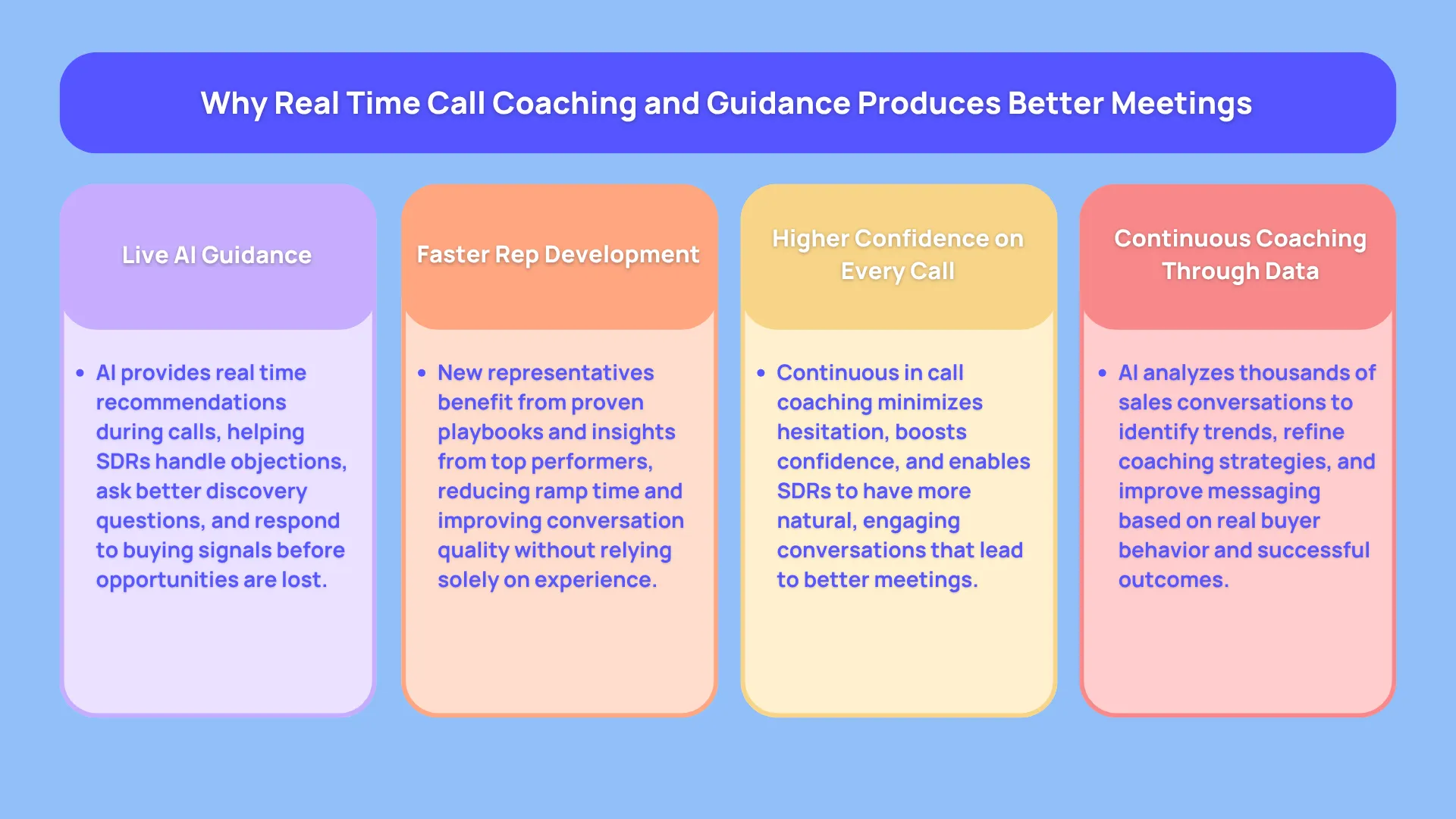
Why Real Time Call Coaching and Guidance Produces Better Meetings
Most sales coaching happens after the conversation has already ended.
- Managers review call recordings.
- They point out missed questions.
- They suggest stronger responses.
- Everyone agrees to improve next time.
That approach certainly helps, but it comes after the opportunity has already passed.
Modern Real time call coaching and guidance changes that process completely. Representatives receive helpful recommendations while the conversation is still happening.
Imagine speaking with a prospect who mentions hiring twenty new SDRs next quarter.
AI immediately recognizes a buying signal.
Without interrupting the conversation, it surfaces recommended discovery questions, relevant customer stories, pricing information, and objection handling suggestions directly on the representative's screen.
The SDR stays present in the conversation while receiving guidance that normally comes months later during coaching sessions.
That shortens learning curves dramatically.
Every Representative Has Access to Your Best Sales Playbook
One reason experienced salespeople outperform new hires is simple. They have seen hundreds of conversations; they recognize patterns.
On top of that, they also know which questions uncover buying intent.
New representatives need months to develop those instincts. AI helps close that experience gap much faster.
Rather than relying entirely on memory, representatives receive recommendations built from successful conversations across the organization. That creates greater consistency without making conversations sound scripted.
Every SDR benefits from knowledge that previously lived only inside the minds of top performers.
Coaching Happens While Confidence Is Still High
One overlooked advantage of Real time call coaching and guidance is psychological.
Cold calling can be emotionally exhausting. After several difficult conversations, even experienced SDRs begin questioning themselves. That uncertainty affects confidence, ultimately affecting the overall communication pattern.
In that order, to render massive support, AI provides steady support throughout the day.
- If a prospect raises a pricing concern, the representative immediately sees recommended responses.
- If a competitor is mentioned, relevant competitive positioning appears automatically.
If discovery questions have been skipped, the system reminds the representative before moving toward scheduling.
Those small moments of assistance reduce hesitation.
Representatives feel more prepared because they know guidance is available throughout every conversation.
That confidence often leads to more natural conversations and stronger meeting quality.
Better Coaching Creates Better Data
- Every conversation teaches something.
- Buyers ask new questions.
- Competitors introduce new messaging.
- Market conditions change.
- Traditional coaching depends on managers manually identifying those trends.
- AI analyzes thousands of conversations continuously.
- Patterns begin appearing much sooner.
Sales leaders can quickly identify which objections appear most frequently, which messaging resonates with different buyer personas, and which questions produce the highest meeting conversion rates.
That creates a feedback loop where coaching continuously improves because it reflects current buyer behavior rather than assumptions made several months ago.
What's the Best AI Outbound Calling Strategy for 2026?
This is one of the most common questions revenue leaders are asking today.
What's the best AI outbound calling strategy for 2026?
Many organizations assume success comes from buying the newest platform with the most impressive feature list. Technology certainly matters; tt simply should not be the starting point.
The strongest outbound programs begin with strategy and allow technology to support that strategy.
Companies that build a thoughtful outbound process create remarkable results because AI amplifies practices that already work.
A successful strategy combines people, AI, data, and workflow into one coordinated system.
Build Highly Focused Prospect Segments
Large prospect lists often look impressive on paper. They rarely produce impressive conversations.
Group prospects according to shared characteristics, business priorities, hiring activity, technologies, company size, and buying signals. The more relevant your messaging becomes, the more naturally AI conversations sound.
This is one area where personalization continues outperforming volume.
Train AI Around Conversations Rather Than Scripts
Many organizations still think in terms of scripts.
Buyers rarely follow scripts.
Every conversation takes unexpected turns.
Train your AI around conversation paths, common objections, qualifying questions, and buying signals.
That flexibility allows AI voice agents and virtual sales assistants to respond naturally while keeping conversations moving toward the next logical step.
Keep Humans Involved at High Value Moments
AI performs repetitive work exceptionally well.
Relationship building still belongs to people.
Allow AI to qualify prospects, answer common questions, schedule meetings, and gather context.
Bring experienced salespeople into conversations where buying decisions become more complex.
That partnership creates a stronger experience for both buyers and sales teams.
Connect AI With Your Existing Sales Stack
One reason AI adoption has accelerated so quickly is that companies no longer need to rebuild their technology ecosystem from scratch.
Many AI calling platforms connect directly with CRMs, sales engagement platforms, calendar software, conversation intelligence tools, and analytics systems.
This naturally answers another question many organizations ask.
How to implement AI calling within your existing sales engagement platform?
A couple of things that you can do for a head start. Take them as a general guideline, because we’d want you to improvise for the best long term results…
- Begin with one outbound team.
- Connect AI to your CRM.
- Import one carefully segmented prospect list.
- Test conversation flows.
- Review call recordings.
- Measure outcomes.
- Refine messaging.
- Expand gradually after performance becomes predictable.
Rolling out AI in phases produces better adoption than attempting a company wide deployment overnight.
Appointing a Technology Champion: Is It a Good Decision?
Technology champions are bunch of people that are well-versed in any software, it’s overall features and how to use the latest technology. Even if the program comes with tons of automation and self explanatory AI tech stack, sales teams do need training from someone who has hands on experience.
A “techie” could be a nominated person from within your company, or they could be someone from outside. In the latter case, external support comes from the same company you bought the software from. Either they do it for free through one or two online meetings, or they charge you extra.
If budget is a major concern, then go for an in-house technology champion who has prior experience with similar software etc. Ultimately, it’s your decision, so do whatever it takes to reduce ramp time for the entire team.
Measure Business Outcomes Rather Than Call Volume
Modern outbound organizations no longer celebrate activity for its own sake. Revenue leaders want conversations that become pipeline. Eventually, it becomes revenue.
That means performance reviews should move beyond simple dialing metrics.
When leadership begins asking What metrics prove AI outbound calling improves sales performance?, the strongest answers usually include held meetings, qualified opportunities, conversion rates, pipeline contribution, sales cycle length, and revenue generated.
Those measurements tell a much more complete story than daily call volume ever could.
Confident SDRs Burn Out Less, Here's How Trellus Helps
One of the biggest problems with traditional sales coaching is timing.
Most coaching happens after the call is over. A manager listens to recordings, points out missed opportunities, shares feedback, and hopes the representative remembers it during the next conversation. Valuable advice arrives after the opportunity has already passed.
Modern Real time call coaching and guidance works very differently.
Platforms like Trellus provide live coaching while the conversation is happening. Rather than waiting for a weekly review session, representatives receive contextual suggestions the moment they need them.
Imagine a prospect asking about pricing, mentioning a competitor, or raising an objection that commonly stalls deals. The platform can surface recommended talking points, objection handling guidance, relevant customer stories, or follow up questions without interrupting the conversation. The representative stays engaged with the buyer while receiving support that feels like having an experienced sales coach sitting beside them.
This becomes especially valuable for newer SDRs who are still building confidence. Even experienced representatives have days when conversations do not go their way. Hearing repeated objections or dealing with multiple rejections can affect energy levels and decision making throughout the day.
With intelligent guidance available during live conversations, hesitation begins to disappear. Representatives spend less time wondering what to say next and more time listening to the buyer. That creates smoother conversations, stronger discovery, and better qualified meetings.
Over time, confidence grows naturally because every conversation becomes another learning opportunity rather than another stressful guessing exercise.