
When Two Dialer Pilot Scorecards Disagree
Trace one disputed account, separate late recovery from the on-time score and write a decision both reviewers can reproduce.
On this page
Sales brings a slide saying the dialer pilot passed. Operations brings a sheet saying only nine of twelve accounts had the required outcome. The decision meeting starts in twenty minutes. Both numbers came from the same pilot.
Pick one disputed line and ask each person to show what counted. If one sheet counts notes and the other counts accounts, you can reconcile that before anyone has to defend a verdict. If the figures still disagree after both people apply the same rule, you have a smaller problem to investigate.
Put the original rule beside the two totals
Pull up the exact language the team agreed to before testing. You need the action, the unit, the deadline, and the place someone should be able to confirm the result. For example, “at least ten of the twelve assigned pilot accounts have an agreed call outcome and a usable next step on the CRM account by Friday at 5 p.m.”
Under that rule, each assigned account can count once. Keep the second note for context. Use a rep’s worksheet to trace what happened, then look in the CRM for the next step another rep could act on. If the missing next step appears after Friday at 5 p.m., record the recovery separately.
If the team now wants a different requirement, give it a name and a new test. The guide to handling a change in pilot success criteria walks through that conversation. In this meeting, start with the rule everyone already agreed to.
Compare records before you compare slides
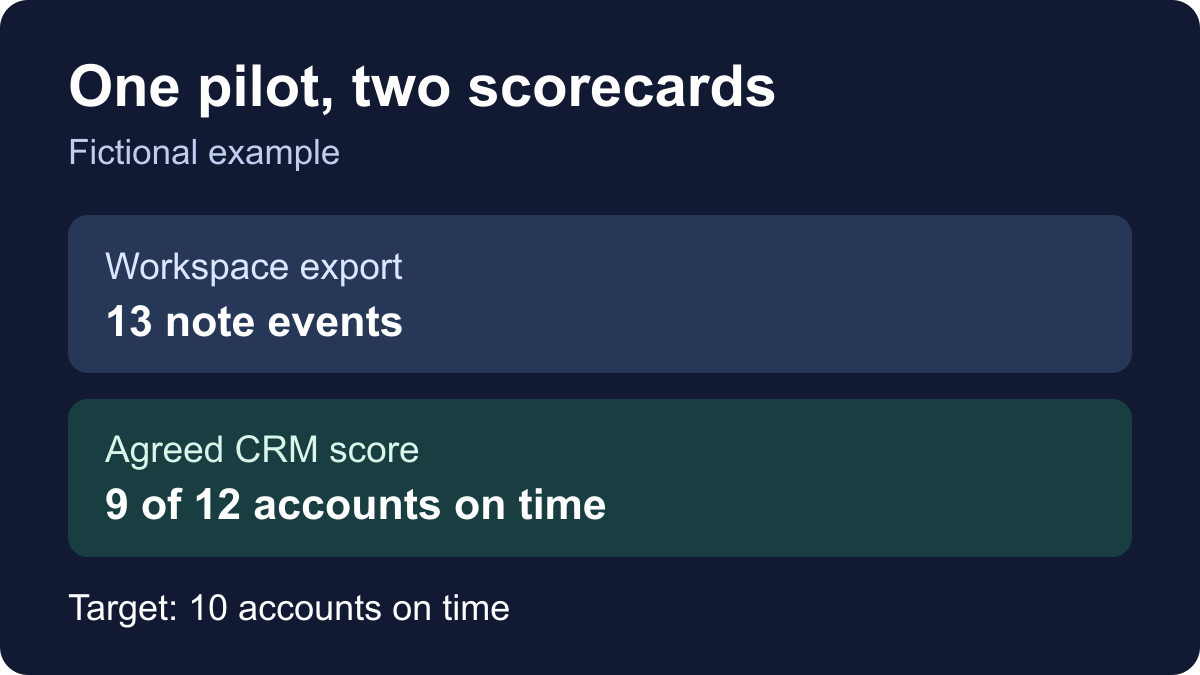
Suppose the sales lead exported 13 note events from the dialing workspace on Monday. Operations checked the same 12 assigned CRM accounts and found nine with the required outcome and next step by the deadline. The sales export gives you a list of records to check. Ask for the account reference, event time and outcome for the disputed rows. Give operations the same cutoff and use one timezone.
| What the reviewers found | Treatment under the agreed rule |
|---|---|
| Nine distinct assigned accounts have both fields on time in the CRM. | Nine qualify. |
| Two extra note events belong to accounts already counted. | Keep the notes. The account count stays nine. |
| One assigned account got its missing next step over the weekend. | Show it as recovered later. Keep it outside the on-time score. |
| One note event has no confirmed match to an assigned account. | Put the event in the unmatched pile until an owner traces it. |
| Two assigned accounts still lack the required CRM evidence. | Keep them in the denominator and assign the follow-up. |
These are fictional numbers. The on-time result is 9 of 12, against a target of 10. The note export had 13 rows because it included the nine qualifying accounts, two repeat events, the later completion and one unmatched event. The extra rows help explain what to fix. If both people had started with the note count, they could have declared a pass without checking what was visible in the CRM.
If a row uses a person ID and the other sheet uses an account ID, pause before treating the two IDs as equivalent. Confirm the relationship with the person who owns the report. The unit-of-analysis guide has examples of how a change in unit changes the answer. The data-lineage guide can help when the difference comes from a saved view, an export filter or a delayed sync.
Check the row that could change the decision
Here, a single additional on-time account would meet the target. Start with the unmatched event. Say it belongs to account 11 and its event timestamp is Friday at 4:46 p.m. That timestamps the note before the cutoff. The agreed rule requires both fields on the CRM account, so look for a timestamped CRM change or a saved snapshot. A Monday export that shows the fields today can’t settle when they appeared.
If the CRM history shows both fields on account 11 before 5 p.m., update the on-time score to 10 of 12 and write down what the original operations check missed. If it shows the fields appeared Monday, keep that account outside the on-time count and record the recovery. If the history is unavailable, leave the score at nine confirmed on time and mark the tenth case unresolved. The target remains ten in all three cases.
You can use the same check when both reports already count accounts. Open one account that appears only in the higher total and look for the smallest difference you can test. One saved report might use the note creation time while the other uses the CRM update time. Fix the disputed report definition and rerun the assigned list once before comparing the new totals.
Write the decision while both reviewers are there
Open a small reconciliation sheet in the team's approved workspace. For each contested number, save the rule and a record reference that the people in the meeting can check. Keep any sensitive call content where it already lives.
- Question — Did the agreed CRM outcome appear on at least ten of the twelve assigned accounts by Friday at 5 p.m.?
- Same set? — Link the assigned account list and record the timezone and cutoff.
- Observed — Save the source and what it counted. Include the difference between repeat notes and distinct accounts.
- State — Mark resolved if the figures reconcile, rerun if someone can repeat the agreed check, or unresolved if the evidence still can't establish an answer.
- Owner and deadline — Name one person to trace each outstanding case and say when the decision group will hear back.
Download the blank scorecard reconciliation sheet and fill it in with the reviewers. It includes the agreed rule, both sources, the confirmed on-time score and the next owner.
A short meeting note could read, “We confirmed 9 of 12 on time against a target of 10. A tenth account was completed after the deadline. Priya will trace the unmatched event by Tuesday morning. We’ll review whether the two remaining accounts need a repeat test before we sign off.” The team can see what happened, what they decided and what could change their mind.
Some disagreements survive a good reconciliation. The old export may be gone or the teams may have watched different parts of a call. If a disputed requirement could change the buying decision, set up a narrow rerun with the same rule and a shared place to record the outcome. If the decision can go ahead, write down the uncertainty and the person who accepted it. Both teams can then refer to the same record when someone asks how the pilot turned out.