How to Respond to a Sales Price-Match Request
Check what the buyer wants matched, keep the current offer clear, and give a complete answer after the right review.
On this page
If a buyer asks you to match another vendor's price, find out what they would be agreeing to at that price. Then separate what you can offer now from what you would need someone else to approve.

Find out what “match” would mean
Start with one question: “Which part of the offer do you need us to match?” The answer may concern the amount, but it could also concern the number of people included, the commitment, payment timing or work needed to get started.
Let the buyer explain the pressure behind it. They may have a spending limit, need to justify a difference internally, or simply want to know whether the proposal can change. Don't turn any of those possibilities into a fact before they've told you.
A useful reply is: “I can check what we can offer. First, could we confirm what the comparison includes and what your team needs?” That commits you to a check, rather than a discount you may not be able to provide.
If the buyer can't share another vendor's proposal, work from the requirements they can discuss. Don't ask them to disclose confidential terms, forward someone else's private correspondence or remove a restriction on a document. A description of the purchase they want may be enough to identify your next step.
Compare the work and the commitment
For a sales dialer, a price comparison needs the calling workflow too. Which CRM or sales engagement platform will the reps use? What calling mode do they need? Who will review what happens after a call? These are questions to verify with each seller, rather than assumptions that two offers include the same things.
Write down the relevant differences in ordinary terms. Keep the comparison small enough to read during the conversation:
- People and work
- Who needs access, what will they do, and which roles or teams are included?
- Scope
- Which capabilities, services or allowances are confirmed in the proposed offer? What would require a separate check?
- Commitment
- What period and payment arrangement is the buyer comparing? Which parts remain unconfirmed?
- Getting started
- What setup or training does each offer actually include, and who would do any remaining work?
- Decision
- What difference would affect the buyer's choice, rather than merely make one column look longer?
Don't fill a blank with a guess. “The buyer hasn't confirmed whether setup is included” is a useful note. “The other vendor charges extra for setup” would be an unsupported claim unless you've established it from an appropriate current source.
If Trellus is one of the options, use the current Trellus pricing page for published plan information and confirm the exact proposed scope. A general product page or an earlier conversation shouldn't stand in for the offer the buyer is considering.
A fictional request with two different problems
Imagine a buyer evaluating a calling tool for a small sales team. They ask: “Another seller has offered a lower price. Can you match it?” This is an invented example, not a report of either vendor's pricing.
On the follow-up call, the buyer explains that their immediate concern is getting approval for six reps. In this example, the rep's current proposal covers six rep seats on an annual term. The buyer hasn't confirmed the competing offer's seat count, term or setup support. An operations colleague also needs to check how the calling workflow fits their existing sales engagement platform.
There are now two questions. What offer could the rep's company approve? And would the proposed workflow meet the buyer's requirement? Even if a revised offer is approved, the workflow check still matters.
The rep could say: “I'll ask whether we can change the offer for the team you described. I haven't confirmed a revised price. Separately, let's keep the operations check in place, because you still need to see how this would fit your platform.”
Suppose the buyer then clarifies that their internal decision is delayed even at the lower price. Keep that information. Don't continue negotiating as though a price match would produce an immediate purchase. The guide to a moved budget-approval date covers agreeing a useful next step when the decision itself has shifted.
Alternatively, the buyer might say the total is acceptable but the commitment is too long. That deserves its own answer. An approved change to one part of the proposal doesn't automatically authorize changing another.
Check what you can actually approve
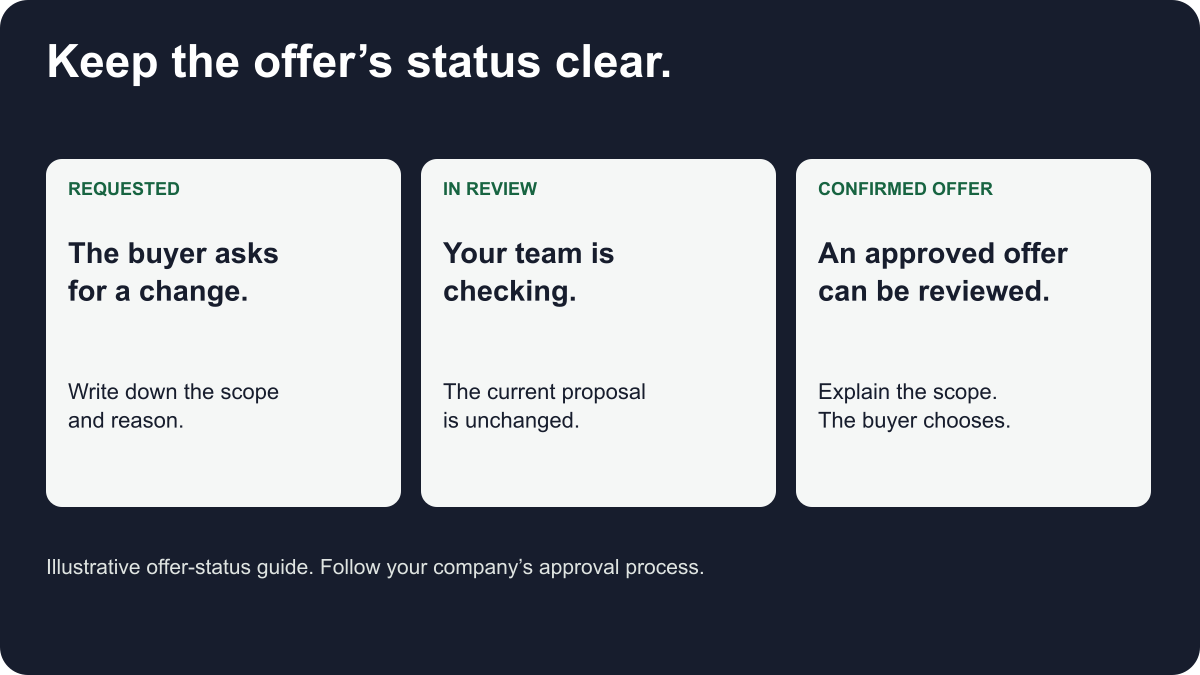
Use your company's existing approval process. Bring the person responsible a clear request: the proposed scope, the buyer's stated concern, the requested change and the decision still outstanding. Share only the information appropriate for that internal review.
Keep the current offer and the requested revision separate. A note saying “price-match request sent for review” helps a colleague pick up the conversation. A note saying “price matched” says something different and should wait until the change has actually been approved.
The same distinction belongs in what you tell the buyer. “I'll ask” is a useful promise you can fulfill. “We'll make it work” can sound like an answer when you don't yet have one. If you give a response date, make it a date you can reasonably honor; say whether the review itself is still pending.
Don't invent a discount deadline, a manager's approval or a special exception to keep the conversation moving. If another person needs to check a product detail, give them the exact question using the product-question handoff. A seller's confidence doesn't settle an unanswered capability question.
Give the buyer a complete answer
If the requested revision is approved, explain what changed and what the offer includes. Follow your normal written-proposal process so the buyer can review the actual terms. Check that the written offer and your explanation describe the same purchase.
If only part of the request is approved, say which part. Don't present a smaller scope as the same offer at a lower price. It may still be a reasonable option, but the buyer needs to understand what they would be giving up and whether it still meets the requirement.
If the answer is no, a direct response is more useful than a speech about value: “We can't approve that requested change. The offer we can make is the one we've confirmed. Would it help to review whether its scope fits what you need, or should we leave it there?” Adapt the wording to your actual authority and the buyer's question.
Sometimes the competing offer is the better choice for this buyer. You can explain a confirmed difference without disparaging that seller or inventing a limitation. If the buyer's requirements are still unclear, another concession may only postpone the same decision.
Keep any product evaluation tied to a real unresolved question. The sales dialer pilot checklist can help define a useful check. Don't require another trial solely to avoid giving an answer about the offer.
Leave a note the next person can act on
After the conversation, a colleague should be able to tell what the buyer requested, what your team confirmed and what remains open. A short note can do that without copying private competitor documents into another broadly shared record.
Buyer request: [the specific change they asked for]. Reason they gave: [their stated concern, without guessing]. Scope being considered: [people, work and commitment]. Current confirmed offer: [reference to the appropriate proposal]. Requested revision: [what needs approval]. Review owner and response date: [only what has been agreed]. Product question still open: [the check, if any]. Buyer next step: [what they actually agreed to do].
For the fictional buyer, the note might say: “Buyer request: match the competing offer for six reps. Reason: get the full-team purchase approved internally; the buyer hasn't confirmed that a revision would secure approval. Current proposal: six rep seats on an annual term, with no revision approved. Missing comparison details: the competing offer's seat count, term and setup support. Rep's next step: identify the required approver and submit the six-seat revision request. Review owner and response date: not yet confirmed. Product check: operations needs to review the calling workflow in the existing sales engagement platform; the reviewer and date aren't agreed. Buyer next step: not yet agreed.”
That note leaves room for a revised offer, a different scope or a decision to stop. It also lets the next rep continue the conversation without turning a request into a promise.