Our Top Picks


Starting your first sales job can be pretty intimidating, which is why many teams are turning to AI-powered sales simulations to build confidence.
If you were to ask sales reps about their past experiences on this, they’d recall how nerve-wracking it was to pick up the phone and talk to prospects.
The fear of messing up the pitch, not understanding their needs, or facing tough objections is a common hurdle that the right sales role play software can help overcome.
And let’s not even get started on the worry that they might know more than you do. It’s a lot to handle!
But here’s the thing: that fear is totally normal.
Everyone goes through it.
Eventually, it becomes their second nature to speak with prospects, dial up numbers, and rake up those conversions like it owes em’ money!
The good news?
There’s a way to get past it, and the answer lies in dedicated AI conversation practice for sales.
Utilizing sales training simulation tools for practicing sales conversations is one of the best ways to build confidence, sharpen your skills, and get ready for real-life scenarios.
The only problem? Sales leaders are often too busy to practice role-plays with every team member, which is where AI sales training platforms provide a scalable solution.
That’s where sales call simulation tools come in to bridge the training gap.
These tools offer virtual role playing for sales reps, letting your team practice sales conversations on autopilot with AI-driven scenarios.
The AI even acts as a virtual coach, providing the AI-driven sales enablement needed to help your team improve.
In a nutshell, we can say that a sales negotiation practice tool is a game-changer for onboarding new reps, ensuring they know the product inside out and master new skills quickly.
Why Should You Use AI Sales Role Play Software?

Couple of reasons for doing so.
Let’s break it down so that you can get the gist of it in a better way.
When you compare traditional 1:1 role-playing with AI sales role play training, the following key factors come into play.
Bear in mind that depending on your company, team’s or business requirements, the reasons might change a little. But they remain the same, more or less.
- Your Time:
In-person role-plays eat up a ton of time. Imagine you have 10 salespeople. If you spend 10 minutes on a role-play session, 5 minutes giving feedback, and another 15 minutes revisiting the session to assess progress, that’s 30 minutes per rep. For a team of 10, that’s 5 hours gone! And if you have 20 reps? Forget about it—your whole day is booked. With a sales performance feedback AI, your team can practice independently, freeing up your time for other priorities. - Repetitions Matter:
Think about how athletes train. Mike Tyson sparred hundreds of rounds to prepare for a fight. Similarly, your sales team needs plenty of repetitions to master their craft. With AI sales training role play, your reps can practice as many times as they need—whether it’s 5, 10, or even 20 times—until they nail your sales standards. - Feedback That Actually Helps:
Giving feedback during role-plays can be tricky. You need to take notes, remember what was said, and provide actionable advice—all while juggling other tasks. The best AI sales role play tools give detailed feedback, analyzing everything from speech delivery to how well the rep handled objections. Some even let you customize the feedback to align with your company’s sales methodology.
Another major advantage concerning the best AI sales role play tools 2026 comes from consistency. Human coaching can vary depending on time, energy levels, or memory recall during feedback sessions. AI platforms evaluate calls through structured scoring systems that remain uniform across every rep. Managers gain clearer visibility into patterns, weaknesses, and coaching opportunities across the team.
Many modern tools also include conversational intelligence capabilities. They evaluate filler words, talk to listen ratios, objection handling quality, response timing, and emotional delivery. Some systems even compare role play performance against live customer conversations to identify gaps between practice and execution.
For onboarding, the impact is substantial. New hires can ramp faster because they are exposed to realistic conversations early in the training process. Experienced reps also benefit because role play scenarios can evolve alongside new products, market conditions, pricing changes, or competitive positioning updates.
How to Choose the Best AI Sales Role Play Software
One of the first things worth evaluating is realism. Strong role play software should simulate conversations that feel natural and unpredictable.
Reps should face interruptions, objections, hesitation, pricing pressure, and difficult buyer personalities similar to real world situations. Platforms that rely too heavily on rigid scripts can limit learning outcomes because sales conversations rarely follow perfect structures.
Feedback quality also matters significantly. Many tools claim to provide AI coaching, but the depth of analysis varies widely. Better platforms evaluate communication clarity, objection handling quality, confidence levels, pacing, active listening, and adherence to sales frameworks. Some solutions also allow managers to customize scoring criteria according to their internal methodology.
Ease of adoption is another critical factor. Sales teams already operate across multiple systems daily. If the platform feels complicated or difficult to navigate, rep engagement tends to drop quickly. A clean interface, simple scenario creation process, and quick onboarding experience often influence long term adoption more than advanced features alone.
On a related note, the integration capabilities should also be reviewed carefully.
Certain platforms connect directly with CRM systems, conversation intelligence software, dialers, or LMS platforms. Those integrations can simplify coaching workflows and centralize performance data for managers.
Top AI Sales Role Play Tools to Consider
Here’s a quick rundown of some of the best tools out there:
1. Trellus.AI

Let’s start with Trellus.
It’s a dedicated lightweight solution that provides behavioral analysis for sales training, made for sales teams and businesses to pivot their overall conversion ratio, performance and workflow optimization.
How does Trellus achieve that?
The benefits are manifold.
The free a.i. sales roleplaying toolset allows your sales reps to setup practice calls that are based off of previous live interactions with your prospects.
In their own time, SDRs can replay those scenarios and come up with better counter statements to improve their conversions.
Then there’s the robust gamified sales training system that picks up on on-going live calls’ behavioral patterns, and gives cues wherever your salesperson might be lacking. This is one of the most sought out and important features because businesses can’t risk losing high ticket clients.
Trellus comes as an AIO solution in the form of a lightweight Chrome Extension.
Thanks to popular demand, we also introduced parallel dialing and LinkedIn superhuman feature to help sales reps and businesses scale everything without risking time over different processes otherwise.
For pricing details and any other feature related information, feel free to reach out to our sales team anytime.
We’d be more than happy to help you get started.
2. SecondNature

Known for its built-in learning management system (LMS), SecondNature offers a form of virtual reality sales training by combining AI role-play with training modules.
It’s great for large teams, but it can feel a bit too easy at times—your reps might not get enough practice with AI role-play for B2B sales and handling tough objections.
3. Outdoo AI
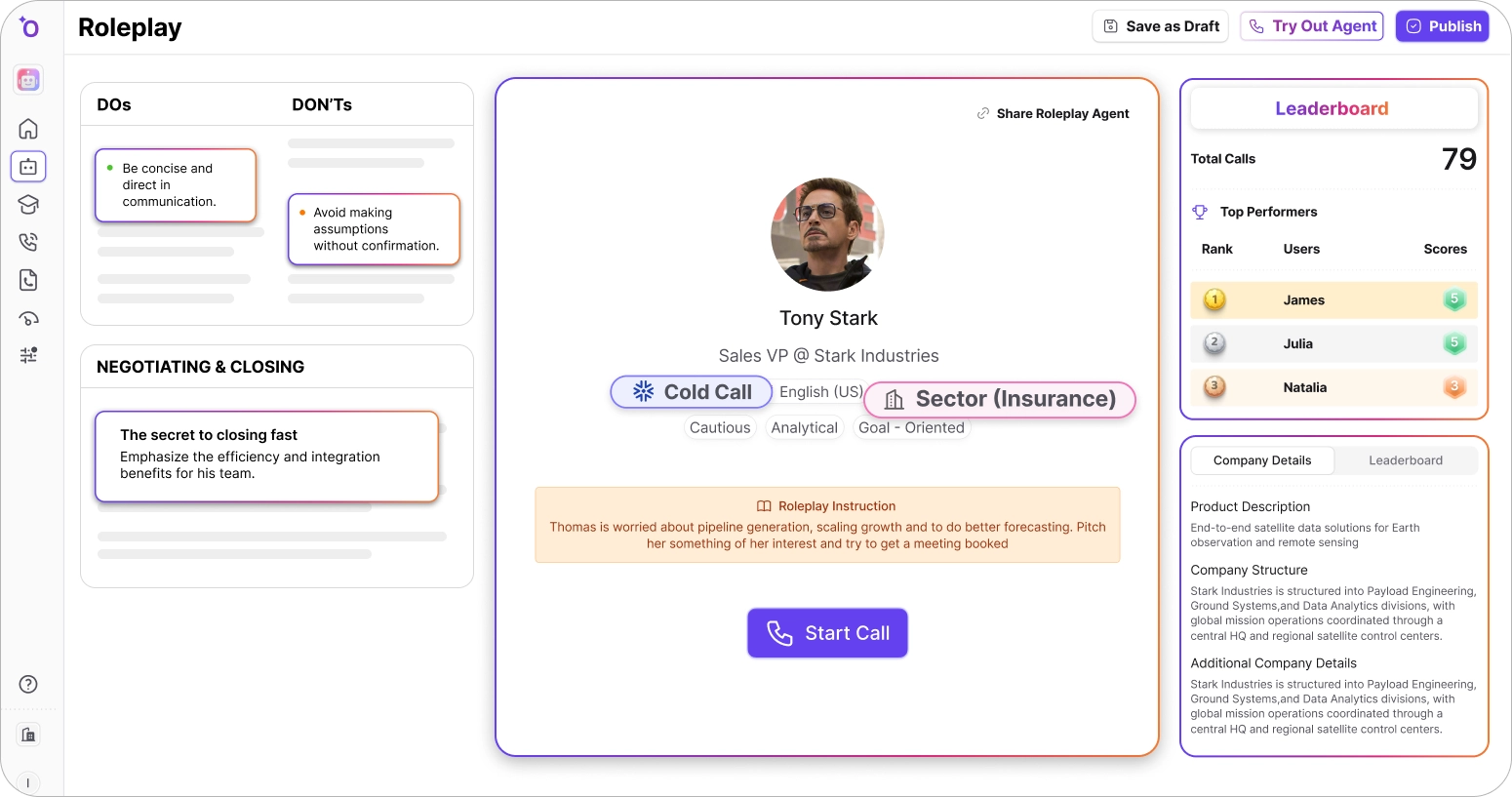
Outdoo is an AI roleplay and coaching platform for customer-facing teams that turns training into real execution. It closes the coaching loop by linking realistic roleplay practice with live customer conversations and post-call assessment, so leaders can see whether coaching actually changes behavior over time.
Outdoo creates roleplays from real calls in one click, using real customer language, objections, and deal context. It applies unified AI scoring across both roleplays and real calls, using deep scorecards for discovery, objection handling, messaging accuracy, and talk track adherence so teams can compare practice performance with real execution. It also supports multi-persona simulations for complex, multi-stakeholder conversations and prompt-based fine tuning so enablement teams can update agents quickly as messaging changes.
Outdoo does not publish public pricing. Pricing is custom (quoted per team) and typically designed for organizations with 5+ users.Outdoo offers a free demo and supports enterprise deployment needs including SOC 2 with GDPR, HIPAA, and CCPA readiness, plus SSO, private cloud options, and PII data scrubbing.
4. Quantified

This tool stands out with its photorealistic avatars, making its cold call simulation software ideal for teams that rely on face-to-face interactions.
However, the AI settings are somewhat limited, so it might not fully prepare reps for real-world “NOs.”
5. Hyperbound

Hyperbound excels in voice customization, letting you create personalized sales training programs by tweaking the AI’s tone, speed, and even how difficult they are to persuade.
Ther program is perfect for cold-calling practice, but it doesn’t offer much for in-person or other types of sales interactions.
6. Zenarate

A solid option for teams looking for sales presentation skills practice and to practice a variety of scenarios, from cold calls to product demos.
The feedback is detailed, but the setup can be a bit time-consuming.
7. Nytro.ai

This tool focuses on helping reps achieve AI-powered sales readiness by improving their conversational skills with AI-driven practice sessions.
It’s user-friendly, but the feedback can feel a bit generic at times, lacking the depth of a dedicated real-time sales coaching software.
8. Brevity

Brevity is a great option for AI for enterprise sales training, especially for teams that want to practice handling objections and closing deals.
The AI feedback is solid, but the platform lacks some of the advanced features of other tools.
9. Replay

Replay offers a mix of AI-driven role-play and video recording, making it a useful tool for sales discovery call practice where reps can watch their practice sessions and learn from their mistakes.
It’s a good option for teams that prefer a more visual approach.
10. FullyRamped
FullyRamped focuses heavily on AI powered sales onboarding and rep ramp acceleration. The platform is designed for companies that need new hires productive faster without forcing managers into endless shadowing sessions and repetitive coaching calls.
The role play environment allows reps to practice cold calls, discovery conversations, qualification frameworks, and objection handling scenarios through conversational AI simulations. Teams can build customized training paths aligned with specific industries, buyer personas, or sales motions, helping reps absorb messaging more effectively during onboarding.
One of the stronger aspects of this AI sales roleplay tool 2026 is its coaching structure.
Managers can review simulated conversations, track rep progression, and identify skill gaps before salespeople begin handling live pipeline opportunities. The platform also includes certification style workflows that ensure reps meet predefined competency standards before advancing further into customer facing activities.
For fast growing outbound teams, FullyRamped provides a practical balance between onboarding automation and performance visibility.
11. PitchMonster
PitchMonster is an AI driven sales role play and objection handling platform designed to help reps improve live conversation performance through repeated practice simulations.
The platform focuses heavily on conversational realism, helping sales teams prepare for cold calls, demos, qualification calls, and difficult customer interactions before entering live selling situations.
One of PitchMonster’s strongest capabilities involves customizable AI buyer personas. Sales leaders can configure different customer personalities, objection styles, industries, and conversational difficulty levels to create more realistic training environments. This helps reps prepare for a broader range of real world selling scenarios instead of memorizing rigid scripts.
The platform also generates detailed coaching feedback after each simulation. Reps receive analysis tied to communication clarity, confidence, objection handling quality, filler words, pacing, and conversational flow. Managers can review performance trends across teams and identify coaching gaps more efficiently through centralized reporting dashboards.
PitchMonster works particularly well for outbound focused organizations looking to improve cold calling confidence and objection management without requiring constant live coaching sessions from sales leadership.
12. Allego
Allego approaches sales training from a broader enablement perspective, combining AI coaching, learning management, content sharing, and video based practice within a single ecosystem. The platform is widely used among enterprise organizations seeking structured sales learning environments that support distributed teams.
One of Allego’s most valuable capabilities involves asynchronous coaching. Reps can record presentations, pitches, and mock conversations while managers review and provide feedback without requiring live coaching sessions. This flexibility becomes extremely useful for remote teams operating across multiple regions or time zones.
The AI coaching layer evaluates communication delivery, presentation structure, confidence levels, and messaging consistency. Teams can also create role play exercises tied to product launches, competitive positioning changes, or new sales methodologies.
Beyond role play functionality, Allego serves as a centralized enablement hub where sales content, onboarding resources, and coaching workflows remain connected. Organizations looking for a combination of training infrastructure and AI powered practice often find strong value in the platform.
13. SecondNature
SecondNature remains one of the more established names in conversational AI training for sales teams. The platform uses AI powered avatars to simulate buyer interactions across different stages of the sales process, helping reps strengthen communication skills through repeated practice sessions.
The simulations are designed to feel conversational rather than scripted. Reps encounter objections, hesitation, pricing pressure, and qualification scenarios that require adaptive responses during the interaction. This dynamic approach helps create more realistic preparation for live customer conversations.
SecondNature also performs strongly in onboarding environments where consistency across training programs matters. Managers can assign practice tracks, monitor performance progression, and standardize coaching frameworks across larger sales teams.
The reporting environment provides useful visibility into communication trends, objection handling quality, and rep improvement over time. Enterprise sales organizations frequently use the platform to accelerate onboarding while maintaining coaching consistency at scale.
14. Mindtickle
Mindtickle combines AI sales coaching, readiness assessment, and enablement workflows into a comprehensive sales performance platform. The system is designed for organizations looking to connect training outcomes directly with revenue execution.
One of Mindtickle’s major strengths lies in readiness tracking. Managers can evaluate rep competency across messaging, objection handling, discovery execution, and product positioning before those reps engage with active pipeline opportunities. This creates stronger quality control throughout onboarding and ongoing coaching programs.
The AI role play capabilities support scenario based learning where reps practice conversations against simulated customer personas. Feedback focuses on communication effectiveness, confidence, conversational structure, and adherence to internal sales methodologies.
Mindtickle also integrates broader enablement capabilities including coaching programs, certifications, learning modules, and performance analytics. For larger organizations managing complex sales structures, the platform offers a more centralized approach to sales development and coaching operations.
15. Yoodli
Yoodli has emerged as a strong AI communication coaching platform with growing adoption among sales teams focused on presentation quality and conversational improvement. While not built exclusively for sales role play, its coaching environment works well for SDRs, account executives, and customer facing professionals looking to strengthen verbal communication skills.
The platform analyzes filler words, pacing, confidence, speaking patterns, clarity, and conversational structure during practice sessions. Reps can simulate presentations, pitches, discovery calls, and objection handling exercises while receiving immediate coaching feedback generated through AI analysis.
One area where Yoodli performs particularly well involves speech delivery refinement. Teams focused on improving executive presence, presentation confidence, and verbal clarity often find the platform useful for continuous coaching support.
The platform also supports personalized coaching recommendations over time, helping reps identify recurring communication habits that may negatively impact live sales conversations.
Final Thoughts
If you’re looking for a way to help your team build confidence and improve their skills, AI sales role play tools are a no-brainer.
As you already know by now, these tools reportedly save time, provide realistic practice, and deliver actionable feedback—all without requiring hours of your day. Whether you’re onboarding new reps or upskilling your veterans, these tools can make a huge difference.
And if you’re curious about trying one out, some platforms even offer AI sales role-play free trials.
It’s a great way to test the waters and see which tool fits your team’s needs. So, what are you waiting for? Give your team the practice they need to crush their sales goals!
Frequently Asked Questions – Ai Sales Roleplay Tools, Apps & General Use
1. What is AI sales role play, and how does it work?
AI sales role play is a training tool that uses artificial intelligence to simulate real-life sales conversations.
The technology allows sales reps to practice scenarios like cold calls, product demos, handling objections, and closing deals in a risk-free environment.
The embedded artificial intelligence acts as a virtual customer, responding dynamically to the rep’s pitch.
After the session, the AI provides instant feedback on areas like tone, pacing, objection handling, and adherence to your sales methodology.
This helps reps refine their skills and build confidence before talking to real prospects.
2. Why should I use AI sales role play instead of traditional role-playing with a manager?
Traditional role-playing with a manager is effective but time-consuming. Managers often don’t have the bandwidth to practice with every rep regularly.
AI sales role play tools solve this by allowing reps to practice independently, anytime they need. The AI provides consistent, unbiased feedback, and reps can repeat scenarios as many times as they want.
Plus, these tools often include advanced features like speech analysis, customizable scenarios, and performance tracking, which can be harder to replicate in manual role-plays.
3. Can AI sales role play tools handle complex sales scenarios?
Yes, many AI sales role play tools are designed to handle complex scenarios.
For example, you can set up a scenario where the AI customer is a skeptical decision-maker with specific objections.
The AI will respond dynamically based on the rep’s approach, just like a real prospect would. Some tools, like Trellus, even let you customize the AI’s behavior to match your ideal customer profile or specific sales challenges.
This ensures your reps are prepared for the toughest conversations.
4. Is AI sales role play suitable for teams other than sales?
Absolutely! While these tools are primarily designed for sales teams, they can also benefit other customer-facing roles like customer support, successful teams, and even account managers.
For example, support teams can practice de-escalating angry customers, while customer success teams can role-play upsell conversations.
Tools like Trellus, as mentioned earlier, allow you to create tailored scenarios for different departments, making them a versatile investment for your entire organization.
5. Are there free AI sales role play tools available?
Yes, some platforms offer free trials or limited versions of their AI sales role play tools.
These free versions are a great way to test the software and see if it fits your team’s needs. However, keep in mind that free tools may have limitations, such as fewer features, restricted scenario options, or limited feedback.
If you’re serious about scaling your team’s training, investing in a paid tool with advanced features and customization options is often worth it...
6. Why are companies moving toward AI sales role play platforms?
Traditional coaching models often require large amounts of managerial time, especially during onboarding and rep development. AI role play platforms allow reps to practice independently while still receiving structured coaching feedback.
Organizations also gain more consistent evaluation standards across the sales team. Managers can monitor skill development, identify recurring weaknesses, and scale coaching programs more efficiently without conducting every training session manually.
For fast growing teams, this creates a more scalable and measurable sales development process.
6. Can AI sales role play tools simulate difficult prospects and objections?
Yes, many modern platforms are designed specifically to replicate challenging customer interactions. Teams can create scenarios involving skeptical buyers, pricing pressure, gatekeepers, competitor comparisons, or aggressive objections.
Advanced platforms also allow customization around buyer personalities, industry specific language, and company messaging frameworks. This helps reps prepare for high pressure conversations before entering real customer situations.
8. Are AI sales role play tools useful for experienced sales reps?
Experienced reps benefit from these platforms as much as new hires. AI coaching environments help reinforce messaging consistency, refine objection handling strategies, improve presentation delivery, and prepare teams for new product launches or market shifts.
Senior reps often use role play simulations to test new talk tracks, practice enterprise conversations, or strengthen negotiation approaches before important meetings.
9. What features matter most when evaluating AI sales role play software?
Several factors play a major role when comparing platforms. Realistic conversation flow is critical because rigid, scripted simulations often produce weaker training outcomes. Coaching depth also matters since some tools provide far more actionable feedback than others.


Power and parallel dialing in your CRM.