When Your Champion Leaves Before the Deal Is Signed
Confirm who owns the work, preserve what the buyer actually agreed to, and choose a useful handover or pause.
On this page
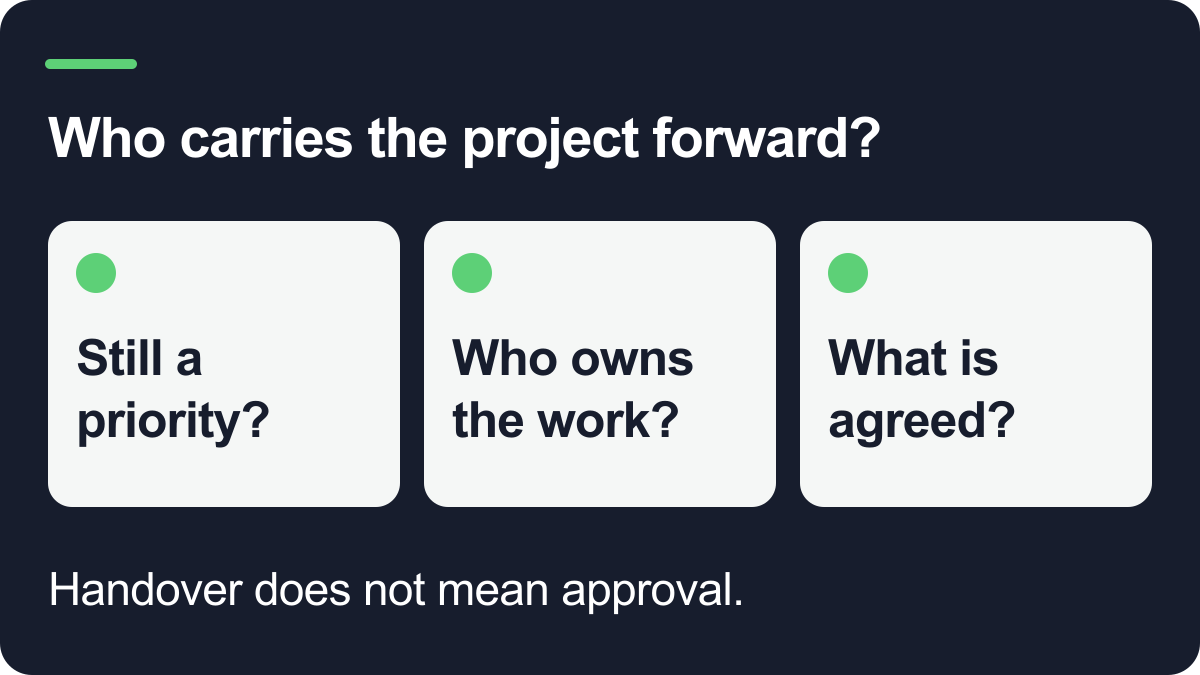
When your champion leaves, find out who still owns the work before asking someone else to take over the purchase. The business problem may survive. The departing person's enthusiasm, introductions and willingness to argue for a change may leave with them.
A useful next step can be a handover, a short conversation with the responsible successor, or an agreed pause. Sending the old proposal to more people won't tell you which one the buyer wants.
Check what actually changed
A bounced email, an unanswered call or a changed profile isn't enough to explain what's happened. If the departure hasn't been confirmed, ask an appropriate existing contact a simple question: “Is Avery still the right person for this project?” Keep the answer separate from your guess about why messages stopped.
Once the change is confirmed, separate three roles that your previous contact may have combined: the person responsible for the business problem, the person willing to support your proposal internally, and the person able to approve the purchase. A successor's job title doesn't establish that they hold all three.
Suppose the head of sales operations leaves during a reporting evaluation. The finance team may still need the report. A temporary operations lead may now own its production. Neither fact establishes that the company wants to continue evaluating your product this month.
Ask what happens to the project itself: “Who is responsible for the reporting review now, and do they want to continue it?” That gives an existing contact something concrete to answer without asking them to recommend you.
Make a handover note that doesn't depend on the old relationship
Before reaching out, write down what a new owner would need to understand. Use the buyer's business question and dated agreements. Leave out your interpretation of how much the departing person liked the demonstration.
This small worksheet is useful even when nobody has agreed to meet. Its blank spaces show you what you still need to ask.
| Handover question | What to record | What still needs an answer |
|---|---|---|
| What work prompted the evaluation? | The buyer's stated problem, who uses the result, and when that was confirmed. | Whether the new owner considers it a current priority. |
| What has the buyer checked or agreed to do? | Completed reviews or agreed actions, with the participants and dates. | Which decisions remain open. |
| What depended on the departing person? | An introduction, internal recommendation or action they personally offered. | Whether anyone else has agreed to carry it forward. |
| Who can receive the handover? | The contact the buyer has identified and the material appropriate to share. | Who owns the project and whether they want the context. |
| What happens next? | A buyer-confirmed action, responsible person and date, if one exists. | Whether to arrange a conversation, wait for a named event, or close the evaluation. |
Use “unknown” where you don't have an answer. “Avery planned to request budget approval” is different from “Finance approved the budget.” An internal action that was promised but never confirmed belongs in the open questions.
Keep the original notes. Add the change and its source rather than rewriting the previous conversation to fit the new situation. If earlier accounts conflict, reconcile the buyer notes before passing along a confident summary.
If your champion can still make an introduction
Ask for a small, specific handover while they're still in a position to help. Don't hand them a new presentation to sell on your behalf during their departure.
An example request: “Would it be useful to introduce me to the person taking over the reporting review? I can send a short summary of the question you were evaluating, what you've already checked and what is still open. If the project is being paused, that's helpful to know too.”
The useful introduction explains why the recipient is being included. It might say that a report still needs an owner and that a product evaluation was underway. It shouldn't imply that the successor has endorsed a supplier they haven't reviewed.
Offer a short written summary first. Let the departing person correct it and decide whether an introduction is appropriate. Share relevant material with the agreed recipients; don't assume the entire email history, recordings or internal comments should follow the handover.
If the introduction arrives, give the new contact room to disagree. “Avery suggested you now own this review. Is the reporting question still something you're working on?” is a better opening than treating their attendance as the next approval.
If they've already gone, ask who owns the work
Start with an appropriate contact already involved in the evaluation, such as someone who attended the working session or asked for the output. Explain the specific project, then ask who is responsible for it now.
You might write: “We were reviewing how the weekly report gets produced. Avery had asked us to work through the exception cases, which are still open. Who owns that review now, and would a short handover be useful?” This is an illustrative message, not a claim that the review remains active.
If you don't have an existing project contact, use an appropriate business contact route to ask for the responsible team. A list of people with plausible titles is a starting point for finding responsibility, not permission to send them the previous buyer's confidential material. An account map can help organize the relationships you actually know.
Avoid asking the former employee to carry information from their old company into their new role. They may no longer be able to make introductions or speak for the project. Keep the next conversation with the organization that would make the purchase.
If nobody can identify an owner, record that plainly. Repeated outreach doesn't turn an ownerless evaluation into an active buying process.
Work through a fictional handover
Imagine an operations manager, Avery, evaluating a tool for two regional teams. One team has reviewed a sample report. The other hasn't. Avery said they would introduce the finance lead after both teams had checked the exceptions. Avery then leaves the company.
The seller's original note says, “Finance introduction next.” After the departure, that description hides two unresolved questions: who will finish the second team's review, and whether anyone still wants the finance introduction.
The seller contacts Jordan, who participated in the first team's review. Jordan confirms that the reporting issue still exists, but says the incoming manager will decide how to address it. Jordan is willing to pass along a short summary.
At this point the confirmed next action is a handover through Jordan. It isn't a finance meeting or a commitment to buy. The summary should say that one team reviewed the report, the second review remains open, and the finance conversation was proposed but hasn't happened.
Two reasonable outcomes could follow. The incoming manager might ask to revisit the reporting question before continuing the evaluation. Or they might decide that another project takes priority and ask to pause it. Neither outcome needs to be forced into the old sequence.
If a conversation is agreed, use the existing guide to bringing a new stakeholder into an evaluation for the meeting itself. The immediate job here is establishing whether there is a continuing project and someone who wants that conversation.
Update the next action, not just the contact name
Changing the primary contact in your CRM won't capture what changed in internal support. Add a dated note explaining the confirmed departure, the project status, the known successor or owner question, and the action the buyer has actually agreed to.
Keep a proposed action separate from an accepted one. “Ask Jordan for a handover” is your task. “Jordan will forward the summary on Tuesday” is a buyer agreement. “New manager will approve this month” is still an assumption unless that person has said so and has the relevant authority.
Review the expected close date and stage using your team's normal rules and the current facts. A departure doesn't automatically mean the deal is lost. A previous target date also doesn't establish that the remaining work can still be completed on time.
If the problem has become an approval or funding delay, handle that question separately. The guide to a moved budget approval helps distinguish a timing change from an unconfirmed purchase plan.
Make a pause useful
“Check back later” leaves both sides guessing. If the buyer wants a pause, ask whether there's a useful event to return to: the new owner starting, an internal project review, or a decision about who will produce the report. Agree how and when to check back if they want that contact.
If there isn't a continuing project, an owner or an agreed reason to return, say so in the opportunity notes. You can preserve the useful history without calling the old evaluation active.
The handover has done its job when the next action belongs to the people still responsible for the work. Sometimes that's a meeting. Sometimes it's a clear pause or an honest end to the evaluation.