
When a Dialer Pilot Ends Without the Conversations You Needed
Review one fictional 150-attempt pilot, separate setup controls from ordinary buyer conversations and take a requirement-level evidence card to the decision.
On this page
If a dialer pilot ends without the conversations the team needed to evaluate, separate what you learned about the calling workflow from what you still don't know about working with a buyer on the line. Zero conversations is a result worth recording. It doesn't turn every feature into a failed test, and it doesn't make the untested parts a pass.
Before extending the trial or choosing a vendor, write a short account of what actually happened. Then choose the smallest useful check for the question that could change the decision. More access is useful only if someone can do that work.
This guide gives a sales operations lead a worked review and a reusable evidence card. The example uses an unnamed product and invented records; use the card with the approved records from your own evaluation.
First check what “no conversations” means
Ask the rep who ran the block to show how the result was counted. An unanswered attempt, a voicemail greeting, a person who immediately asks to be removed and a conversation with the intended buyer are different outcomes. A report may group some of them under “connected.” Your evaluation may require something more specific.
Keep the original labels, then explain how they relate to the definition agreed for the pilot. Don't change that definition afterward to turn the result into a success. If it was never agreed, say so and review the underlying records before comparing tools.
Suppose the team recorded 150 outbound attempts and no conversations under its stated definition. The observed conversation rate is 0 divided by 150, or 0%. That describes those attempts. It doesn't establish that the product can never produce a conversation. If the attempt count itself is unavailable or disputed, leave the rate uncalculated until the denominator is resolved.
Also check whether setup calls were mixed into the prospecting total. A colleague answering a practice call can help inspect audio or a saved record. It isn't a prospecting conversation, a meeting or a qualified opportunity. Keep those calls in a separate test note.
Keep the useful evidence the team already collected
Even an unanswered block may reveal whether a rep can find the intended list, choose the correct phone field, start an attempt and record a no-answer result. It can also reveal a missing permission or a repeated manual step. Preserve that work instead of calling the whole week inconclusive.
Write each finding at the level the observation supports. “The rep could open the saved list” is narrower than “the integration works.” “The no-answer result appears on this contact” is narrower than “all call outcomes sync.” The guide to save requests and saved-record evidence helps distinguish a message in the calling screen from information someone can find afterward.
For an error, keep an example and the step where it occurred. An invalid-number message deserves a different investigation from audio that fails during an answered control call. Don't assign either to list quality, the carrier, the dialer or the rep until the available evidence supports that explanation.
Check a small, deliberately chosen set of records across the outcomes you actually have. State how you chose them. Five inspected attempts can explain those five attempts; they don't establish the condition of every row in a 150-attempt block.
Use a controlled call to answer a workflow question
If the open question is whether the intended colleague can hear the rep and find the saved note, arrange a practice call with someone who has agreed to participate. Use the team's approved test records and normal access. Don't call more prospects merely to troubleshoot a setup problem.
Start from the same kind of list or task the rep intends to use. Have the participant answer, exchange a short agreed conversation, finish the call and save the result through the supported workflow. Then have the person responsible for follow-up open the intended record in their usual view.
Look at the required result, not just the caller's screen. Can the next person read the note? Is any required task linked to the right record and assigned to the intended owner? If the workflow needs a separate manual task, include that action in the test. Don't silently replace an automatic-task requirement with a note.
Be precise about what the control established. Hearing a colleague through a test call doesn't establish sound quality across the team's normal destinations. Finding one saved note doesn't establish every disposition or callback path. A prepared conversation also can't tell you how useful coaching will be during an unfamiliar buyer objection.
Use the control to settle a bounded setup question. Keep the ordinary buyer-facing experience marked as untested where it remains untested. If your team cannot arrange the control through an approved workflow, preserve that limitation rather than treating a seller's demonstration as your team's completed check.
A fictional pilot with one useful pass and one unresolved gap
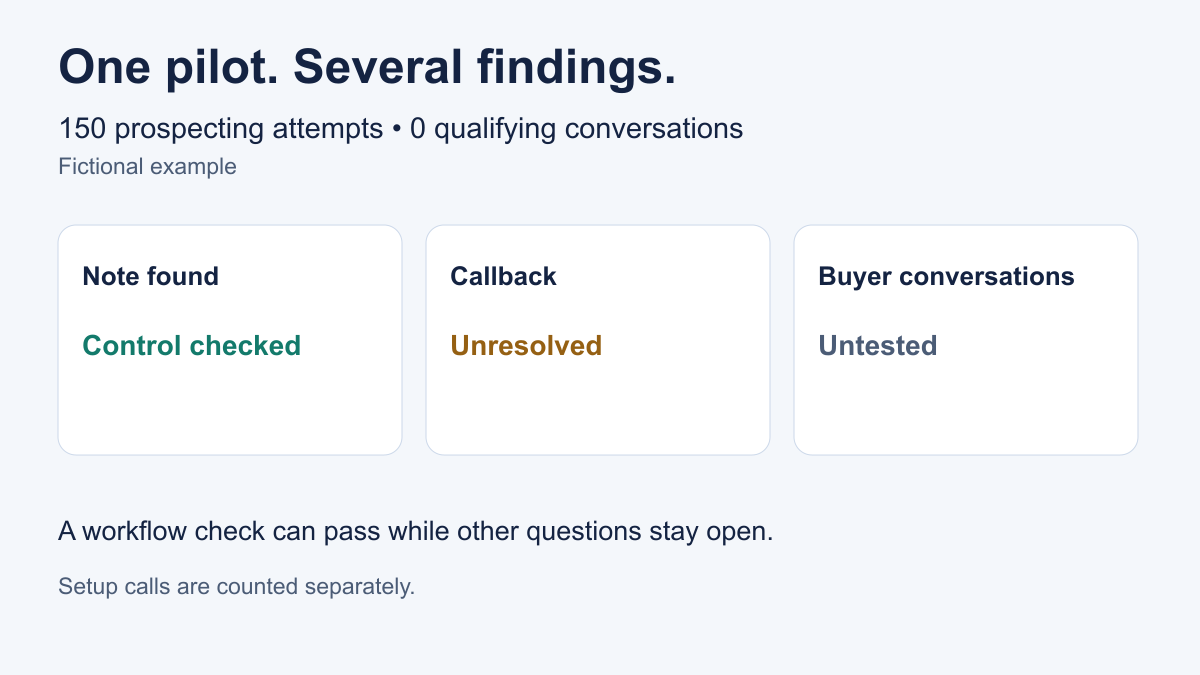
Imagine that Lena's team records 150 prospecting attempts over two days on one saved list. None meets the team's agreed conversation definition. Those totals alone don't tell Lena whether the list, timing, number setup or another factor explains the result.
She asks a rep to trace five selected attempts: three no-answer results, one voicemail and one error. The rep can find the corresponding activity on the intended contacts. That supports a finding about those records and their recorded outcomes. The error still needs investigation; Lena doesn't classify all 150 attempts from this small review.
The team separately makes two agreed calls to a colleague using approved test records. Those two calls stay outside the 150 prospecting attempts. In the first, the colleague hears the rep, and the follow-up owner can find the saved note. Lena records that specific workflow check as passed.
In the second, the team follows the proposed callback process, but the intended owner cannot find the next action in their normal worklist. Lena keeps the cause open. The review needs to establish whether the task exists, which record and owner it uses, what access is available and whether another step is required.
The trial now has several findings, rather than one score: selected attempt records inspected; one controlled note path checked; callback worklist unresolved; ordinary live-conversation experience untested. A successful note check doesn't cancel the callback gap. Zero prospecting conversations doesn't erase the note check.
Lena can ask the vendor to investigate the callback example before arranging more prospecting. If that workflow is essential and cannot meet the requirement, the team can stop for that reason. It doesn't need a larger calling sample to settle an already-established product gap.

Make the next decision about the unresolved requirement
Return to why the team started shopping. If the aim was to remove a particular manual step, the relevant control may answer whether that step remains. If the aim was a better experience while speaking with buyers, an unanswered block leaves a central part of the evaluation open.
Three decisions can all be reasonable:
- Stop: A necessary workflow doesn't meet the requirement, or the team no longer has a worthwhile reason to evaluate it.
- Run one bounded check: A specific setup, access or record question can be answered without repeating the whole pilot.
- Agree a further calling period: The remaining question needs ordinary conversations, and named people can run and review a suitable test.
An extension should name the question, owner, planned work and review date. Confirm access and any changed terms separately. The trial-extension guide covers that agreement; more days alone aren't an evaluation plan.
If another calling period makes sense, keep the comparison fair. Record list source, relevant filters, rep time and calling windows. A new inbound list and a different group of reps change the test. Preserve both periods rather than presenting the second as an identical rerun or crediting the software for a difference you haven't explained.
Take a short evidence card to the review
Download the blank pilot evidence card.
Use this card for one evaluation. Link to examples in the approved system instead of copying private contact details into a new spreadsheet.
Requirement and intended user:
Pilot period and list:
Agreed conversation definition:
Prospecting attempts:
Conversations under that definition:
Setup/control calls (separate):
Observed workflow and checked record:
Finding: passed / failed /
  unresolved / not tested:
What this evidence does not answer:
Question that changes the decision:
Next check and accepted owner:
Access/setup and agreed review date:
Decision and remaining conditions:
For Lena's callback example, the finding might read: “Intended owner cannot find the next action in the usual worklist. Cause unresolved. Operations and vendor inspect this task and owner before another calling block is proposed. Ordinary buyer conversations remain untested. No extension confirmed.”
The full dialer-pilot checklist is useful for the broader evaluation. This card keeps an incomplete result from becoming either a blanket rejection or a purchase recommendation.
If you're considering Trellus for power or parallel dialing inside a supported CRM or sales engagement platform, bring the unanswered workflow and the record the next person needs to find. Ask to work through that question. Finish the review knowing which requirement was answered, which remains open and whether further evaluation is worth the team's time.