Our Top Picks


What is an AI sales agent? It's software that uses conversational AI technology to autonomously carry out sales work that used to require a human rep — researching accounts, writing outreach, qualifying inbound leads, booking meetings, and even holding live phone conversations.
Unlike a simple chatbot or a rules based workflow, an AI sales agent can reason over context, take multi step actions across your tools, and adapt its behavior based on how a prospect responds. In short, it's automated sales engagement with a brain: a system that owns a slice of the pipeline end to end rather than just firing off a single templated email.
The market has moved past "AI assisted" features bolted onto legacy platforms and into genuinely agentic systems that plan, act, and learn. Below, we'll break down exactly how these agents work, what they can and can't do, and then compare the 8 best AI sales agents — with honest notes on where each one fits.
What Is an AI Sales Agent, Really?
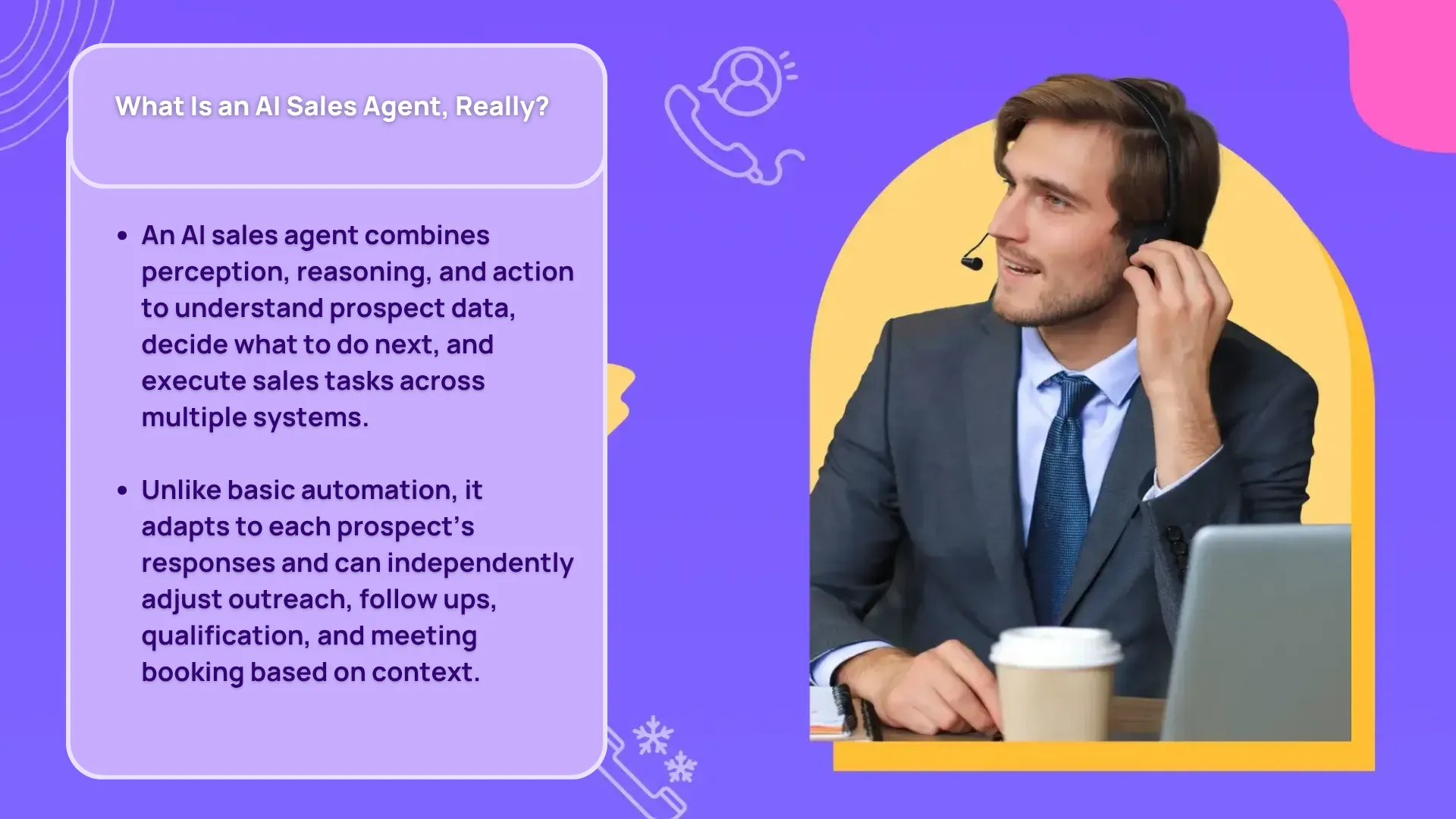
At its core, an AI sales agent combines three capabilities that older tools kept separate:
• Perception — it reads and understands unstructured data: an inbound chat message, a prospect's LinkedIn profile, a CRM record, a call transcript.
• Reasoning — it decides what to do next based on goals and rules you set (qualify this lead, book a demo, route to a human).
• Action — it executes across systems: sends the email, updates the CRM, dials the number, drops the calendar link.
This loop is what separates true intelligent customer interaction from basic automation. A mail merge sequence sends the same three emails to everyone. An agent notices that a prospect replied "not right now, ask me in Q3," schedules a follow up for the right quarter, and adjusts its messaging to reference the earlier exchange. That's the difference between scripted steps and agentic behavior.
Most AI sales agents specialize in one of a few jobs. Understanding these categories helps you avoid buying the wrong tool:
Outbound / SDR agents
These handle lead qualification and nurturing at the top of the funnel: they build target lists, enrich contacts, personalize cold outreach, and run multi touch cadences. Many overlap heavily with modern AI sales prospecting tools, and the best of them tie directly into AI sequencing so that timing and channel mix adapt automatically. If you want a deeper look at how this reshapes the SDR function, see our breakdown of the role of AI in sales development.
Inbound/conversational agents
These live on your website or in chat, engaging visitors in real time, answering questions, qualifying intent, and booking meetings for the right rep — 24/7, with no lead sitting in a queue overnight.
Voice and calling agents
A newer and fast growing category, these agents place or take phone calls. Some fully automate routine calls (appointment reminders, simple qualification); others act as a co pilot that supercharges human reps. This is where an AI dialer and modern AI voice bots meet: the agent handles dialing, navigation, and even live coaching while the human focuses on the conversation.
Why the category is exploding
Research firms have been blunt about the trajectory. According to Gartner's work on agentic AI in sales, a large share of B2B seller tasks are candidates for automation as agentic systems mature, shifting the rep's role toward judgment, relationship building, and complex negotiation. Similarly, McKinsey's research on the state of AI in sales and marketing points to meaningful revenue and productivity gains for organizations that operationalize AI across the funnel rather than piloting it in isolation. The through line is consistent: revenue generation automation is no longer experimental — it's becoming table stakes.
How AI Sales Agents Fit Into Your Stack
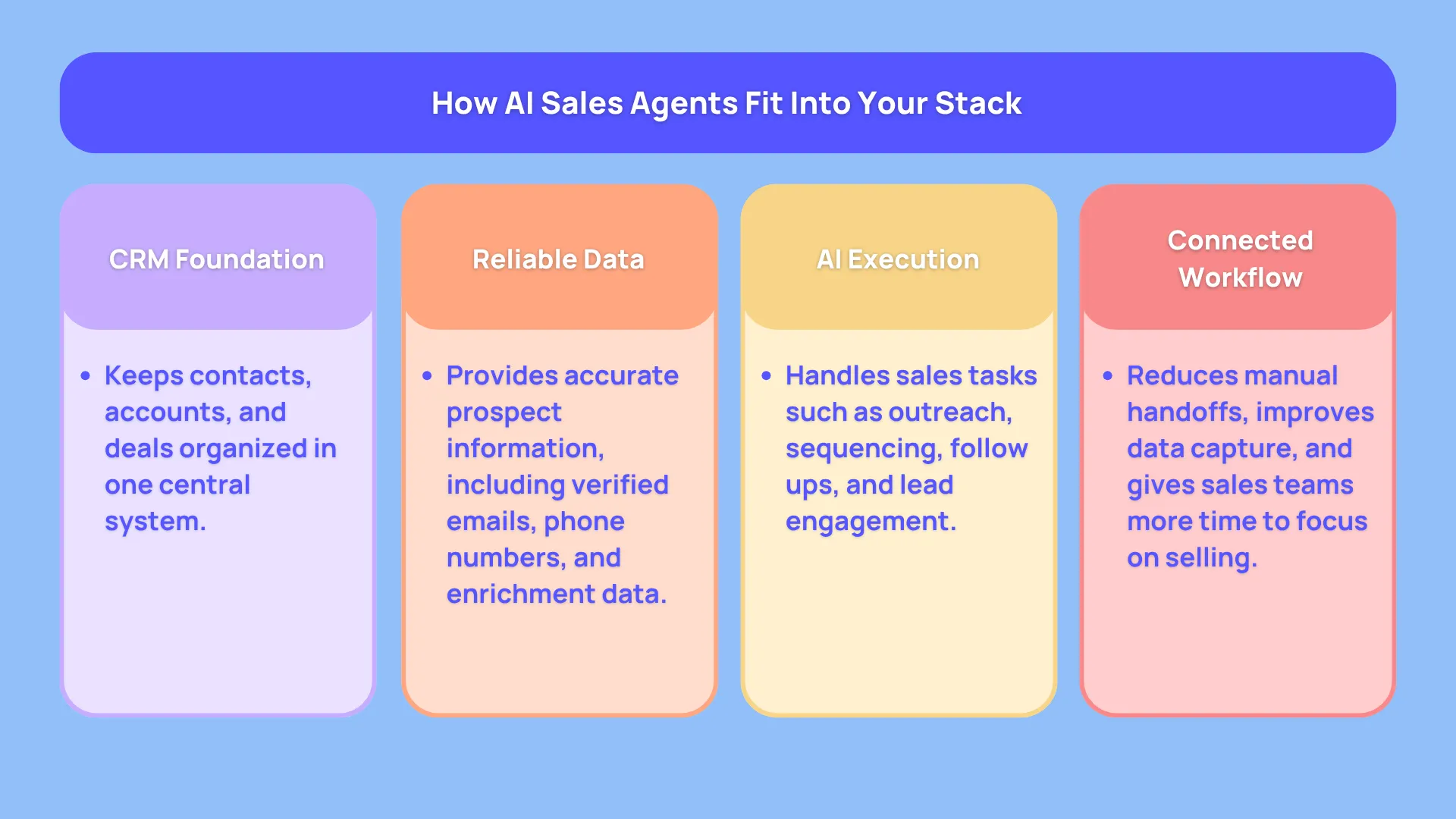
An AI sales agent is not a replacement for your CRM or your data provider. It's an execution layer that sits on top of them. A healthy 2026 stack usually looks like this:
• A system of record (Salesforce, HubSpot) — where deals and contacts live.
• A data source (a B2B contact database or enrichment provider) — where accurate phone numbers and emails come from.
• A sales engagement platform — where cadences, tasks, and multi channel sequencing are orchestrated.
• One or more AI sales agents — that do the actual work inside that framework.
The agents that win are the ones that reduce swivel chairing between tabs. Broadly, this is the promise of sales automation: fewer manual handoffs, cleaner data capture, and more selling time. The best agents also feed insight back up the stack through conversation intelligence tools, so every interaction becomes coaching and forecasting fuel rather than a black box.
With the fundamentals covered, here are the eight AI sales agents worth evaluating this year.
The 8 Best AI Sales Agents for 2026
We evaluated each on autonomy, integration depth, transparency, and real world fit for SDR, AE, and RevOps teams. No single agent wins for everyone — the right pick depends on whether your bottleneck is list building, inbound speed to lead, or live call throughput.
1. Salesforce Agentforce
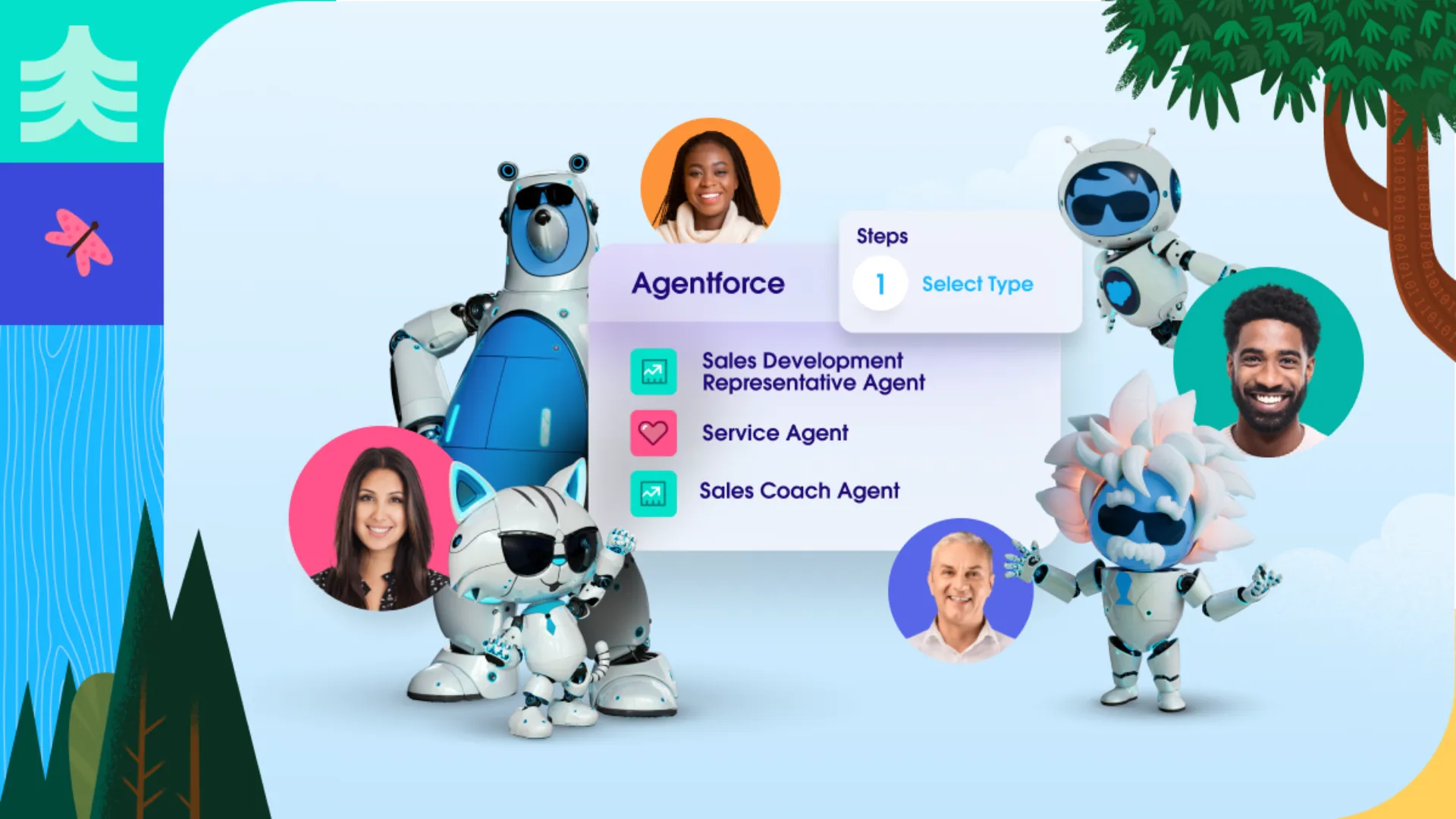
What it is: Salesforce's agentic layer built directly into the Customer 360 platform. Agentforce lets you deploy autonomous agents for sales development, coaching, and inbound handling that operate natively on your Salesforce data.
Best for: Enterprises already standardized on Salesforce that want AI agents governed by the same permissions, data model, and security they already trust.
Standout features: Deep native access to CRM records and workflows; a low code Agent Builder for defining actions and guardrails; tight coupling with Data Cloud for grounding.
Limitation: Value is heavily tied to being a committed Salesforce shop. Costs (including consumption based pricing) and implementation complexity can be significant for smaller teams, and it's less compelling if your data lives elsewhere.
2. 11x (Alice)
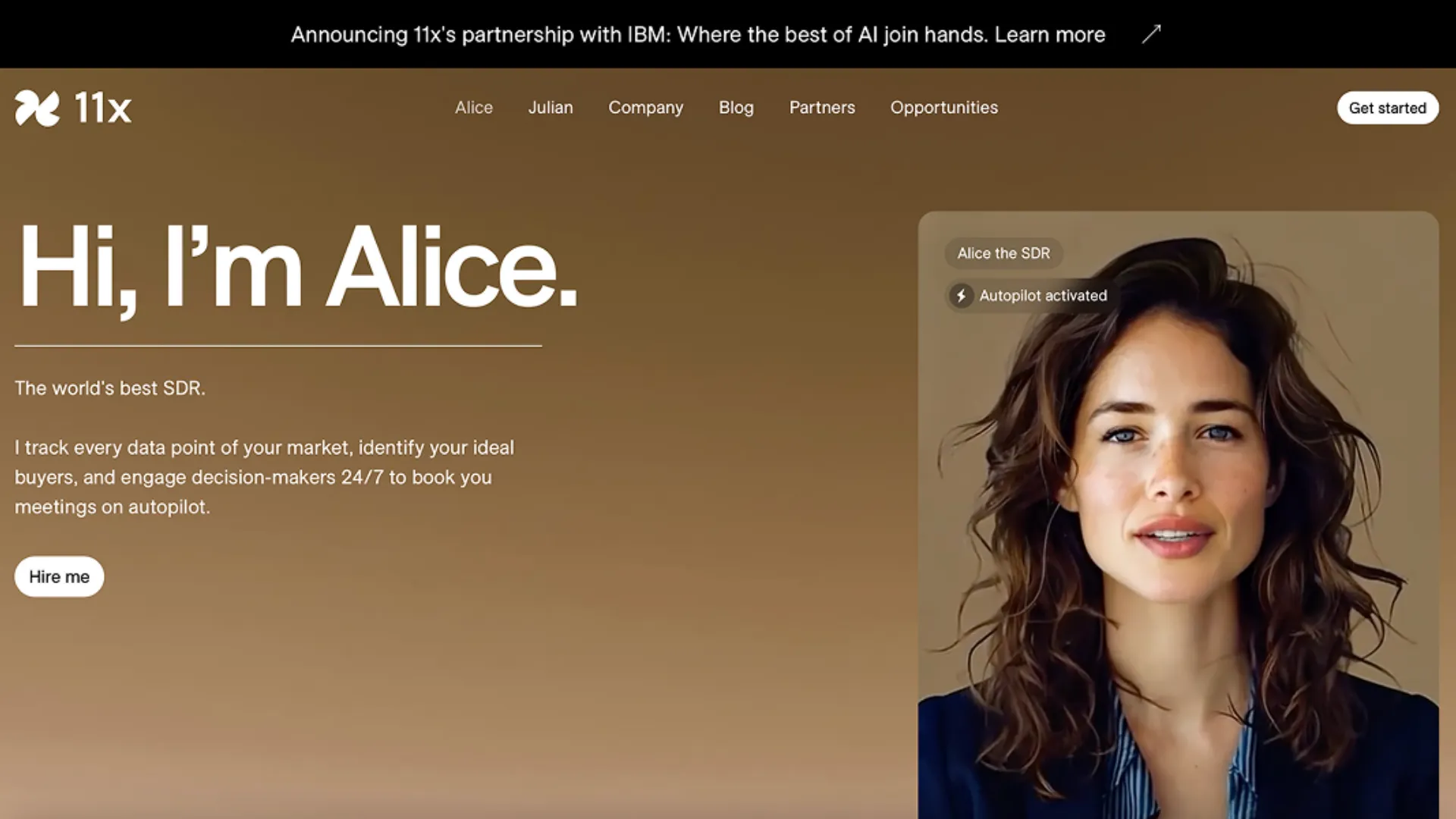
What it is: 11x builds digital workers for outbound. Alice, its AI SDR, researches accounts, identifies prospects, and runs personalized multi channel outreach largely autonomously.
Best for: Fast scaling startups and outbound teams that want to add "headcount" of pipeline generation without linearly adding recruiters and desks.
Standout features: End to end autonomous prospecting; multi channel sequencing across email and other touchpoints; a positioning squarely around replacing manual top of funnel grunt work.
Limitation: Fully autonomous outbound demands careful oversight — deliverability, brand voice, and list quality all need monitoring, and buyers have publicly debated results variance. Treat it as a system to be managed, not a set and forget button.
3. Trellus.AI
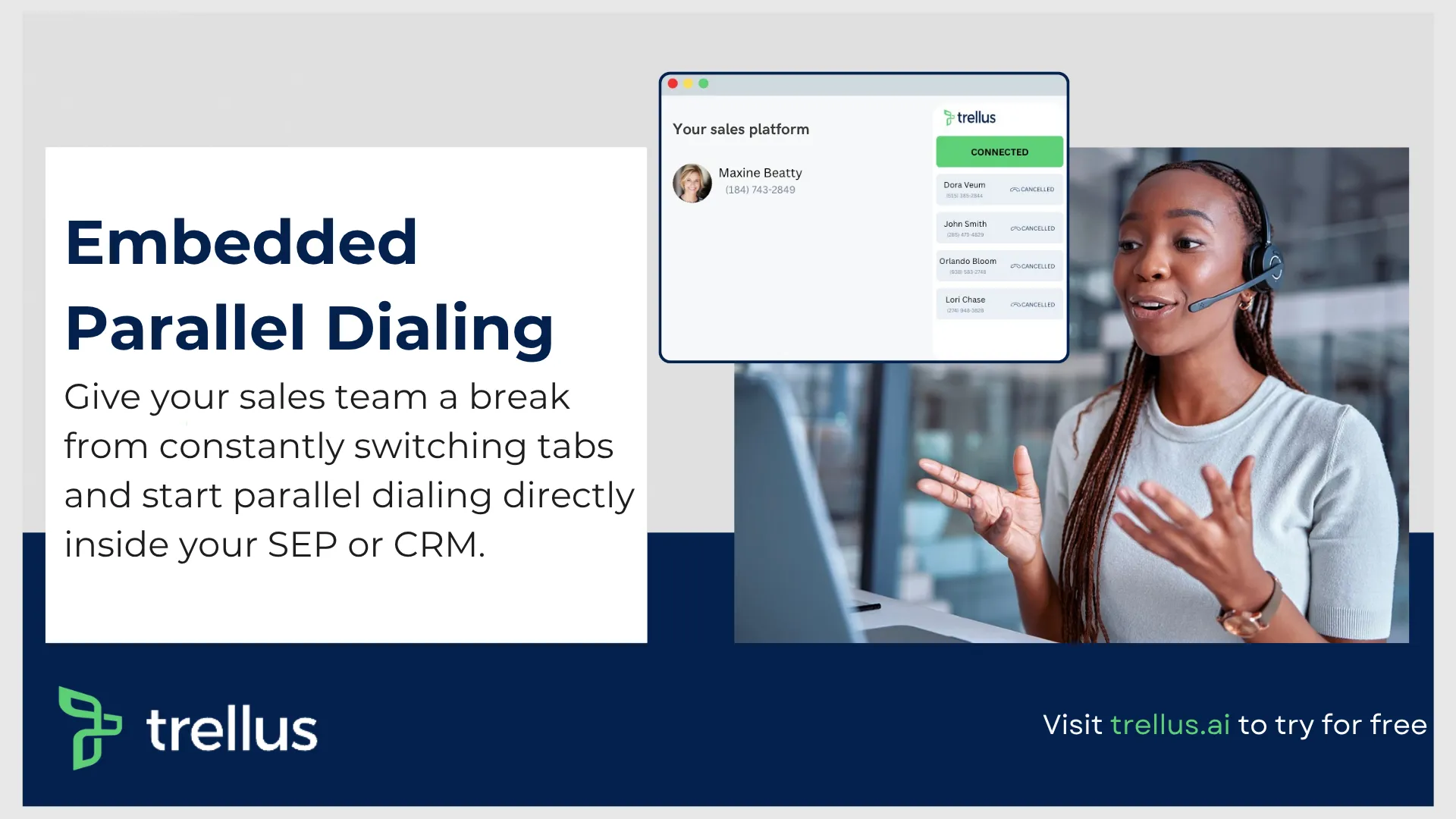
What it is: Trellus is an AI powered sales acceleration and coaching platform built for teams that live on the phone. Its signature product is an embedded parallel dialer that runs inside the tools reps already use — Salesloft, Outreach, Apollo, HubSpot, and Salesforce — via a Chrome extension, so reps never context switch into a separate dialer app. On top of dialing, Trellus layers AI voice agents, real time AI coaching, and automatic call scoring.
Best for: SDR/BDR and AE teams running high volume outbound calling who want automated sales engagement on the phone without leaving their existing sales engagement platform. It's also a strong fit for remote and hybrid teams that need live visibility and coaching.
Standout features:
• Parallel dialing across multiple live lines (up to ~5) with automated voicemail drop, multiplying live connects per hour.
• Real time AI coaching — live, on screen objection handling, competitor battle cards, and customizable talk tracks during the call.
• AI voice agents that handle inbound routing and qualification and act as 24/7 practice partners for reps to rehearse against.
• 100% call scoring — every call is analyzed automatically (not just samples), surfacing behavior gaps between top and bottom performers, all visible in a shared Virtual Sales Floor.
On pricing, Trellus is refreshingly self serve: the Power and Parallel plans are both $34.99/mo (promotional, reduced from $99.99 and $149.99), with a custom priced Business tier for team analytics and AI modeling — and no forced demo to get started.
Limitation: Trellus is a calling and conversation execution layer, not a full CRM or a B2B contact database — you'll pair it with your own data provider and SEP. Parallel dialing also rewards disciplined list hygiene and TCPA/DNC compliance, and it's a younger brand than some incumbents on this list.
4. Artisan (Ava)

What it is: Artisan's Ava is an "AI BDR" that automates the outbound workflow — lead discovery, enrichment, email personalization, and sending — inside Artisan's own platform, aiming to consolidate the outbound stack.
Best for: Teams that want a single, opinionated tool to own outbound email prospecting end to end rather than stitching together point solutions.
Standout features: A large built in B2B lead database; automated personalization and deliverability management; an all in one workflow that reduces tool sprawl.
Limitation: Primarily email first, so it's less suited if phone or a truly omnichannel motion is your priority. As with any autonomous emailer, output quality and reply rates depend on tight ICP definition and ongoing tuning.
5. Regie.ai
What it is: Regie.ai blends AI content generation with autonomous prospecting "Auto Pilot" agents that prioritize accounts, generate messaging, and engage leads while keeping humans in the loop for higher value touches.
Best for: RevOps and enablement teams that care about consistent, on brand messaging at scale and want AI to nurture colder leads while reps focus on warm ones.
Standout features: Strong AI copywriting grounded in your content and brand guidelines; a "human in the loop vs. auto pilot" model that lets you dial autonomy up or down; nurture logic that keeps leads warm.
Limitation: The content plus agent breadth means there's a learning curve to configure it well, and teams wanting a pure dialing or pure data tool may find it broader than they need.
6. Qualified (Piper)
.webp)
What it is: Qualified's Piper is an AI SDR built for the website itself. It engages inbound visitors in real time — chat, and increasingly voice and email — qualifying them and booking meetings directly on the Salesforce pipeline.
Best for: Marketing and demand gen teams with meaningful website traffic that want to convert anonymous visitors into booked meetings instantly, especially on Salesforce.
Standout features: Real time inbound conversation and instant meeting booking; signal based engagement using account and intent data; deep Salesforce alignment.
Limitation: Its value scales with inbound traffic volume — low traffic sites won't see the same ROI — and it's inbound focused, so it won't run your outbound calling motion.
7. Relevance AI
What it is: Relevance AI is a platform for building custom AI agents and multi agent "teams," including its BDR agent, Bosh. It's less a fixed product and more a builder for bespoke sales workflows.
Best for: Technical RevOps teams and ops savvy organizations that want to design agents around their exact process rather than adopt a one size fits all SDR.
Standout features: Highly customizable, low code agent builder; multi agent orchestration where specialized agents hand off tasks; broad tool and API integrations.
Limitation: Flexibility is a double edged sword — you have to design, wire, and maintain the workflows, so it demands more internal ownership than a turnkey agent and has a steeper ramp for non technical teams.
8. Lindy
What it is: Lindy is a general purpose AI agent builder used widely for sales workflows — lead routing, meeting prep, follow up automation, and CRM updates — triggered by events across your stack.
Best for: Lean teams and founders who want to automate the connective tissue of sales (the follow ups, handoffs, and data entry) without hiring an ops engineer.
Standout features: Easy trigger and action workflow creation; a large library of integrations; strong at "glue" tasks that bridge email, calendar, and CRM.
Limitation: As a horizontal tool, it lacks the specialized depth of a purpose built dialer or data platform, and complex sales logic can require several chained Lindies to get right.
How to Choose the Right AI Sales Agent?
Match the agent to your actual bottleneck rather than the loudest feature list:
• If your gap is pipeline volume at the top: look at outbound SDR agents (11x, Artisan, Regie.ai) and pair them with strong prospecting data.
• If your gap is inbound speed to lead: an inbound agent like Qualified converts existing traffic fastest. • If your gap is live call throughput and coaching: a phone first platform like Trellus multiplies connects and turns every call into coaching.
• If your gap is custom process automation: builders like Relevance AI and Lindy let you design exactly what you need.
• If you're an all in Salesforce enterprise: Agentforce keeps governance and data in one place.
Three practical rules apply regardless of pick. First, insist on transparency — you should be able to see and audit what the agent did and why. Second, keep a human in the loop for high stakes touches; the strongest
2026 deployments treat agents as force multipliers for reps, not replacements. Third, protect deliverability and compliance: autonomous outreach at volume magnifies both good and bad list hygiene.
Frequently Asked Questions
What is an AI sales agent in simple terms?
It's software that autonomously performs sales tasks — researching prospects, writing and sending outreach, qualifying leads, and booking meetings — using conversational AI technology. Unlike a basic chatbot, it reasons over context and takes multi step actions across your tools.
Are AI sales agents going to replace human sales reps?
Not wholesale. They automate repetitive, high volume work — the top of funnel and administrative tasks — which frees reps for judgment heavy work like discovery, negotiation, and relationship building. Both Gartner and McKinsey frame the shift as augmentation and role redefinition rather than straight replacement.
What's the difference between an AI sales agent and a chatbot?
A chatbot follows scripted rules and answers questions. An AI sales agent perceives context, reasons about a goal, and executes actions across systems — sending emails, updating the CRM, dialing a number — and adapts based on how prospects respond.
How much does an AI sales agent cost?
Pricing ranges widely. Phone first tools like Trellus start around $34.99/mo per seat on promo, while enterprise agentic platforms and autonomous AI SDRs often run into four or five figures monthly, sometimes with consumption based pricing. Match the cost model to the volume of work the agent will actually do.
Do AI sales agents work for outbound calling?
Yes. Voice and calling agents handle dialing, navigation, voicemail drops, and live coaching. Platforms with an embedded parallel dialer, like Trellus, keep reps inside their existing sales engagement platform while multiplying live connects per hour.
The Bottom Line
So, what is an AI sales agent? It's the evolution of sales tooling from passive automation into active, goal driven execution — a system that perceives, reasons, and acts across your funnel to drive revenue generation automation with far less manual effort. The eight tools above each own a different slice of that mission, from Agentforce's enterprise governance to Trellus's phone first acceleration to Lindy's flexible workflow glue.
The winning strategy in 2026 isn't buying the flashiest agent — it's diagnosing your single biggest bottleneck, choosing the agent purpose built to remove it, and keeping humans in the loop where trust and judgment matter.
Start there, measure honestly, and expand your agentic stack as the results earn it.
Ready to see what an embedded, phone first AI sales agent does for live connects and coaching? Explore Trellus AI and put it to work inside the tools your reps already use.


Power and parallel dialing in your CRM.